
2027 BMW M350 xDrive Prototype First Drive Review
Article Summary
- The M350 xDrive replaces the M340i with a B58 six making close to 440 hp, and drives closer to an M3 than any M Performance 3 Series before it.
- BMW’s engineers explained the chassis engineering behind the feel: anti-roll bar preload, torsional stiffness, and a torque-vectoring software stack adapted from the electric i3’s Heart of Joy.
- Drift Moment, a rear-drive-only mode, arrives in 2027 via over-the-air update to every M350, including cars already delivered.
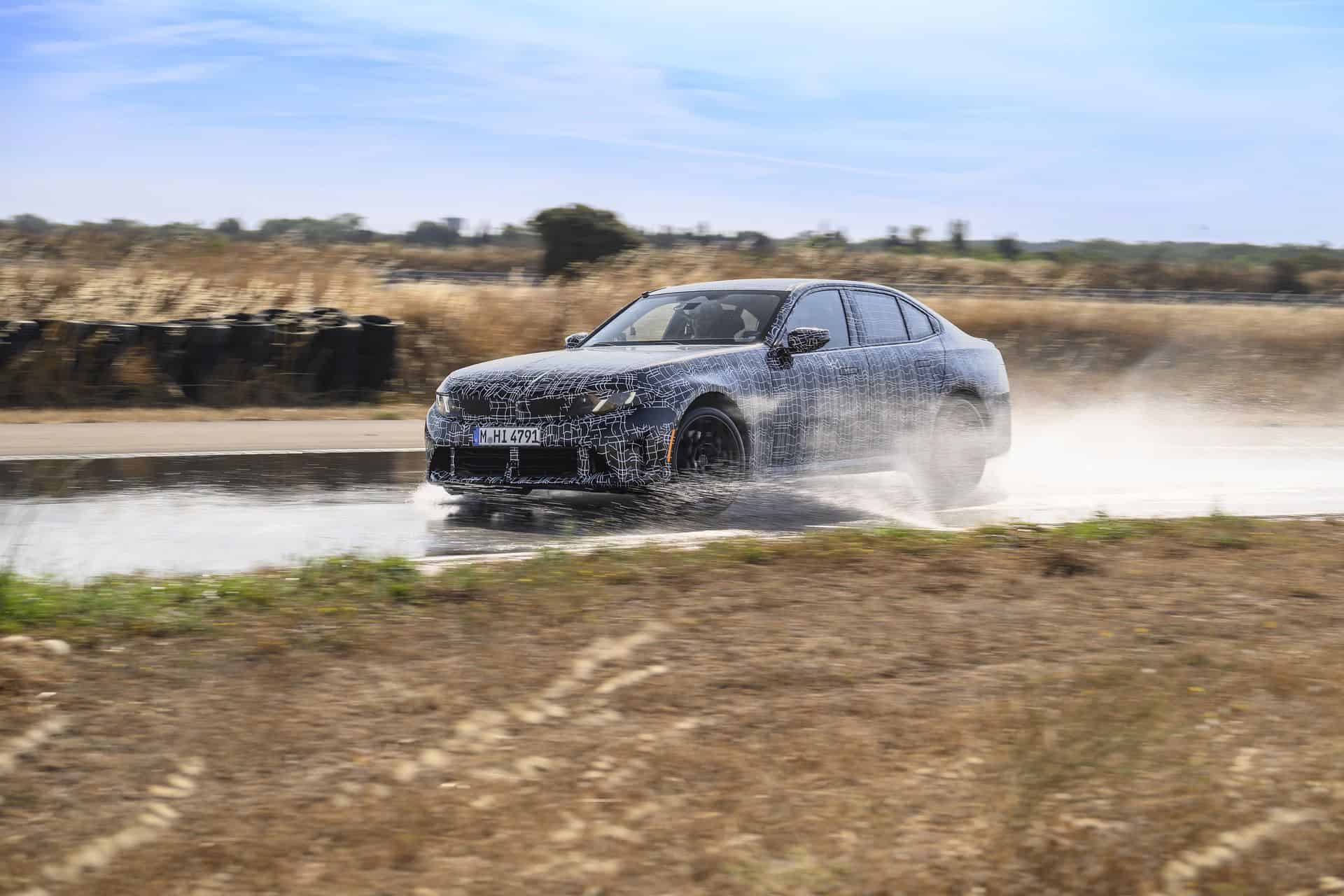
I have been on this Miramas skid pad before, in an iX3, trying and failing to get it sideways. The Heart of Joy software made that car feel like it was driving itself out of every mistake I tried to make. Twelve months later I am back at the same facility, in a camouflaged prototype of the new BMW M350 xDrive, and by the end of a full day behind the wheel and in the passenger seat, across four completely different driving environments, it was obvious this is a different 3 Series than ever before.
BMW brought a handful of journalists to its proving ground outside Miramas, in southern France, to sample the combustion-engined half of the next 3 Series before the car’s design goes public. The wrap covers everything, the interior is half-blocked off, and nobody would give me a straight answer on some final figures, like weight. But the chassis is real, the roads and tracks were real, and I got plenty of seat time to have an informed opinion on whether this M350 is actually better than the M340i.

The day broke into four distinct parts: a technical handling track inside the facility, a wet slalom section built for testing traction control logic, a high-speed circuit that requires a special license, and finally a 2 hour-long loop on public roads around Miramas. Each one told me something different about the car, so buckle up, this will be a long one.
BMW Has Put A Lot Of Engineering Work In This New Generation 3 Series
For the first part of the day, I was joined by Roman Daiker,, an old friend by now and the man responsible for a lot of BMW’s recent driving dynamics work. Clearly, I was loaded with questions. First one went straight after the M340i: what has BMW changed mechanically on the M350? His answer was blunt: almost everything. New tires, in new dimensions. New steering tuning. New suspension. Modified axles front and rear. Nothing carried over untouched.

On paper, that spec sheet reads closer to M3 territory than any M Performance 3 Series before it: a twin-turbo inline six making 437 hp (443 PS in Europe), an active rear differential, quad exhaust tips, and a rear-drive drift mode arriving next year. What keeps it from actually feeling like a baby M3 is that none of that is mandatory. Leave it in its softer modes and it settles right back into something you could drive to work without thinking about any of it.
None of that aggression came from guesswork, either. A separate engineer running a technical presentation later in the day told the room plainly that BMW pulled its targets straight from M340i owner surveys: more comfort, steering that felt less nervous and less overly direct in certain situations, and a car that still delivered on the sporty end without losing that improved comfort in the process. He drew a hard line around Sport Plus mode specifically, saying the goal was to make the car better everywhere else without touching what Sport Plus actually feels like, since that character is the entire reason people buy this trim.
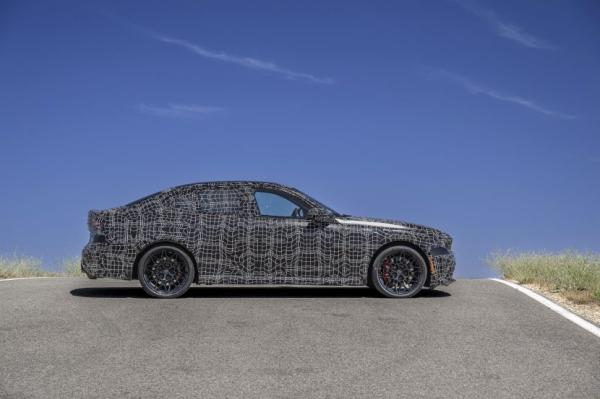
BMW also put real numbers behind the platform story it would otherwise only gesture at. The gas car keeps an updated version of the outgoing 3 Series’ CLAR underpinnings, internally coded G50, rather than the all-new architecture underneath the electric i3. The wheelbase grows by a modest nine millimeters, while the front track widens by roughly 40 and the rear by about 32, figures small enough on paper that I would never have guessed them from behind the wheel, but they line up with exactly how planted the car felt once we got to the higher-speed sections later in the day.
The car keeps BMW’s B58 turbocharged inline six, still working with 48V mild hybrid assistance and BMW’s familiar eight-speed ZF-sourced transmission, sending power through xDrive all-wheel drive. When someone asked whether this is the same B58 update already running in the X3 M50, the answer was yes, same core hardware and same result, with the differences limited to tuning for this application and a different cooling setup rather than a fundamentally different engine.
The US press materials quote 437 hp, while the German market quotes 443 PS. Torque wise, the new BMW M350 makes 580 Nm (428 lb-ft) of torque. An engineer let slip where the extra torque actually comes from: BMW retuned the turbos for the horsepower gain, but the additional torque over the outgoing M340i is coming almost entirely from the hybrid system, which now sends about 40Nm of its own straight to the gearbox specifically to bridge the gap before the turbocharger has fully spooled. It’s likely that you won’t feel that, unless you’re driving the M350 back-to-back with the M340i, but it’s there.
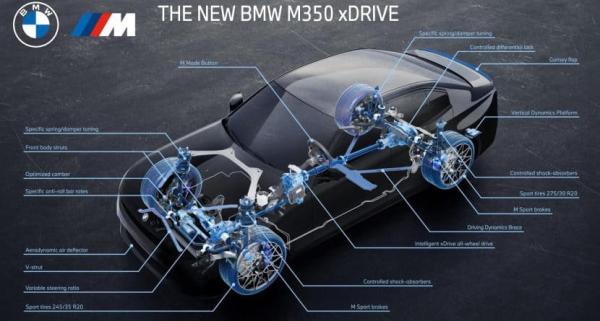
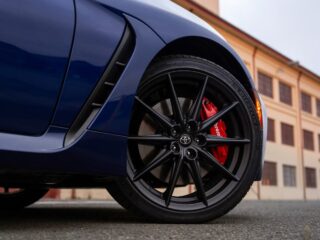
While the M340i already offered adaptive M suspension as an option, the M350 will make it standard, and there is no lesser adaptive setup available on the M350 the way there is on the four-cylinder cars. If you buy this car, you get the top suspension, full stop. Tire sizes are up too, to 245-section fronts and 275-section rears, both on 20-inch wheels, the largest wheel and tire package BMW has ever fitted to an M Performance 3 Series. Unless of course you fitted the M340i with the aftermarket M340i wheels.
Standard equipment includes variable sport steering and a controlled rear differential lock, alongside a dedicated M Mode button on the steering wheel that lets you jump straight into a chosen setup rather than cycling through modes one at a time. The chassis hardware runs deeper than the axle and tire changes: specific spring and damper tuning front and rear, dedicated front body struts, optimized camber, increased front caster, specific anti-roll bar rates, a V-strut, an aerodynamic air deflector, and stiffer wishbone mounts up front.
At the rear there is a Gurney flap, a Vertical Dynamics Platform, controlled shock absorbers, and a structural brace BMW calls the Driving Dynamics Brace, on top of the intelligent xDrive hardware already doing the torque-vectoring work. Brakes are M Sport units, fixed calipers up front and floating calipers at the rear, sized specifically for this car. The tire story has a wrinkle worth knowing before you spec one: the 275-section rear tire only comes with BMW’s sport tire option on the 20-inch wheel; skip that box and the same wheel gets a narrower 255-section rear tire instead. The car’s three drive personalities are officially Personal, M Sport, and M Sport Plus, instead of the old Sport and Sport Plus, and they behaved exactly as advertised once I actually got to try all three later in the day: Personal for comfortable everyday driving, M Sport tuned for dynamics, M Sport Plus for the maximum version of that same idea.
The Technical Track: Where the Suspension Talk Turns Real
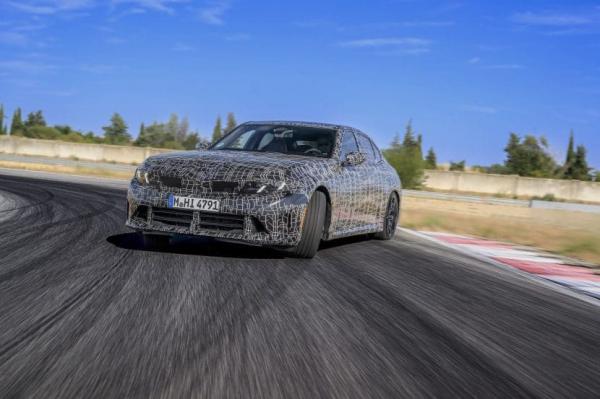
The first laps happened on a technical handling circuit inside the facility, the kind of layout built specifically to expose a chassis rather than flatter it. Long, fast straights feed into corners tight enough that you have to properly slow down for them, and BMW left a few sections of intentionally rough, broken pavement mid-corner, presumably because customers do not always get to choose smooth roads either.
This is where the suspension conversation became interesting. Roman had told me BMW retuned spring rates, redesigned the top mounts, and reworked the damper hydraulics for this generation, while carrying over a hydraulic rebound stop from the base Neue Klasse suspension into the adaptive dampers here. What that translates to on track is a car that hits a rough patch mid-corner, at real load, and simply does not get knocked off its line. In his testing, the M340i would shudder and require a small correction. This car absorbed the same kind of hit and stayed committed to the arc I had already put it on. I went back over the same rough section three or four times just to make sure I was not imagining it, and the result was consistent every time.
Steering off center felt sharp immediately, sharper than I expected walking in, even in Personal mode, which technically is the comfort setting. It is precise, self-centers cleanly without demanding much effort, and stays perfectly weighted whether you are crawling through a hairpin or committing to a fast sweeper. Turn-in is sharp without ever feeling nervous or artificially quick, and there is none of the harsh, jarring stiffness you sometimes get from a variable-ratio rack trying too hard to feel sporty near center. Roman’s explanation for why was simple: the ratio itself is not more direct than before. What changed is how connected everything feels together, because the steering, the suspension, and the drivetrain were all tuned as one system rather than bolted together and hoped for the best.
The Wet Slalom: Watching the Car Get More Honest as the Modes Get Bolder
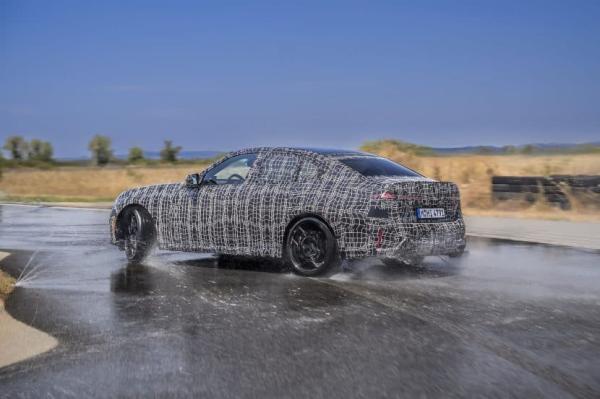
From the technical track we moved onto a dedicated wet handling section. The pavement here is not just soaked, it is watered irregularly by sprinklers specifically to force the stability systems to deal with friction levels that keep shifting under the tires, which is exactly why the grip felt like it was moving mid-corner rather than staying uniformly low the way a simple flooded skid pad usually does. The car on hand wore Bridgestone Potenza Sport tires, BMW’s performance-oriented option for the M350 aimed at sharper handling and bigger safety margins; a rolling-resistance-optimized Goodyear Eagle F1 Asymmetric 5 is also available for buyers who want a sportier baseline without giving up as much efficiency, though that was not what we had for this session. Roman laid out the plan: first lap in Personal mode with full stability control, just to learn the surface. Then M Sport with DSC still on. Then M Sport Plus. Then DTC only, which strips away full stability intervention and leaves just the traction control layer active. And finally, if I wanted it, DSC fully off.
Personal mode on a wet, slippery surface was almost boring, in the way you want a car to be boring when you are aquaplaning slightly and have no idea what the surface grip actually is. The controls held the car dead straight and predictable, even when I could feel the tires losing and regaining grip underneath me. Switching to Sport changed the character noticeably even with DSC still on. Roman pointed out that BMW moved power distribution further rearward as you climb through the modes, not just by loosening the stability control thresholds, and I could feel it: a small, controlled slip angle appeared under power out of the slower corners that simply was not there in Personal. M Sport Plus pushed that further again, visibly more tail-happy while still catching itself the moment things got out of hand.
DTC only was the mode that actually let me play. With full stability intervention gone and only traction control watching, the car would step out under power in a genuinely controllable, progressive way, provided I did not carry too much speed into the corner first. Carry too much speed in and the car understeers and will not rotate no matter what you do with the throttle. Get the entry speed right and it will hang a slide as long as you are willing to hold it.
DSC fully off was the closest thing to a preview of what Drift Moment might eventually feel like, without actually being Drift Moment. Roman would not give me technical detail on the feature itself, only confirming what BMW’s own press release already said: it is a rear-wheel-drive mode activated at the press of a button, arriving via remote software update sometime in 2027, and every M350 gets it, including cars already sitting in customer driveways by then.
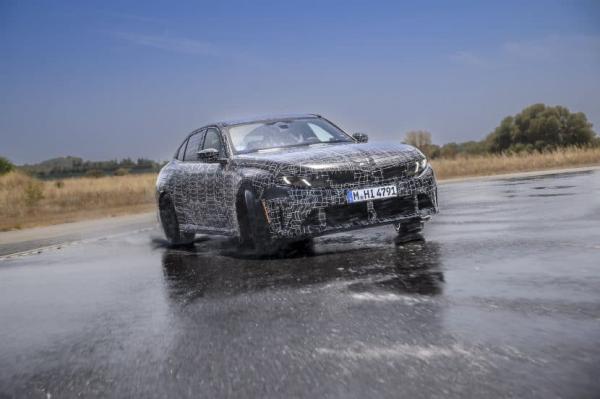
With DSC off, the AWD system was already biasing hard to the rear under power, letting the car rotate around a slow corner in a long, sustained slide that I could hold with the throttle and only had to catch with a small correction. Add throttle mid-slide, though, and the front axle does still come back into play trying to straighten the car out, since that is the all-wheel-drive system doing its job rather than a flaw, and full power oversteer only stays available because DSC is switched off, not because the front axle has actually been removed from the equation. BMW says the current maximum front-to-rear split is somewhere around 20-80, a long way from the roughly 40-60 split it uses as a typical cruising default, which gives some sense of how much ground Drift Moment still has to cover on its way to sending everything rearward.
The High-Speed Circuit: The One You Need a License For
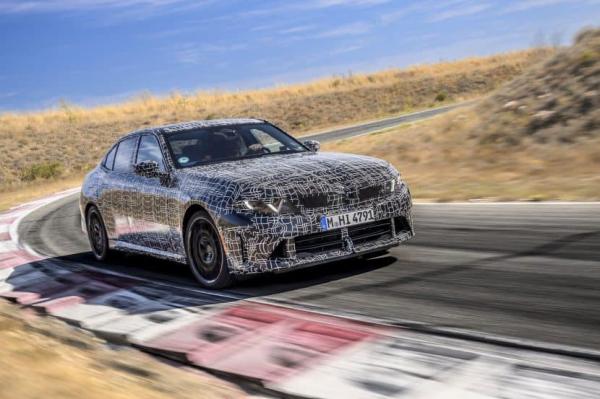
After the slalom, we moved to the the fast track used across the entire range of BMW cars, including racing models. Roman said BMW uses this track for validation work rather than journalist joyrides, and the kind you are not allowed to drive yourself without a specific license BMW issues to a small number of its own test drivers. No pressure, really.
We opened with a straight-line acceleration test, but unfortunately I was not allowed to time the sprint time. On paper, BMW quotes a 0-62 mph (0-100 km/h) time in 4.1 seconds. It felt faster than that, enough that I would not be shocked if the real 0 to 60 mph number, once BMW actually publishes one separately from the 0 to 62 mph claim, comes in under four seconds. I want to be honest that this is a seat-of-the-pants impression and not a verified time, but there is also a confusing wrinkle here that came up later in the day, when we asked whether these figures get measured with a one-foot rollout, the trick used to shave a few tenths off a published time by not counting the first foot of movement from a dead stop.
Nobody gave me a straight yes or no for this specific car, and one of the engineers openly admitted the whole industry convention around it is a mess right now, since certain other BMW M press materials have started quietly using rollout numbers because they look better on paper. Until BMW clarifies which method it used here, I would treat 4.1 seconds as a number with an asterisk rather than a fixed target.
Launch control itself is well sorted though: left foot on the brake, right on the gas pedal and now on the iDrive X screen you will get a series of checkmarks which will tell you when the car is ready for launch control. Finally no more guessing or reading manuals for a simple feature.
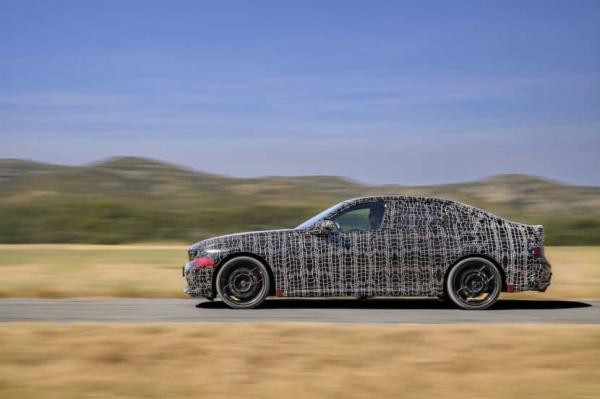
Once we were up to speed, the character of the circuit changed completely from anything I had felt earlier in the day. This track mixes long, high-speed corners with elevation changes and a couple of straights long enough to actually stretch the car’s legs. We went through several long-radius corners at 150 to 190 km/h with real elevation working against the chassis, the kind of load that will expose a soft structure immediately, and the car stayed flat and predictable through all of it. On the longest straight we saw north of 220 km/h before braking hard for the next sequence, and the brakes did exactly what they had done on the slower tracks earlier in the day: an early, linear bite with a mechanical feel that made me trust them the first time I used them at that speed, not the third or fourth.
This is also where the torsional stiffness upgrades Roman mentioned earlier came into play. BMW added upper and lower structural struts at the front, effectively sandwiching the engine into the chassis, plus a similar reinforcement at the rear, a stiffer overall frame, and those wider tracks and marginally longer wheelbase from earlier. At high speeds through a long, off-camber corner with elevation working against you, that is exactly the kind of stiffness that keeps a car’s structure, and not just its suspension, doing the job of holding a line. Nothing about the car felt like it was flexing or working against itself at speed, which is not something I could say with confidence about the outgoing 3 Series on the same kind of corner.
Keep in mind this though: I was still pretty far from the car’s top capabilities, despite Roman praising my track performance, I truly felt there is a lot more to come from the car.
Lots Of Software Engineering
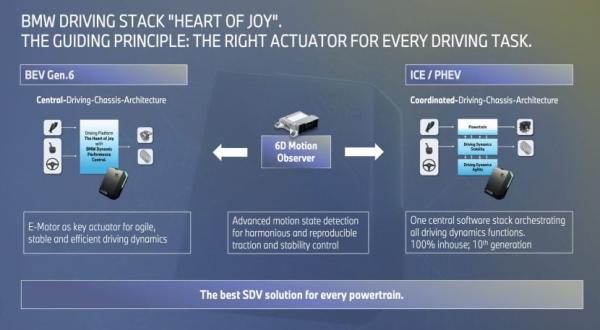
BMW calls its combustion-engine driving stack an adaptation of the same Heart of Joy philosophy it built for the fully electric i3. The software stack was adapted to a combustion engine, same functional principle, just working with a slower actuator. The benchmark they measure themselves against is not an M car or a race car, it is BMW’s own EVs, because a pair of electric motors can shuffle torque front to rear faster than any mechanical all-wheel-drive system ever will, and closing that gap without an electric motor to do it is the entire point of everything below.
An electric motor can react in milliseconds and can also decelerate a car through recuperation strongly enough, up to roughly 0.4g, to cover most everyday braking without the friction brakes doing much at all, which means an EV’s central computer can constantly and invisibly shuffle torque between axles to shape how the car turns and stops. A combustion engine cannot do that. Spooling torque up or down through an internal combustion engine takes on the order of 100 milliseconds, which is slow enough for a driver to actually notice, so BMW’s ICE version of the stack leans on a different set of fast actuators instead: the brakes, the electronically controlled xDrive clutch, and the rear differential lock, all coordinated by one central controller reading a six-dimensional motion sensor that tracks lateral, vertical, and longitudinal acceleration alongside roll, pitch, and yaw in real time. That sensor cluster knows exactly what the car’s body is doing at any given moment regardless of what the driver is doing with the wheel or pedals, which is the entire basis for everything else working together without stepping on itself.
The clearest example an engineer gave was a single dynamic corner entry, which lines up almost exactly with what I felt on some of the faster sections of the high-speed circuit. Enter the corner with a default torque split of roughly 40 percent front and 60 percent rear, then turn in harder. The system responds first with a small brake intervention on one of the inside wheels to help rotate the car, which effectively shifts more torque to the outside, while simultaneously trimming the front axle’s share down and pushing more to the rear. Only once that initial, very fast brake-based correction has done its job does the mechanical rear differential lock actually engage, because it is the slower of the two systems and setting it too early would fight the brake intervention rather than support it. What you feel is a car that simply does what you asked it to do, which was exactly my experience turning into the long-radius corners at speed.
This same electronically controlled clutch is also the hardware doing the work in DSC-off mode, and by extension in Drift Moment once it exists. In its normal, efficiency-focused state, the multi-plate clutch stays ready to slam torque back onto the front axle within about 100 milliseconds if the rear axle needs help, because losing traction is worse than losing a fraction of a percent of efficiency.
In DSC-off mode specifically, BMW deliberately introduces a small amount of extra clearance between the clutch plates to reduce drag losses while the car is being driven rear-biased, which costs roughly 20 milliseconds of extra response time if you suddenly need front-axle torque back. One more detail worth knowing if you were hoping for a rear-drive-only M350 to show up as a separate model somewhere: it will not. There is no plan for a real, mechanically rear-wheel-drive-only version of this car in any market. Drift Moment, whenever it ships, is the only route to that feeling, layered entirely in software on top of the same all-wheel-drive hardware I drove.
What You Can Actually See Under the Wrap
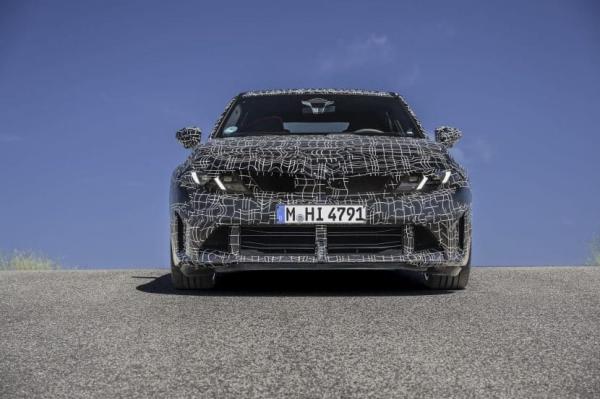
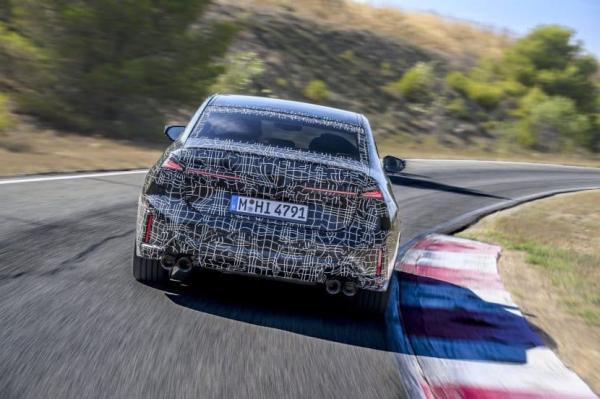
Between the track sessions and the road loop, I got a walk around the car with the camouflage still on, which is not nothing, since enough shows through the wrap to sketch the shape. The front end shares its Neue Klasse language and slanted LED signature with the BMW i3, though the M350 gets a noticeably more aggressive M Performance bumper with larger intakes. Because it has to package a combustion engine rather than an electric motor, the hood is longer than the i3’s, which actually helps the proportions read as a more traditional BMW sedan shape: long hood, short overhangs, in a way the i3 cannot quite replicate. The car is wider and longer than the outgoing 3 Series, with pronounced rear haunches covering those 275-section rear tires, a deep rear diffuser, and quad exhaust tips, two per side, which is a relief after several recent non-M BMWs shipped with hidden or fake pipes.
Inside, camouflage aside, it is clearly a sibling of the i3. BMW Panoramic iDrive is present and functional, same for the central display with iDrive X. There is no iDrive controller, as expected, and of course, no physical switches to adjust the vents or climate control. The M Sport seats, whether or not these specific units are production-ready, have serious thigh support and bolstering, and the steering wheel was the same M Sport Pro one found in the i3 with 4 and 8 o’clock spokes. There is also a Boost Power button for overtaking on demand.
The Street Loop and the Daily Driving Experience
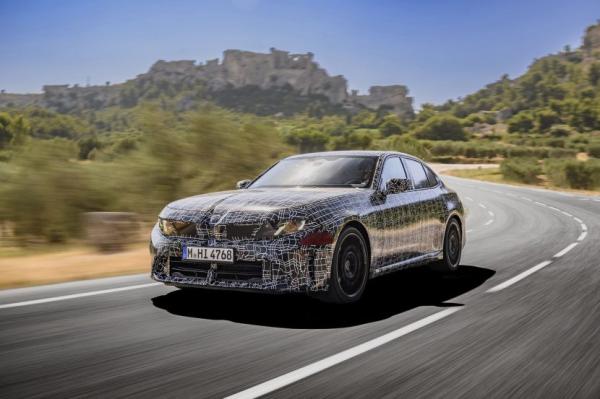
The last part of the day was the one I suspect matters most to an actual customer, and BMW clearly agrees, because it is the one they saved for last. A two hour-long loop on public roads around Miramas, mixing smooth sections with really rough ones, including stretches with real elevation change that put the suspension and the car’s overall balance under a different kind of stress than anything on track.
This time my host was Dr. Georg Burkhard, the engineer responsible for ride comfort, body motion, and handling on this car, and he was direct about what BMW targeted with this generation: three specific things, steering, body motion, and handling. One story stuck with me for the rest of the loop: an engineer had personally driven a development M350 the roughly 1,000 kilometers from Munich to Miramas in a single run, about nine and a half hours behind the wheel, and described it as comfortable the entire way.
We started in Personal mode on a really bad stretch of road, full of potholes and mid-corner surface changes. Burkhard’s explanation was that BMW specifically worked on limiting acceleration peaks in this mode, meaning the car absorbs an impact without transmitting a sharp jolt through the body, and it stays parallel rather than kicking to one side. That matched what I felt: the car moved over broken pavement without ever feeling floaty or vague, staying composed in a way I associate more with cars a class up in price.
Switching to M Sport tightened everything up noticeably, and pressing the M Mode button to jump straight to M Sport Plus made the difference obvious immediately, more than ever before. Burkhard agreed when I pointed out that the gap between Sport and Sport Plus feels wider on this car than it did on the M340i, where that step was sometimes barely noticeable unless you were actively looking for it. Here you feel it through the wheel and through your body at the same time.
Comfort, Sport, and the Anti-Roll Bar’s Dirty Secret
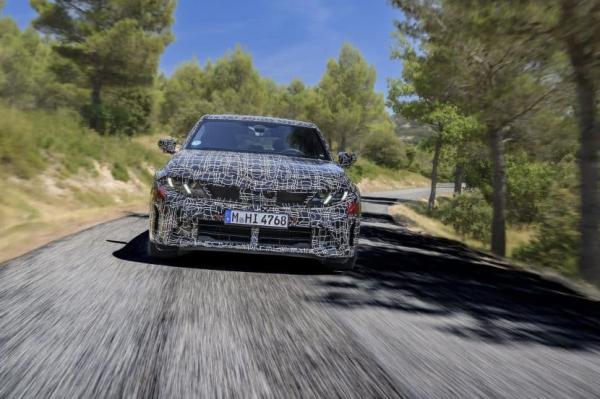
The most interesting engineering explanation of the entire day came from a straightforward question: why did BMW increase anti-roll bar preload on this generation, when more preload usually risks making a car feel more unsettled on rough, uneven roads rather than less. Burkhard’s answer was that preload gives you a flatter, more balanced car through a corner and better traction, but the tradeoff is a feel of one side of the car copying whatever the road surface is doing on that side and transfers that motion to the other side, so you end up with one wheel kicking while the other stays flat.
BMW deliberately preloaded the bar harder to get the flat cornering behavior it wanted without importing that kick, which meant retuning the springs, the top mounts, and the damper length around it to compensate. Seen from the suspension side rather than the anti-roll bar itself, the two halves of that decision fit together neatly: BMW reduced front shock compression damping to soften the ride and calm the steering at speed, which on its own would have let the car roll more in corners, so raising the anti-roll bar’s preload, without actually stiffening its overall spring rate, was the fix that let them soften the dampers without giving back any of the flat cornering they already had.
For the car geeks, my understanding was that longer dampers mean more wheel travel and more time before the suspension has to arrest a compression event, which Burkhard said helps avoid the sharp rebound that used to make the outgoing car feel like it was jumping slightly on its way out of a big hit. On the roughest section of our loop, over a series of closely spaced dips that would have unsettled the M340i noticeably, the M350 simply absorbed them and moved on, without the small secondary bounce I remember from the older car on similar roads.
Steering, Brakes, and Better Sound
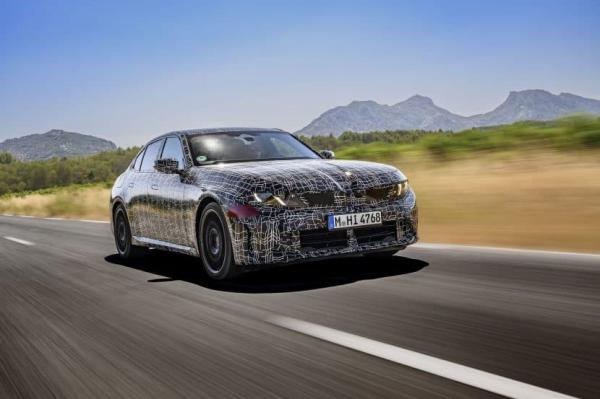
The steering ratio itself is slightly more indirect than the M340i’s, a deliberate choice to reduce nervousness at higher speeds and in certain edge-case situations, but the response just off center is still immediate, thanks to the added chassis stiffness and the tire’s own potential. It felt that the initial response was quick, but linear afterward, meaning the car follows your input faithfully without building up unpredictably if you hold a steering angle, which is exactly what it felt like on both the rough public roads and the smooth high-speed corners earlier in the day. Comfort mode reduces the steering’s resistance and self-centering moment specifically to make the car easier to place with minimal effort, while Sport adds friction and feedback deliberately, so you feel more of what the road is doing under you.
We also got into brake feel again, this time in the context of daily driving rather than a hot lap. Burkhard confirmed the car uses BMW’s now-common integrated brake system, and that the priority was a mechanical, linear bite rather than a brake that only wakes up once you are already pushing hard into the pedal.
The one detail I did not expect to come up was sound, and it is worth spelling out clearly because it answers a question I get asked constantly. The car I drove on the road was a European-spec version, while the earlier track car had been US-spec, and Burkhard confirmed there is still a decibel gap between the two, driven by emissions regulations. European cars have historically been quieter than their US counterparts because of particulate filter requirements that US-spec cars do not carry in the same form. What has changed on this generation, according to Burkhard, is that the European-spec exhaust sounds better (that’s always a subjective feeling), meaning louder from the outside, than the previous generation’s European car.
It is not a wholesale fix and the US car still wins on outright volume, but it is a real, acknowledged improvement rather than BMW quietly accepting that European buyers get the muted version forever. The B58’s voice itself, regardless of market, is still one of the most satisfying ways to burn gasoline in this segment, and nothing about the mild hybrid hardware or the tighter emissions rules coming down the road has dulled it yet.
Where This Leaves the M340i Faithful
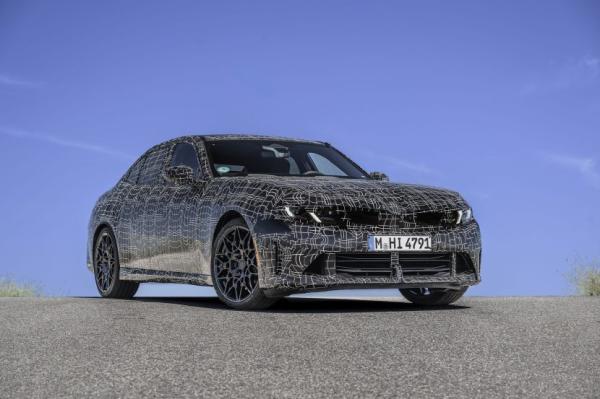
If you already own an M340i, here’s the uncomfortable news: BMW built a better car. Period. Every complaint people quietly had about that car, a steering rack that got nervous at speed, a ride that stiffened up without actually feeling faster, and a clear differentiation between driving modes. BMW is not calling this as good as the G80 M3, and it shouldn’t. But the gap between the two has never been this narrow, and for most people cross-shopping this segment, that gap closing is the actual story here. And might close even more when the Drift Mode comes out.
This also gives me hope about the next generation G84 M3 because as always, BMW always leaves a gap between its products.

Related posts
Latest Post


No Comments