
2026 Norton Manx R: First Look
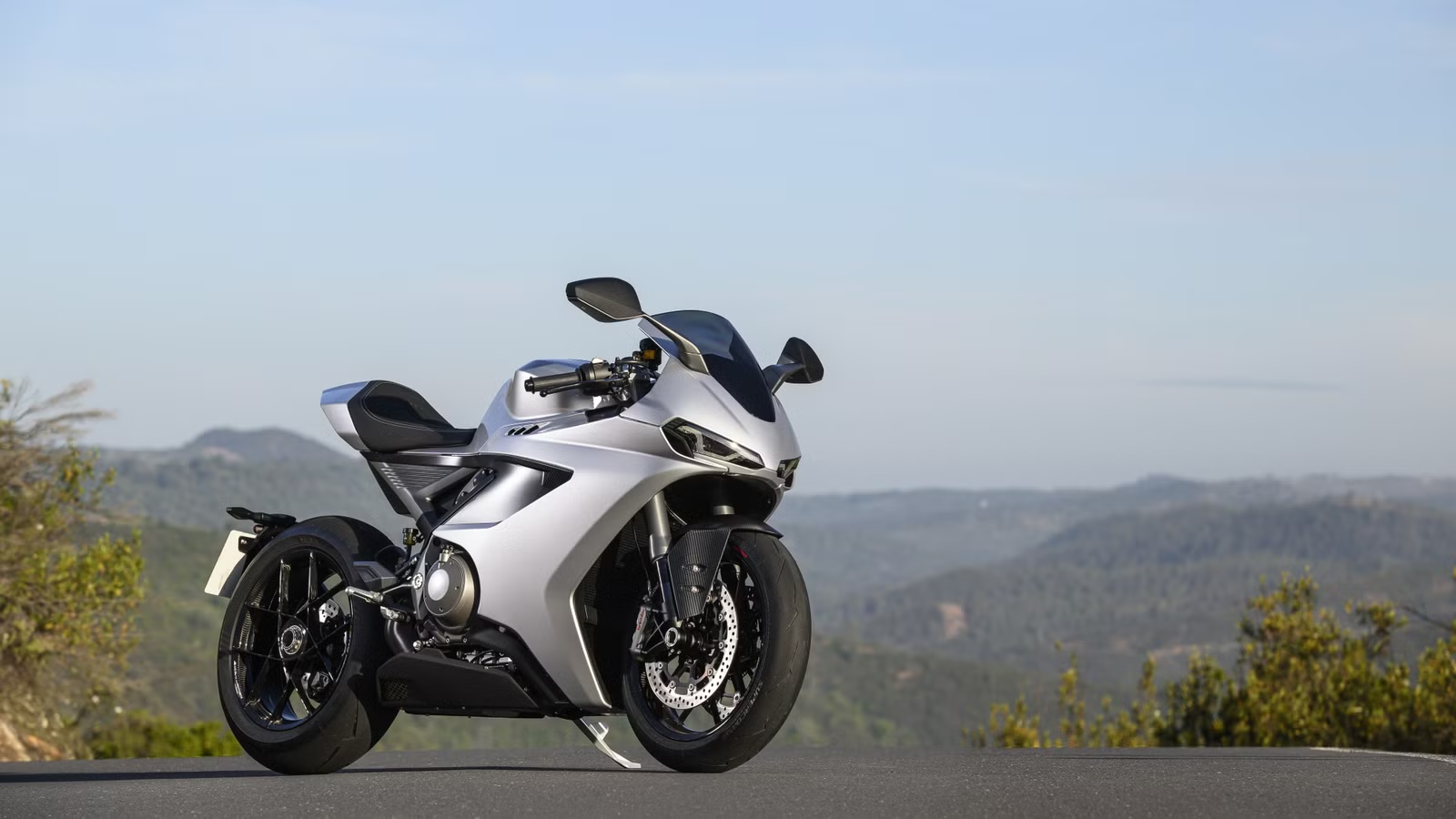
There’s a new superbike on the horizon: Meet the 2026 Norton Manx R, the flagship model from the legacy British marque, launched under what it calls its “Resurgence” program. Built around an all-new 1,200cc 72-degree V4 powerplant, it’s aimed at the premium end of the superbike class, with a design brief that prioritizes real-world road performance without abandoning track capability.

Norton has released specifications and more about its new four-variant Manx R superbike range, but one big question remains for the North American market: the price. According to the legacy manufacturer, official pricing is being finalized for the United States.
For now, we can reference the current UK pricing structure for ballpark estimates: £20,250 for the base Manx R, £24,750 for the Apex, and £38,750 for the Signature. The ultra-exclusive, top-spec First Edition is capped at 150 units worldwide and does not have an established MSRP in any market yet. As the saying goes, “if you have to ask, you can’t afford it” may apply here.
Resist the urge to run those figures through a currency converter and take the numbers at face value, because it’s slightly more complicated than that. British prices carry a 20 percent Value Added Tax (VAT) that Americans don’t pay, so a straight conversion inflates the figure by thousands. Back the tax out and the three priced variants land in the neighborhood of $22,600 (base), $27,600 (Apex), and $43,300 (Signature), based on exchange rates at the time of publishing.

Norton is currently working on establishing new dealerships within the United States.
Is Norton A Newcomer To Superbikes? It Depends On The Decade
Norton was founded in 1898 and even ran in the inaugural 1907 Isle of Man Tourist Trophy, then known as the International Auto-Cycle Tourist Trophy. The Manx namesake doesn’t date back quite as far, entering production in 1947 with 350cc and 500cc single-cylinder engine variants that dominated road racing through the 1950s until production ended in 1963. Norton has 94 wins and 323 podiums on the Isle of Man among its historical racing accolades.
Describing Norton’s business history as tumultuous is both kind and accurate. Associated Motor Cycles bought the company in 1953 and collapsed in 1966, sending Norton to Manganese Bronze Holdings as Norton-Villiers and then, under Dennis Poore, into the government-brokered Norton Villiers Triumph merger of 1973. NVT was short-lived, losing state support in 1975 and going into liquidation in 1978. Manganese Bronze sold out in 1987 to an investor group led by Philippe Le Roux, who took the business public as Norton Group plc and built the famed Wankel rotary engines at Shenstone, outside Lichfield, until roughly £7 million of debt halted production in early 1993.

The trademarks drifted through Canadian owners over the following years, ending with Vancouver’s Aquilini Investment Group, before American entrepreneur Kenny Dreer spent a decade and a reported $12 million consolidating them and developing a modern Commando under the Norton Motorsports name. His 952 prototype grew into the 961, which drew strong reviews in 2006 but never reached production, as Dreer couldn’t raise the money to build it. Stuart Garner bought the prototypes and the name in October 2008, moved the brand back to the UK at Donington Park, and finally put the 961 Commando into production in 2010. That era ended in administration in January 2020. Britain’s pensions adjudicator ruled in June of the same year that Garner had acted dishonestly as sole trustee of three schemes into which members transferred £11.5 million, nearly all of it invested in Norton, and ordered him to repay £14 million. He was convicted in 2022 of breaching employer-related investment rules.
TVS Motor Company bought Norton out of administration in April 2020 and has since invested more than £200 million, roughly $268 million. That funded the current Solihull factory, which opened in 2021 with capacity for 8,000 units annually, and a 25 percent headcount increase. Norton’s new owners also re-engineered the inherited 961 Commando and re-released it in 2023. In September 2025, the Commando line was retired alongside the V4SV and V4CR to clear the decks for the Manx, Manx R, and Atlas ranges.
Okay, enough history. Let’s get onto the Manx.
The V4: A Clean-Sheet Design
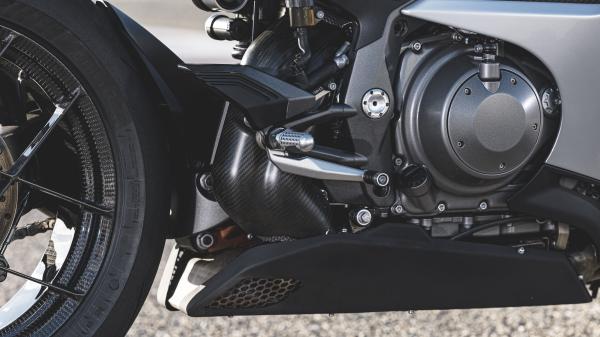
The past is the past. This time around, Norton started with a clean-sheet design for its liquid-cooled 72-degree 1,200cc V4 powerplant, producing a claimed 206 horsepower at 11,500 rpm and 96 lb-ft of torque at 9,000 rpm. Bore and stroke measure 82mm x 56.8mm against 14:1 compression. Those dimensions match the outgoing Norton V4SV, but the British firm states the two engines share no mechanical components.
Chain-driven cams with an idler gear operate direct-acting bucket tappets, which actuate lightweight titanium intake valves. Interestingly, the valvetrain is not the finger-follower design that has become nearly ubiquitous in the superbike class, where reduced reciprocating mass allows for higher redlines. Fueling is multi-point sequential injection through eight injectors, two per cylinder, the lower pair metering at low load and the upper handling high-airflow demand. Meanwhile, ride-by-wire throttle bodies act independently on each bank.

Norton specifies a Phased Pulse firing order with irregular intervals meant to build mechanical traction before traction control engages. The V4 fires at 180, 270, 180, and 90-degree intervals across the 720-degree cycle (source: Cycle News). Ducati’s Desmosedici Stradale V4 chases the same mechanical-grip goal by an entirely different firing order route. Its V-twin-inspired Twin Pulse arrangement fires at 0, 90, 290, and 380 degrees, clustering the cylinders into two tightly spaced pairs separated by long gaps, so a 90-degree V4 behaves like a 90-degree V-twin. Ducati buys that character with crankshaft geometry, using a 70-degree offset crankpin to stagger the throws. Norton’s spacing is uneven but far less clustered, and the company states its 72-degree V-angle allowed it to develop those irregular intervals without staggering the crankpins at all, as wide-angle V4s must. The British V4 is counterbalanced and features rear cylinder deactivation.
The exhaust is a 4-2-1 stainless steel system, while the limited First Edition receives a lightweight titanium Akrapovič exhaust as standard.
The tuning priority was midrange, and Norton claims 77 percent of peak torque is available at a street-friendly 5,000 rpm. A 20 percent displacement advantage over the 1,000cc inline-fours that define the class lends weight to that claim, and we expect the V4 to feel considerably less peaky than a Japanese superbike, even if peak power still arrives at 11,500 rpm.

That displacement does come at the cost of eligibility for superbike competition. FIM regulations cap three- and four-cylinder Superbikes at 1,000cc, making the Norton ineligible for both WorldSBK and MotoAmerica Superbike championships, though Norton says it avoided a purely race-replica philosophy. Ducati and Aprilia made the same street-focused trade with the 1,103cc Panigale V4 and 1,099cc RSV4 platforms. That said, Ducati still competes at the professional level with its 998cc-powered Panigale V4 R homologation special. A six-speed gearbox is equipped with a bi-directional quickshifter, and an assist-and-slip clutch is standard.
Chassis, Brakes, and Electronics
The twin-spar frame is formed from five die-cast aluminum members welded and then CNC machined as a single assembly. A single-sided die-cast aluminum swingarm is a bit of a throwback in the superbike class, with Ducati moving to a conventional swingarm for its top-tier superbike. Wheelbase is 56.5 inches, seat height 33.1 inches, and fuel capacity is 3.8 gallons. Norton quotes wet weight without fuel at 463 pounds for the base bike, 457 for the Apex, 448 for the Signature, and 443 for the First Edition. Add roughly 24 pounds to any of those weight figures to achieve a rough estimate of true curb weight.
Marzocchi supplies a fully adjustable 45mm inverted fork with 4.7 inches of travel and a shock featuring 5.0 inches of travel. Apex, Signature, and First Edition models receive semi-active Marzocchi suspension with DLC-coated fork tubes.

Braking is handled by Brembo’s latest Hypure 4-piston calipers and dual 320mm rotors up front. A two-piston caliper and 245mm disc take care of stopping duties out back. Pirelli Diablo Supercorsa SP V4 tires are standard in 120/70 ZR17 and 200/55 ZR17 sizes, mounted to cast aluminum, OZ Racing forged aluminum, or Rotobox Bullet Pro carbon wheels, depending on trim.
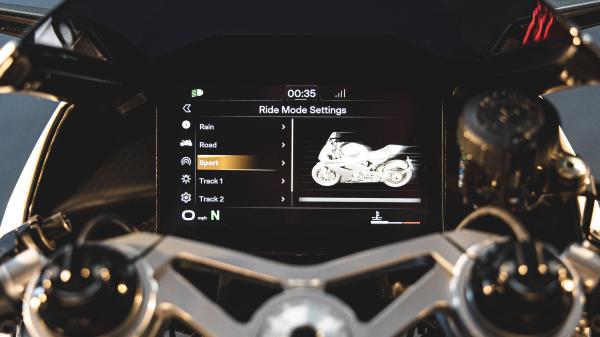
Rider aids run on a Bosch six-axis IMU that informs adjustable traction control, cornering ABS, wheelie control, slide control, engine braking management, rear wheel lift control, and launch control. Five ride modes are also offered, and all features are adjustable via the massive 8-inch full-color TFT display.
When Will The Manx R Arrive In U.S. Dealers?
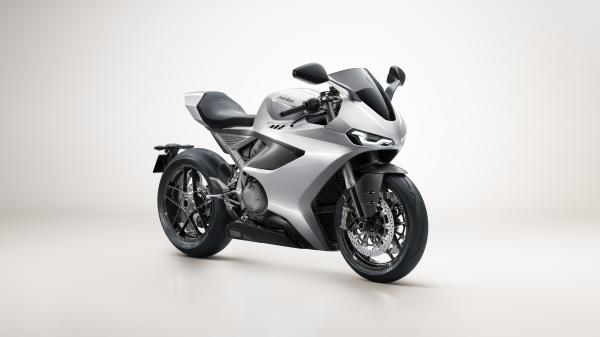
Norton representatives are aiming to see Manx R models rolling into forthcoming U.S. dealerships by early 2027. Pricing information has not been announced for the North American market, and we will update this story accordingly.
2026 Norton Manx R Photo Gallery:
2026 Norton Manx R Specifications:
Engine
|
Type |
72-degree V4 four-stroke |
|
Displacement |
1200cc |
|
Bore x stroke |
82mm x 56.8mm |
|
Maximum horsepower |
206 horsepower @ 11,500 rpm (claimed) |
|
Maximum torque |
96 lb-ft @ 9,000 rpm (claimed) |
|
Compression ratio |
14.0:1 |
|
Valvetrain |
Chain-driven camshafts w/ idler gear; compact direct-acting bucket tappets; titanium intake valves; ramped cylinder heads. |
|
Fueling |
Multi-point sequential electronic fuel injection; eight injectors, two per cylinder (lower pair for low-load metering, high-mounted pair for high-airflow delivery); ride-by-wire w/ separately driven electronic throttle bodies for the front and rear banks. Octane requirement Not Provided By Manufacturer |
|
Exhaust |
Underslung 4-2-1 steel system w/ two catalytic converters (one per cylinder bank), triple oxygen sensor system, and back-pressure valve integrated into the silencer (Manx R, Apex, Signature); road-legal Akrapovic titanium 4-2-1 system (First Edition) |
|
Cooling |
Liquid |
|
Transmission |
6-speed w/ bi-directional Quick Shift and auto rev-matching |
|
Clutch |
Cable-operated Assist & Slip multiplate wet clutch |
|
Final drive |
X-ring 525 chain, 17/41 (2.41:1) |
Chassis
|
Frame |
Die-cast aluminum twin-spar; five cast members welded and CNC machined as a single assembly, connecting the steering stem to the swingarm pivot. Swingarm: single-side die-cast aluminum (Manx R, Apex, Signature); single-sided braced aluminum (First Edition) |
|
Front suspension; travel |
Fully manually adjustable Marzocchi 45mm inverted fork, chromed inner tubes, passive damping (Manx R); semi-active Marzocchi 45mm inverted fork, DLC-coated inner tubes, external spring preload adjustment (Apex, Signature, First Edition); 4.7 inches |
|
Rear suspension; travel |
Fully manually adjustable Marzocchi monoshock, passive damping (Manx R); semi-active Marzocchi monoshock w/ external spring preload adjustment (Apex, Signature, First Edition); 5.0 inches. Stroke Not Provided By Manufacturer |
|
Wheels |
Cast aluminum (Manx R); OZ Racing forged aluminum (Apex); Rotobox Bullet Pro carbon fiber (Signature, First Edition) |
|
Front wheel |
17 x 3.50 |
|
Rear wheel |
17 x 6.00 |
|
Tires |
Pirelli Diablo Supercorsa SP-V4, radial |
|
Front tire |
120/70 ZR17 |
|
Rear tire |
200/55 ZR17 |
|
Front brake |
Dual 320mm semi-floating discs w/ radially mounted Brembo Hypure 4-piston calipers (First Edition adds First Edition-colored calipers) |
|
Rear brake |
245mm disc w/ 2-piston caliper |
|
ABS |
Standard; Bosch Cornering ABS EVO, front and rear |
|
Electronic rider aids |
Bosch 10.3ME platform w/ 6-axis IMU: N-TEC Tractive Effort Control, N-TWC Total Wheelie Control, N-RSC Rear Slide Control, N-DTC Drag Torque Control, N-RLC Rear Lift Control, N-ECB Electronic Combined Braking, N-VHC Vehicle Hold Control, N-TCL Torque Controlled Launch, N-DCC Dynamic Cruise Control. Five ride modes: Rain, Road, Sport, Track 1, Track 2. 8-inch full-color 1280 x 720 TFT touchscreen; Bluetooth and Wi-Fi; dynamic brake lights |
Dimensions & Capacities
|
Wheelbase |
56.5 inches (1435mm) |
|
Rake |
24.1 degrees |
|
Trail |
3.7 inches (94.5mm) |
|
Seat height |
33.1 inches (840mm) |
|
Ground clearance |
5.2 inches (133mm) |
|
Fuel capacity |
3.8 gallons (14.5 liters) |
|
Estimated fuel consumption |
36.7 mpg (US) |
|
Curb weight |
Norton publishes wet weight without fuel: 463 pounds (Manx R); 457 pounds (Apex); 448 pounds (Signature); 443 pounds (First Edition). Fully fueled curb weight Not Provided By Manufacturer; adding 14.5 liters of fuel is roughly 24 pounds |
Price & Warranty
|
Website |
nortonmotorcycles.com |
|
Price |
U.S. MSRP Not Provided By Manufacturer (Norton states U.S. pricing is being finalized). UK: £20,250 (Manx R); £24,750 (Apex); £38,750 (Signature); price on application (First Edition, 150 units worldwide) |
|
Warranty |
36 months / 30,000 miles |
|
Service interval |
12 months / 10,000 miles. Valve service interval Not Provided By Manufacturer |
|
Color |
Matrix Black and Trophy Silver (all variants); Celestial Grey and Aqua Green (Apex, Signature, First Edition; £500 option on Manx R); Carbon (Signature, First Edition); Glacier Blue (First Edition; £500 option on Signature); Matrix Black, Trophy Silver, Celestial Grey, Aqua Green and Glacier Blue with Carbon (First Edition) |
Source: Norton

Related posts

Latest Post


No Comments