
12 Factory Sleepers That Came With Engines From Supercars
Factory sleepers occupy a unique corner of automotive culture — machines that look utterly ordinary but conceal engineering that belongs in a completely different league. While the aftermarket tuning scene gets most of the headlines, some of the most thrilling performance stories were written by the manufacturers themselves, hiding exotic powertrains beneath the skin of family sedans, wagons, and even pickup trucks. These are the cars that made stoplight heroes out of unsuspecting commuters and left sports car owners genuinely embarrassed.

Manufacturers build these vehicles to showcase engineering dominance or to save costs by sharing expensive engines across different platforms. Sometimes, it is about giving a regular bread-and-butter model enough prestige to compete with luxury rivals like BMW or Mercedes. The real appeal is the element of surprise. You get the raw power and speed of a supercar in a practical package that flies completely under the radar.
12
Lancia Thema 8.32
2.9-Liter V8 From The Ferrari 308
|
Engine |
 79 autotech Transmission |
Power |
Torque |
|
2.9L Ferrari V8 |
5-Speed Manual |
212 hp |
210 lb-ft |
During the 1980s, the Lancia Thema was a handsome but largely conventional executive sedan. It shared a platform with the Saab 9000 and Fiat Croma, designed to ferry Italian businessmen in comfort. However, Lancia wanted to elevate the brand to compete with the high-performance sedans coming from BMW M and Mercedes-AMG. The solution was to borrow a heart from the most famous name in automotive history: Ferrari.

The Thema 8.32 featured a 2.9-liter V8 engine pulled straight from the Ferrari 308 and Mondial Quattrovalvole. This made it the only front-wheel-drive car to ever factory-ship with a Ferrari engine. Fitting the powerplant for luxury-sedan duty rather than a mid-engine sports car required meaningful changes. The most significant was the switch from a flat-plane crankshaft to a cross-plane design, which traded the signature Ferrari scream for the smoother, more refined vibration character that premium-car buyers expected.

Engineers also revised the valves and firing order to prioritize torque. Despite these changes, it remained a mechanical masterpiece. The exterior stayed remarkably subtle — the only real hint of its power was a retractable rear spoiler that sat flush with the trunk lid until the driver activated it. The 8.32 offered a unique blend of Italian hand-stitched leather luxury and supercar-derived performance, sprinting from 0–60 mph in 6.8 seconds. While that sounds modest today, it was genuinely quick for a luxury sedan when it launched in 1986.
11
Ford Taurus SHO (First Generation)
3.0-liter V6 From The Canceled GN34 Project

|
Engine |
Transmission |
Power |
Torque |
|
3.0L Yamaha V6 |
5-Speed Manual |
220 hp |
200 lb-ft |
In 1989, the Ford Taurus was one of the best-selling family cars in America, known more for its jellybean shape than its speed. That changed with the introduction of the SHO, which stood for Super High Output. This sleeper looked almost identical to the standard sedan, yet it featured a high-tech 3.0-liter V6 engine developed entirely by Yamaha, designed to make muscle cars look slow.

The history of this engine is fascinating. Ford originally commissioned Yamaha to build it for a mid-engine supercar project internally called the GN34 — a car intended to be a direct rival to the Ferrari 328. When Ford eventually canceled the GN34 project to save money, they were still under contract to purchase the engines. Rather than absorb the loss, they dropped the exotic V6 into the front-wheel-drive Taurus to recoup the investment.

The engine was unlike anything else in the Ford catalog. It featured a 7,000 RPM redline and a beautifully engineered intake manifold with a variable induction system that used long and short runners to optimize airflow across the entire rev range. Because it had to fit into a sedan, the engine was mounted transversely instead of longitudinally as originally planned for the supercar. It transformed a soft-riding commuter into a high-revving performance machine that could hold its own against the best sports sedans from Europe.
The first-generation SHO reached 0–60 mph in 6.6 seconds — incredible performance from a car that looked like a typical rental.
10
Saab 9-7X Aero
Used LS2 V8 From The C6 Corvette

|
Engine |
Transmission |
Power |
Torque |
|
6.0-liter naturally aspirated LS2 V8 |
4-speed Hydra-Matic 4L70-E automatic |
390 hp |
400 lb-ft |
For decades, Saab built its reputation on quirky engineering, turbocharged performance, and aviation-inspired design. That changed after General Motors took full ownership of the Swedish automaker in 2000, as Saab increasingly relied on GM platforms and components to reduce development costs. One of the most unusual products of that era was the 9-7X Aero, a premium midsize SUV based on GM’s GMT360 platform. Created to expand Saab’s lineup in the booming luxury SUV market, it also became the brand’s most powerful production vehicle.

The real surprise was under the hood. Rather than a turbocharged Saab engine, GM reached into its performance parts bin and equipped the 9-7X Aero with the 6.0-liter LS2 V8 from the C6 Corvette. The naturally aspirated small-block needed only minor revisions for its SUV application, delivering 390 horsepower and 400 lb-ft of torque through a four-speed automatic and all-wheel-drive system. The result was a 0–60 mph time of around 5.5 seconds and effortless V8 performance that almost nobody saw coming from a Swedish luxury SUV.

Sadly, not even a Corvette-powered flagship could rescue Saab from years of declining sales, and the storied automaker entered bankruptcy in 2011, bringing more than six decades of Saab automobile production to an end.
9
Volvo XC90 V8
4.4-liter DOHC V8 Shared With Noble M600

|
Engine |
Transmission |
Power |
Torque |
|
4.4-liter naturally aspirated Yamaha DOHC V8 |
6-speed Geartronic automatic |
311 hp |
325 lb-ft |
The Volvo XC90 V8 is a slight outlier on this list because its engine didn’t originate in a supercar — but it earned its place here by eventually becoming the foundation of one. Introduced in 2005, the XC90 V8 was Volvo’s answer to growing demand for premium three-row SUVs with genuine power, allowing it to compete with rivals like the BMW X5 and Porsche Cayenne S. Rather than settling for a conventional truck-derived engine, Volvo commissioned one of the most sophisticated V8s ever fitted to a family SUV.
Volvo partnered with Yamaha, which designed an all-aluminum 4.4-liter DOHC V8 compact enough to fit transversely beneath the XC90’s hood. Thanks to a narrow 60-degree bank angle, offset cylinder design, and balance shaft, the engine delivered exceptional smoothness while producing 311 horsepower and 325 lb-ft of torque. It earned praise for its distinctive exhaust note and surprising willingness to rev — qualities more commonly associated with sports cars than luxury SUVs.

Its engineering impressed more than just Volvo buyers. Noble selected the Yamaha V8 as the foundation for the M600, though little remained untouched. Twin Garrett turbochargers, forged internals, a new intake manifold, revised cylinder heads, upgraded cooling, and bespoke calibration transformed the engine into a 650-horsepower supercar powerplant with a brutally raw personality. The M600 earned widespread acclaim, including high praise from Jeremy Clarkson, who famously called it one of the most exhilarating cars he had ever driven.
8
BMW M5 (E28)
3.5-Liter Straight-Six Derived From The BMW M1 Supercar

|
Engine |
Transmission |
Power |
Torque |
|
3.5-liter S38B35 naturally aspirated inline-six |
5-speed Getrag 280 manual |
256 hp |
243 lb-ft |
The original BMW M5 deserves its place here because it perfected the sleeper formula long before the term became fashionable. When it debuted in 1985, the E28 M5 looked remarkably similar to an ordinary 5 Series, distinguished only by subtle aerodynamic tweaks, unique alloy wheels, and discreet M badging. Few people realized they were looking at the fastest production sedan in the world.

That performance came courtesy of a 3.5-liter straight-six derived from the engine in BMW’s groundbreaking M1 supercar. European models received the M88/3 essentially unchanged, while North American cars adopted the closely related S38B35 with revised engine management, a catalytic converter, and other updates to satisfy emissions regulations without sacrificing the engine’s motorsport character. The result was 256 horsepower and 243 lb-ft of torque in U.S. specification, enough for a 0–60 mph run of roughly 6.1 seconds.

The BMW M1’s production run ended after just 453 road cars, making it an unattainable dream for most enthusiasts. Fortunately, its greatest asset didn’t disappear with it. By adapting the M1’s race-bred straight-six for the E28 M5, BMW gave far more drivers access to its free-revving character, razor-sharp throttle response, and motorsport pedigree.
7
Audi RS 6 Avant (C6)
5.0-Liter V10 From The Lamborghini Gallardo

|
Engine |
Transmission |
Power |
Torque |
|
5.0L Twin-Turbo V10 |
6-Speed Automatic |
572 hp |
479 lb-ft |
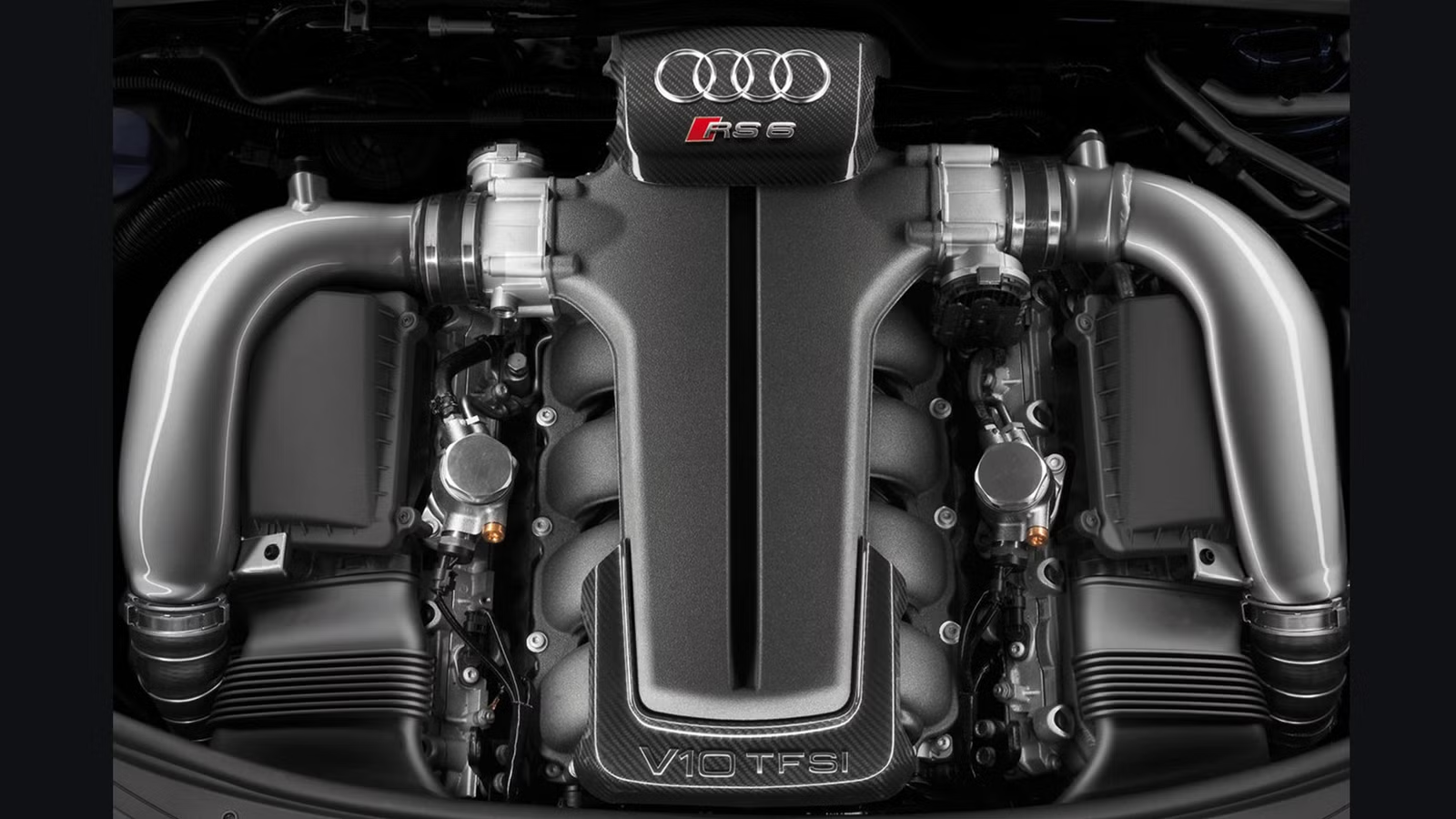
Audi has a long history of building fast wagons, but the C6-generation RS 6 Avant remains their most ambitious project. At a glance, it looked like a standard family hauler used for grocery runs and school drop-offs. Under the hood, however, lived a massive 5.0-liter V10 whose basic architecture — including cylinder spacing and the aluminum block design — it shared with the naturally aspirated V10 found in the Lamborghini Gallardo.

Audi deployed this exotic engine to push the boundaries of the super-wagon segment. To ensure it had the muscle to move a heavy all-wheel-drive chassis, engineers added twin turbochargers — a significant departure from the Lamborghini version of the V10, which relied on natural aspiration for high-revving thrills. The Audi version also received a dry-sump lubrication system so the engine could sit as low as possible in the bay, improving the center of gravity.

The result was a vehicle that actually outproduced the contemporary Gallardo in terms of raw power — an engineering marvel combining the traction of Quattro all-wheel drive with the lung-crushing acceleration of an Italian exotic. The C6 RS 6 Avant remains a fan favorite because it delivers supercar speed without drawing any unwanted attention in traffic, and it remains the only twin-turbo V10-powered wagon in history.
The RS 6 Avant was capable of hitting 0–60 mph in just 4.5 seconds, delivering effortless pace that could shame many dedicated two-door sports cars of its era.
6
Volkswagen Phaeton W12
6.0-liter W12 From The Bentley Continental GT

|
Engine |
Transmission |
Power |
Torque |
|
6.0L W12 |
5-Speed Automatic |
414 hp |
406 lb-ft |
The Volkswagen Phaeton is perhaps the most ambitious project in the history of the German brand. Ferdinand Piëch, the chairman of Volkswagen at the time, wanted to build a luxury car that surpassed the Mercedes-Benz S-Class in every measurable way. Piëch famously demanded a vehicle that could cruise at 186 mph all day in blistering heat while keeping the cabin at a perfect 72 degrees. The end product was a car that looked like a larger Passat but contained the engineering of a private jet.

To achieve that level of effortless performance, Volkswagen turned to a 6.0-liter W12 engine — the exact same unit found in the Bentley Continental GT. The W-shaped configuration packed a massive 12-cylinder displacement into a compact footprint, providing the smoothness and silence required of a flagship luxury sedan. Unlike the twin-turbocharged version in the Bentley, the Phaeton used a naturally aspirated setup, prioritizing linear, velvet-smooth power delivery over raw, aggressive thrust.

The Phaeton was, in essence, a Bentley in a discreet Volkswagen suit. It featured a complex 4Motion all-wheel-drive system and an adjustable air suspension capable of soaking up any road imperfection. It remains the ultimate stealth luxury car because most people in traffic would never guess it shared its mechanical DNA with a legendary British grand tourer.
The W12 Phaeton could accelerate from 0–60 mph in 5.9 seconds, moving its considerable mass with a level of grace and silence that few cars could match.
5
Chevrolet SS
6.2-liter LS3 V8 Taken From The Corvette C6

|
Engine |
Transmission |
Power |
Torque |
|---|---|---|---|
|
6.2L LS3 V8 |
6-Speed Manual / 6-Speed Automatic |
415 hp |
415 lb-ft |
The Chevrolet SS is one of those cars that slipped completely under the radar — and that’s exactly what makes it such a perfect sleeper.
At a glance, it looks like a generic, slightly upscale sedan. No wild styling, no aggressive wings, nothing that screams performance. Most people wouldn’t give it a second look in traffic.
But underneath, it’s essentially a rebadged Australian muscle car.

The SS packs a 6.2-liter LS3 V8 pushing out 415 horsepower, sent to the rear wheels through either an automatic or — if you knew what to look for — a rare six-speed manual. It could hit 60 mph in around 4.5 seconds, putting it right in line with much more conspicuous performance machines.
What really seals the deal is how invisible it is. Unless you know what an SS badge means, it just blends in. That’s why it has become such a cult favorite — it delivers serious V8 performance in a package that almost nobody expects.
4
Mercedes-Benz R63 AMG
Shared M156 V8 Architecture With The Mercedes-Benz SLS AMG

|
Engine |
Transmission |
Power |
Torque |
|
6.2-liter naturally aspirated M156 V8 |
7-speed AMG Speedshift 7G-Tronic automatic |
503 hp |
465 lb-ft |
Mercedes introduced the R-Class in the mid-2000s as a premium alternative to the minivan. Sitting alongside the M-Class and GL-Class in the lineup, it targeted affluent families who needed space for up to seven without sacrificing luxury. Then AMG got involved. AMG saw an opportunity to inject some excitement into the unconventional model, pairing the practical packaging of the R-Class with one of the division’s greatest V8 engines. The result was the R63 AMG.

At the heart of the R63 was a naturally aspirated 6.2-liter V8 internally known as the M156 — AMG’s first in-house engine and a milestone for the performance division. Hand-built under AMG’s “One Man, One Engine” philosophy, it served as the brand’s flagship powerplant, finding its way into models like the C63 AMG, CLK63 AMG Black Series, and SL63 AMG. In the R63 AMG, it produced 503 horsepower and 465 lb-ft of torque — outrageous figures for a three-row family vehicle.

Strictly speaking, the M156 never lived under the hood of a supercar. However, it became the direct foundation for the M159 that powered the iconic Mercedes-Benz SLS AMG. Engineers fitted the SLS engine with a revised intake, revised cylinder heads, reworked exhaust, forged internals, dry-sump lubrication, and numerous lightweight components — changes that raised output to 563 horsepower and transformed its character into a sharper, higher-revving unit built for track performance rather than effortless family hauling.
3
Cadillac CTS-V Wagon
Powered By A Close Relative Of The Corvette ZR1’s Legendary LS9

|
Engine |
Transmission |
Power |
Torque |
|
6.2-liter supercharged LSA V8 |
6-speed manual / 6-speed Hydra-Matic 6L90 automatic |
556 hp |
551 lb-ft |
Cadillac launched the CTS-V to prove it could build a world-class performance sedan capable of taking on the BMW M5 and Mercedes-Benz E63 AMG, and the second-generation version maintained that focus when it debuted in the late 2000s. The formula was simple: rear-wheel drive, sharp chassis tuning, and a supercharged V8 with enough muscle to worry Europe’s best. The result was one of the finest driver’s cars of its era, even setting a Nürburgring lap record for a production sedan. Cadillac then doubled down by introducing the CTS-V Wagon, giving enthusiasts the practicality of a wagon without sacrificing any performance. It quickly became one of the most outrageous factory wagons ever built.

At the heart of the CTS-V Wagon was the 6.2-liter supercharged LSA V8, a close relative of the Corvette ZR1’s legendary LS9. Both engines shared GM’s Gen IV small-block architecture, but Cadillac’s version traded the ZR1’s larger supercharger, forged internals, and dry-sump lubrication for a smaller 1.9-liter Eaton TVS supercharger, wet-sump oiling, and a tune better suited to everyday use. Even so, the LSA delivered 556 horsepower and 551 lb-ft of torque — enough to launch the CTS-V Wagon from 0–60 mph in just 3.9 seconds while carrying five passengers and a week’s worth of luggage.

Cadillac built just 2,139 CTS-V Wagons between 2011 and 2014, and their rarity, available six-speed manual, and Corvette-derived performance have since transformed them into modern collector favorites.

Related posts

Latest Post


No Comments