
Why This Motorcycle Is A Game-Changer For Couples Who Ride
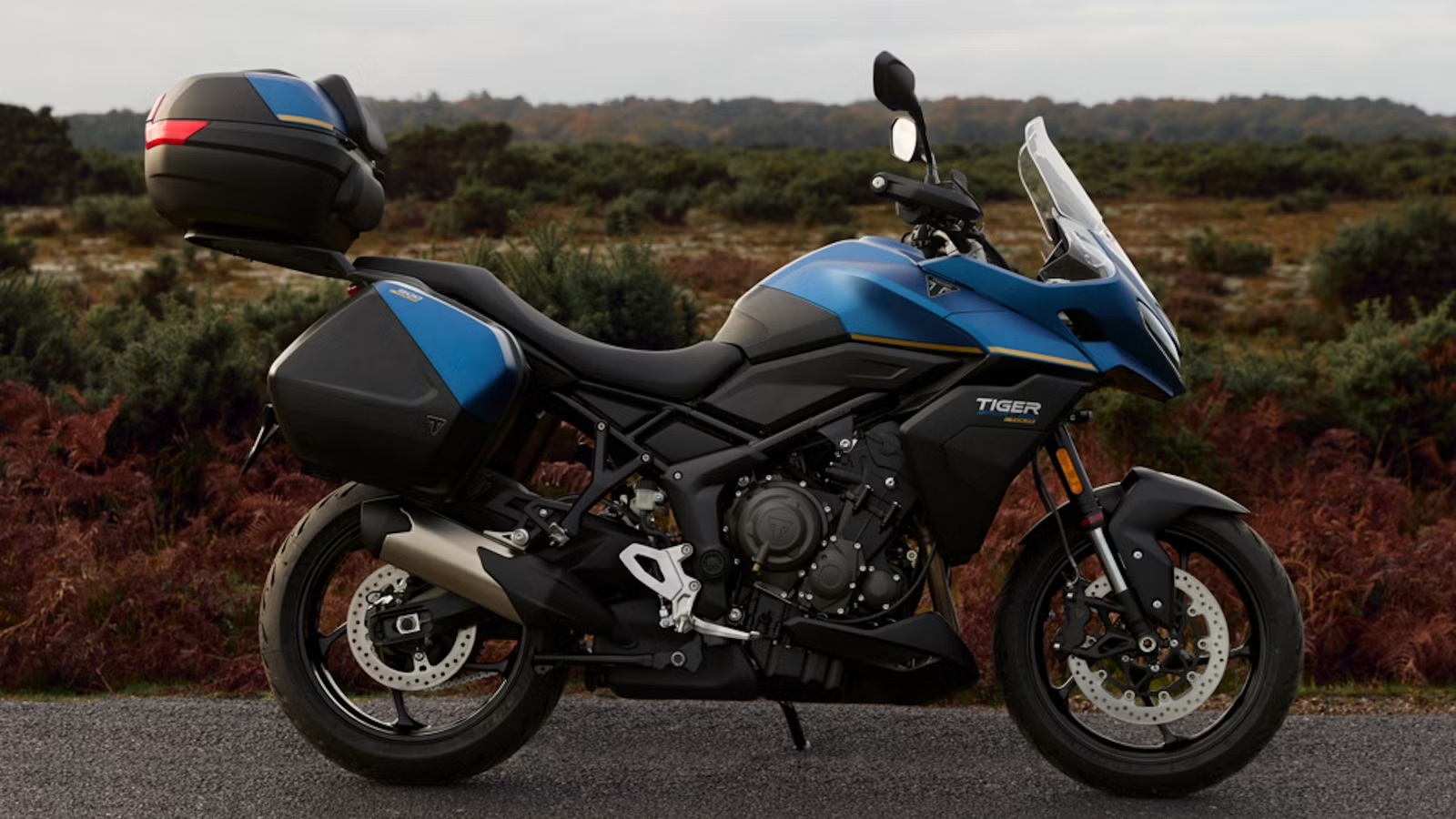
Finding a motorcycle that works brilliantly for two riders without draining your bank account has always been a frustrating exercise. The traditional answer — a full-dress tourer — typically demands well north of $20,000, which puts it out of reach for most riders. But the middleweight touring segment has been quietly maturing, and today there are genuinely compelling options that deliver real touring capability at a fraction of that cost. The Triumph Tiger Sport 800 sits at the sharp end of that conversation, and it makes a strong case for being the smartest two-up purchase on the market right now.

All of these middleweights offer something a little different, but the one thing they have in common is fantastic value. Each delivers features previously reserved for top-spec models, along with great real-world performance — but only one offers a level of refinement not usually associated with budget-friendly motorcycles.
The 2026 Triumph Tiger Sport 800 Is Perfect For Couples Who Ride Together
Starting MSRP: $12,845
What makes the Tiger Sport 800 a game-changer is the fact that it is an all-new motorcycle. It faces stiff competition from Japan, but all the Japanese contenders have been around for a while and rely on older platforms to hit this price point. That makes them a known quantity — but it is also where innovation tends to stall. Honda brought the NT1100 to the U.S. after years of strong European sales. It has the least exciting engine of the bunch, yet it will always be part of the conversation thanks to its ultra-competitive price and the reassurance that comes with the Honda badge.

Kawasaki and Suzuki offer the Ninja 1100 SX SE and the GSX-S1000GT+, respectively. Both deliver exceptional value by leveraging older but still potent liter-bike engines. Both are well-equipped and arguably more comfortable. Although more expensive, neither is dramatically so, and the value proposition on each makes them worth a serious look.
BMW offers the F 900 XR at a very competitive base price, but BMW is notorious for keeping minimal stock of base models — you will either wait or end up paying more for options you may not want. The most like-for-like alternative is the Yamaha Tracer 9. It is the only other bike here that uses a triple and offers a similarly long list of premium features at a bargain price, including hard cases as standard fitment. But as entertaining as that CP3 engine is, it will never quite match the refinement that Triumph consistently delivers.
Rivals
- Honda NT1100
- Kawasaki Ninja 1100 SX SE
- Suzuki GSX-S1000GT+
- BMW F 900 XR
- Yamaha Tracer 9
The Tiger Sport 800 Got A Brand-New Triple
Power: 113 Horsepower
Unlike its rivals, the Tiger Sport 800 is built around a brand-new engine. It is also meaningfully more powerful than the more affordable Tiger Sport 660, which clearly differentiates it within the lineup. Japanese manufacturers have dominated this middleweight space in recent years, but emboldened by the success of the 660 platform, Triumph is evidently hungry for a larger share.
To earn that share, Triumph is willing to offer more. At 113 horsepower, this is one of the stronger bikes in this emerging 800-class segment. But, like all the bikes competing here, raw peak power is less important than mid-range punch. This is a motorcycle engineered for real-world enjoyment, with a broad, flat torque curve that rewards relaxed riding as much as spirited canyon runs.

The advantages of inline triples are frequently touted in marketing materials, and for good reason — but widespread adoption has been slow because triples are genuinely difficult to balance. Like any triple, this one will produce some vibration at higher revs. Even so, Triumph more than compensates with a level of refinement that other manufacturers struggle to match. Throttle snatch at low revs is a persistent industry-wide problem with ride-by-wire systems, yet Triumph appears to have cracked it — virtually every recent model from the brand delivers smooth, linear response throughout the entire rev range.
Engine Specifications
|
Engine Type |
Inline-3, liquid-cooled |
|
Displacement |
798cc |
|
Max Power |
113 HP |
|
Max Torque |
62 LB-FT |
|
Transmission |
6-speed |
The Tiger Sport 800 Is The Perfect Lightweight Tourer For Couples
The Affordable Travel Companion
Affordability is central to the Tiger Sport 800’s appeal. While there are several outstanding luxury touring motorcycles available, all of them carry eye-watering price tags. What the Tiger Sport 800 delivers instead is a comprehensive suite of modern safety technology, a characterful triple, and a sharp contemporary design — all wrapped in a refined yet genuinely accessible package. For the 2026 Tour model, Triumph added integrated luggage, heated grips, and a comfort seat to the Tour.
Chassis, Suspension, And Weight Specifications
|
Chassis |
Tubular steel perimeter frame |
|
Front Suspension |
Showa 41mm upside-down separate function cartridge forks, adjustable compression and rebound damping (5.9-in travel) |
|
Rear Suspension |
Showa monoshock RSU with adjustable rebound damping and remote hydraulic preload adjustment (5.9-in travel) |
|
Front Brakes |
Dual 310mm discs |
|
Rear Brakes |
255mm disc |
|
Weight |
471 lbs |
Triumph made smart compromises in areas that matter least to the target buyer. A conventional steel chassis is no track weapon, but it is perfectly suited to city streets, motorways, and winding canyon roads. You will not find exotic Swedish suspension components here either, but Showa has decades of expertise in the field and delivers a thoroughly competent setup for this application.
Usable Features Round Off The Tiger Sport 800’s Package

The absence of standard luggage is not ideal on a touring-focused bike, but most of the competition also leaves hard cases on the options list, so the Tiger Sport 800 is not at a meaningful disadvantage there. The lack of a full TFT display may disappoint riders accustomed to large screens, though it is ultimately a non-essential on a motorcycle. What you do get is traction control and cornering ABS — an important safety net for both rider and passenger. Add an adjustable windscreen, a quickshifter, cruise control, and multiple ride modes enabled by the ride-by-wire throttle, and the value on offer is genuinely hard to argue with.
Features
- Adjustable windscreen
- Switchable traction control
- Cornering ABS
- Ride-by-wire throttle
- Ride modes
- Cruise control
- Quickshifter
Sources: Triumph

Related posts



Latest Post


No Comments