
Volvo TurboPlus: The Factory Overboost Kit Nobody Knew
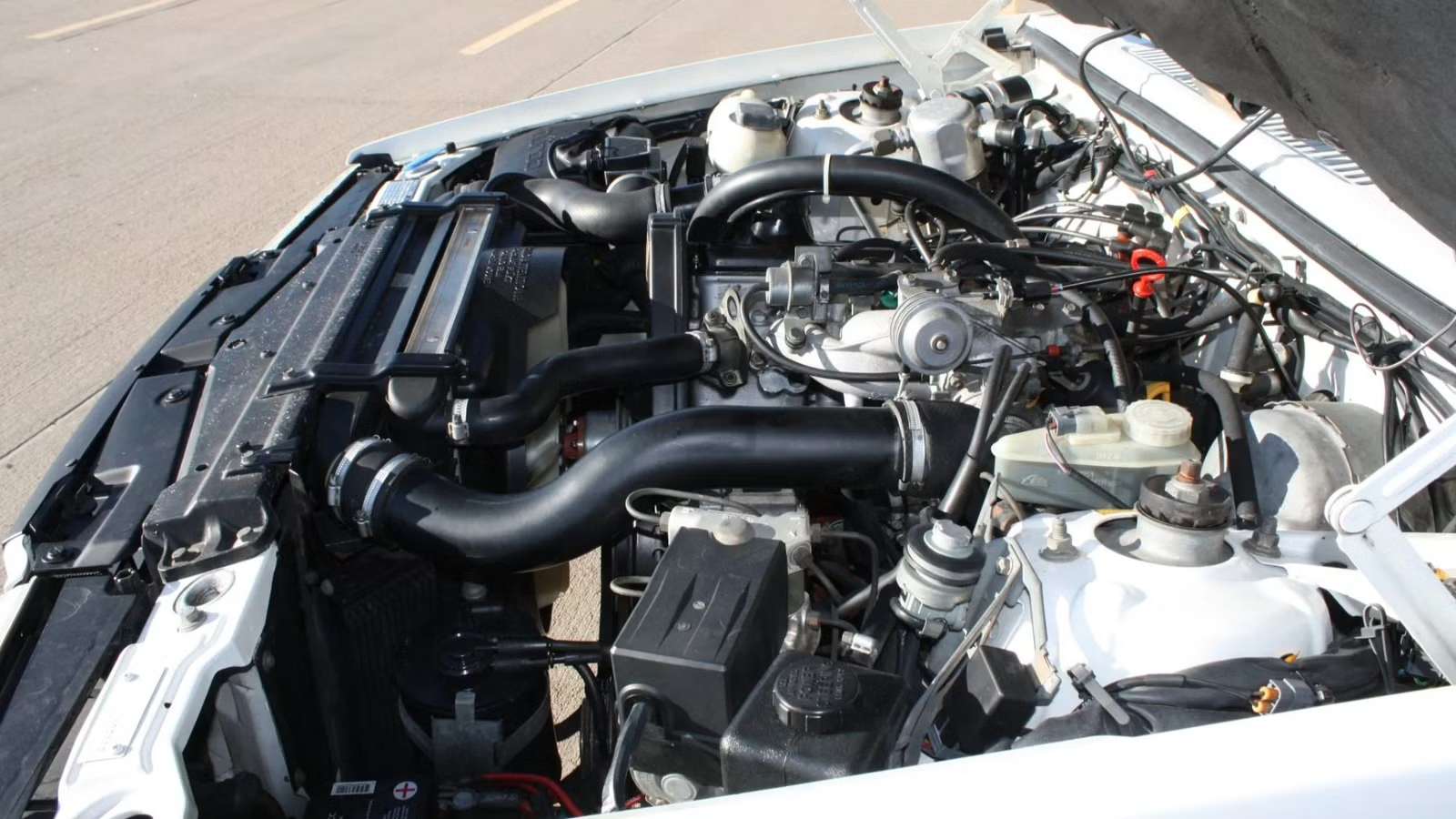
Boost has always been the easiest drug in the tuning world to get hooked on, and the cheapest way to get burned. By the late 1980s, a whole cottage industry had sprung up promising more turbo power with nothing more than a screwdriver and a prayer. What almost nobody noticed at the time was that one manufacturer, Volvo, had already solved the problem properly, sold the fix through its own dealer network, and never really bothered telling anyone how clever it was.

The story sat buried in dealer parts bins and forgotten service bulletins for decades, the kind of detail that survives only in enthusiast archives written in a language most of the English-speaking tuning world never bothered translating. It’s the sort of thing that only surfaces when someone goes digging through old forum threads for the fun of it, not because a manufacturer ever thought to shout about it.
The Wild West of Early Turbo Tuning
Chasing extra boost in the 1980s meant one of two things, and neither was pretty. You either turned a manual wastegate actuator screw and hoped, or you spliced a bleed valve into the boost line and watched the needle climb past whatever the factory had decided was safe. Neither approach knew a thing about what was happening inside the cylinder. They just shoved more air in and let the engine sort out the consequences, and the engine rarely got a vote in the matter.

Consequences showed up fast. Detonation, melted pistons, cracked ring lands, blown head gaskets. None of it talked to the ignition system, none of it backed off when things got dicey, and none of it had any concept of fuel quality beyond whatever was in the tank that week. Tuning shops built entire reputations on fixing the wreckage this kind of guesswork left behind, and a fair few owners learned the hard way that a turbo happy to spool harder was not the same thing as a turbo built to survive it.
An Engine Built to Take Punishment

Buried under the hood of a fairly unglamorous European sedan and wagon lineup sat a turbocharged four-cylinder with a reputation nobody in the tuning scene could quite explain away. Cast-iron block, single overhead cam, non-interference valvetrain, dished low-compression pistons designed from the outset with a margin for abuse. It was the kind of engine built by people who assumed someone, someday, would ask it for more than the brochure promised, and they engineered around that assumption rather than pretending it wouldn’t happen. There was nothing flashy about any of it on paper, which is probably why nobody outside Sweden paid the engineering much attention at the time.
That margin mattered, because the manufacturer behind it eventually decided to cash it in themselves rather than leaving the job to aftermarket shops. Sturdy internals meant a boost increase didn’t have to mean new pistons or a stronger head gasket. It just meant controlling the air more intelligently than a bleed valve ever could, and that is exactly the problem one engineering team quietly went and solved, years before anyone outside the company had any idea it existed.
The Volvo 740 Turbo Hid a Factory Overboost Kit

That engine was the Volvo B230FT, and the fix was a factory-sanctioned kit called TurboPlus, sold through dealers for B230FT-equipped 740, 760, and 940 Turbo models. On the revised 1990-onward cars running Bosch’s LH-Jetronic 2.4 fuel injection, the stock engine made roughly 163 hp at 4,800 rpm. Bolt in TurboPlus and that climbed to around 187 hp, arriving at 5,200 rpm, with peak torque of roughly 207 lb-ft spread across a useful 3,400 to 4,500 rpm band. Boost pressure at wide-open throttle jumped from a stock 0.5 to 0.55 bar up to roughly 0.9 bar. Not one piston, valve, or turbo housing changed to get there.
The Knock Sensor Feedback Loop That Made It Safe

Here is the part the bleed-valve crowd never managed. TurboPlus wired straight into the car’s ignition and knock sensor circuit, and it only allowed the extra boost once the throttle hit full stop and engine speed cleared a threshold that sources place at roughly 3,750 rpm, though at least one enthusiast account puts activation closer to 5,000 rpm. Either way, the moment the knock sensor heard trouble, the box backed itself off before any real damage got done. That is a closed-loop system reacting to what the engine was actually doing, not a fixed multiplier hoping for the best, and it’s exactly the kind of logic most bolt-on boost boxes of the era simply didn’t have room for.
Why This Beat the Tuners by Decades

Put this next to what passed for performance tuning in the 1980s and the gap is almost embarrassing. Aftermarket boost controllers of the era were dumb devices. They raised pressure by a set amount and left the rest to luck, and a change in fuel quality or ambient temperature could turn a safe setup into a scrap engine within a single hard pull. Nobody selling those boxes was reading a knock sensor in real time, let alone backing off automatically when the reading got ugly.
TurboPlus behaved more like the closed-loop factory tunes that showed up on turbocharged performance trims a full generation later, the kind of software-gated overboost mapping that outfits like Mountune, building tuning kits for Ford, and Cobb would eventually get credit for pioneering. Volvo had already shipped a version of that idea through dealer parts counters attached to a wagon nobody thought of as sporty. It was standard equipment on the 760-SE and a factory option on other B230FT cars, which meant this wasn’t some skunkworks prototype. It was catalog hardware.
The Fuel and Engine Requirements Behind the Gains

None of it worked on regular pump gas. TurboPlus demanded 98 octane fuel to keep the knock threshold high enough for 0.9 bar to survive without pre-detonation eating a piston crown. Owners who ran cheaper fuel simply never saw the extra power, since the knock sensor would clip it before it arrived. Sustained wide-open running with the kit engaged could still cook an exhaust manifold or a turbine housing over time, so Volvo’s own guidance treated it as a tool for short, sharp acceleration rather than an all-day boost increase.
The Forgotten Pioneer of Factory Tuning

TurboPlus never made it into English-language enthusiast folklore the way it probably should have. It shows up mostly on German Volvo forums and archival sites, half-documented, mostly forgotten, sitting quietly in dealer parts catalogs that nobody bothered translating. That obscurity is the whole irony of the thing. A factory-engineered, knock-gated, dealer-installed overboost system, running on a cast-iron block built specifically to take it, predates the modern factory-tune era most enthusiasts associate with turbocharged compact cars and pony cars of the last fifteen years, and it did so with a level of restraint that plenty of later aftermarket kits never bothered matching.
Give credit where it’s overdue. Long before anyone coined the phrase factory tune, a boxy Swedish wagon was already living it, quietly, through a dealer parts bin most owners never even knew to ask about. Somewhere in a Redblock forum thread, that story is still waiting for the audience it deserved the first time around.
Sources: volvo-turbo.de, Bring a Trailer.

Related posts





Latest Post




No Comments