
Volkswagen ID.7 GTX review – first UK drive

Make and model: Volkswagen ID.7 Tourer GTX
Description: Large electric estate
Price: from £60,400, plus optional extras
Summary: The Volkswagen ID.7 Tourer GTX is a roomy, refined electric estate with excellent long-distance comfort, but too many clever-clever controls make it more frustrating than it needs to be.
Introduction

Before we even consider how good the ID.7 is, Volkswagen deserves credit for building a large electric estate car. The new car market is drowning in SUVs, so the Volkswagen ID.7 Tourer already feels like a welcome change before you’ve even driven it.
The ID.7 Tourer is the estate version of the large electric Volkswagen ID.7 hatchback, while the GTX is the faster, all-wheel-drive version. As of July 2026, the ID.7 Tourer range starts at just over £52K, with Pro Match Plus, Pro S Match Plus and GTX Plus trims. The GTX Plus starts at just over £60K and has 340hp, an 86kWh battery and an official test range of up to 357 miles.
Based on a limited first drive in the car in the UK, the good bits are genuinely good. The ID.7 Tourer GTX is smooth, spacious, refined and potentially excellent for long-distance family use. The frustrating bits are the sort of unnecessary usability problems that have affected several Volkswagen ID models, and they make the car harder to like than it should be.
Price and equipment

The Volkswagen ID.7 Tourer range starts at about £52K, while the GTX Plus sits at the top of the line-up. It has 250kW (340hp) of power, all-wheel drive, an 86kWh battery, an official battery range of up to 357 miles and a 0-62mph time of 5.5 seconds.
Standard GTX Plus equipment includes 20-inch alloy wheels, adaptive suspension, ventilated and massaging front seats, heated front and rear seats, a Harman/Kardon sound system, a heat pump and a 15-inch central touchscreen. There’s also a head-up display with augmented reality, three-zone air conditioning, a 360-degree camera, parking assistance and several driver assistance systems.
That is a lot of equipment, and the ID.7 Tourer GTX certainly feels like a well-specified car. But this is still an expensive Volkswagen estate, and the price tag raises expectations that the overall experience doesn’t quite meet.
Value for money is therefore mixed. You get a lot of space, performance and standard equipment, but some of the cabin controls feel cheap or poorly thought through in a way that’s disappointing at this price.

Inside the car
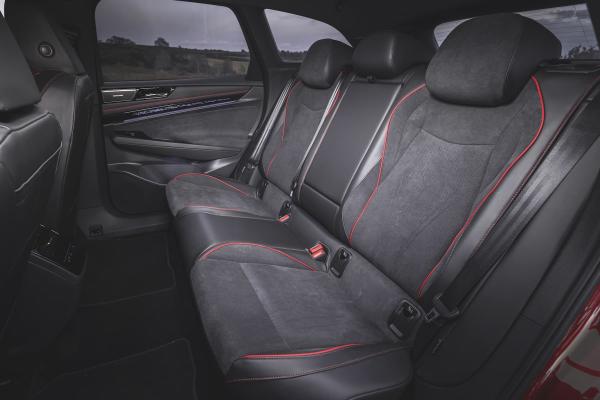
The ID.7 Tourer GTX is certainly spacious. There are acres of rear cabin space for back-seat passengers, and the boot is a useful size. Volkswagen quotes 605 litres with the rear seats up and 1,714 litres with them folded, which is competitive with other large estate cars of any fuel type.
There’s no frunk (front trunk), which is disappointing in such a large electric car. It’s not a deal-breaker, but customers coming from other EVs may expect somewhere separate to store charging cables.
The seats are excellent. They’re bolstered enough to suit the more sporting brief of the GTX, but they’re still comfortable and supportive rather than hard or overdone. We didn’t have the car for long enough to make a firm judgement on a full day behind the wheel, but they certainly feel like they’d be comfortable on a long trip.
Volkswagen has also got the driver information displays mostly right. Instead of a large, overcomplicated screen in front of the steering wheel, there’s a small speed display with clear numbers. In practice, that works well because it shows the information you actually need rather than filling the display with tiny characters that are difficult to read on the move.
The head-up display is excellent. Its augmented reality navigation graphics are genuinely useful, and the best part is that it also works with Apple CarPlay and Android Auto. Many systems only work properly with the car’s built-in navigation, so this is a welcome bit of technology that actually helps the driver.
Unfortunately, the cabin also contains several examples of technology making things worse. The touch controls on the steering wheel are poor, and Volkswagen has already started replacing similar controls with proper buttons on newer and updated models. The same change can’t come soon enough for the ID.7.
The touch-sensitive door handles, inside and out, are another annoyance. They don’t feel as solid or reassuring as proper manual door handles, and there’s no real benefit for the customer. It feels like technology for the sake of technology, rather than addressing a genuine customer need.
The same applies to the window controls on the driver’s armrest. There are no separate switches for the rear windows, so you have to press another button and then use the front window switches to operate the rear ones. It’s ridiculous cost-cutting, and it makes the car more irritating to use every day.
The worst offender is the touchscreen-controlled air vents, although Volkswagen is not the only car company to succumb to this madness. If you’re driving at motorway speed and want to redirect the airflow, you should be able to grab the vent and move it by hand. In the ID.7, you have to go into the touchscreen, find the climate menu, open the page for the air vents, draw where you want the air to go, then exit back out again. It’s an awful system, and one of the clearest examples of car makers forcing basic controls through a touchscreen in a way that makes the car worse.
Other minor irritants in the cabin include a lack of a start/stop button, flimsy-feeling column stalks and no obvious way to adjust brake regeneration on the move. None of these are deal-breakers, but combined with the other issues above, they add to a sense that Volkswagen can and should do better with its flagship EV model.

Driving range and charging
The ID.7 Tourer GTX Plus has an official battery range of 357 miles from its 86kWh battery. Other models in the ID.7 Tourer line-up offer a smaller 77kWh battery, but the GTX only gets the larger one.
The battery can charge at up to 200kW from a public rapid charger, with a 10-80% charge taking just under half an hour in ideal conditions. All ID.7s now come with a heat pump as standard, which should help efficiency in colder weather.
We didn’t have the car for long enough to judge real-world efficiency properly. The ID.7 Tourer’s shape should help compared with a similarly sized SUV, and the range figure is useful, but the GTX’s extra motor, extra performance and large wheels mean it won’t be the most efficient version in the range.
There also appear to be no simple regeneration controls, at least none that were obvious during our short time with the car. Every EV should have paddles behind the steering wheel so the driver can easily increase or reduce regenerative braking without diving through menus.
On the road
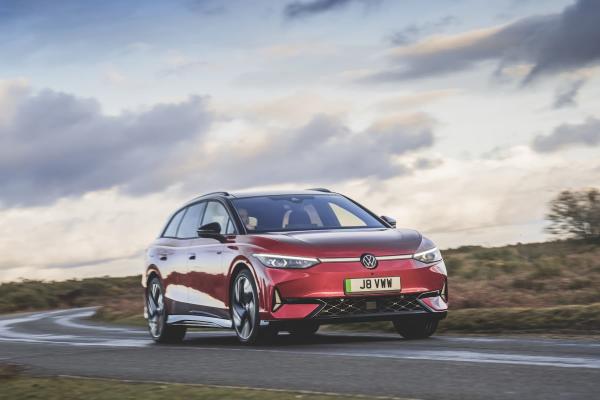
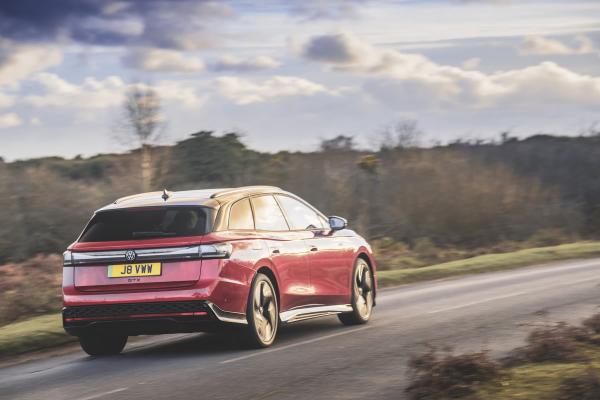
The Volkswagen ID.7 Tourer GTX is very smooth and refined, as you’d expect from a large EV. The ride quality is good overall, although road noise is higher than expected. That’s probably related to our car’s optional 21-inch wheels and tyres, which look great but will inevitably be noisier than the standard 20-inch tyres, or the smaller and narrower tyres on lower-spec ID.7 models.
It feels like a car designed for long journeys rather than short bursts of excitement. The suspension is comfortable, the cabin is calm and the performance is more than strong enough for normal driving. Despite the GTX badge, it doesn’t feel especially sporty.
As with many powerful EVs, we spent most of the time in Eco mode. That gives a smoother throttle response and makes the car easier to drive around town. Normal and Sport modes feel too sensitive in urban driving, although they make more sense once the road opens up.
The GTX is quick, but it doesn’t feel playful or especially engaging. It’s more of a sheep in wolf’s clothing: plenty fast enough, and certainly more powerful than most buyers will ever need, but not really a sports estate in the way the badge and styling might suggest.
That isn’t necessarily a problem. A comfortable, refined, long-range electric estate is a more useful thing for most customers than a heavy EV pretending to be a hot hatch. It’s just a pity that Volkswagen has given it the performance branding without making the car feel especially exciting.
Ownership
The wider Volkswagen ID.7 range currently holds an A-grade rating in The Car Expert’s unique Expert Rating Index, with a New Car Expert Rating score of 76%. It scores well for media reviews, safety and zero tailpipe emissions, while running costs are also rated well. Volkswagen’s warranty cover is only average, which holds the overall result back.
Euro NCAP awarded the Volkswagen ID.7 a five-star safety rating in 2023. That rating applies to ID.7 Tourer versions, including the GTX Tourer, according to Euro NCAP’s variant listing.
Volkswagen’s new car warranty is three years or 60,000 miles, whichever comes first. The high-voltage battery warranty is eight years or 100,000 miles, and the ID.7 Tourer also comes with a 12-year body protection guarantee and three-year paint warranty.
The review score reflects the driving experience. Our Volkswagen ID.7 Expert Rating tells a broader story, combining the subjective opinions of car reviews with objective safety data, running costs, warranty information and more. It’s worth reading both before making any buying decision, especially as the Expert Rating covers the wider ID.7 range rather than only this Tourer GTX version.
Verdict
The Volkswagen ID.7 Tourer GTX left us with very mixed feelings. It does several important things extremely well, including passenger space, comfort, refinement and useful technology like the excellent head-up display.
It’s also refreshing to see Volkswagen building a large electric estate rather than yet another SUV. For family buyers who want space and long-distance comfort without the height and bulk of an SUV, the ID.7 Tourer is exactly the sort of car more manufacturers should be making.
But the ID.7 Tourer GTX also shows the worst side of Volkswagen’s recent ID models. Touch-sensitive door handles, touch-sensitive steering wheel controls, touchscreen-controlled air vents and cost-cut rear window controls all make the car more annoying than it needs to be.
Given a longer time with the car, you’d probably get used to most of its foibles. The problem is that many buyers will only take a short test drive before making a decision, and there’s too much unnecessary irritation during those first few miles.
It feels like Volkswagen decided that an electric powertrain wasn’t futuristic enough, so the rest of the car had to feel futuristic as well. In reality, that risks making EVs feel more complicated and frustrating than petrol or diesel cars, which is the opposite of what Volkswagen should be aiming for.
The ID.7 Tourer GTX is a very good long-distance electric estate with a frustrating cabin. It’s practical, comfortable and refined, but the GTX badge promises more excitement than the car really delivers.
We like:
- Excellent rear-seat space
- Strong boot capacity
- Very comfortable seats
- Excellent head-up display
- Refreshing alternative to yet another SUV
We don’t like:
- Touchscreen-controlled air vents are awful
- Touch-sensitive door handles feel unnecessary
- Touch steering wheel controls need replacing
- Rear window switch arrangement is ridiculous
- GTX badge promises more sportiness than the car delivers
Similar cars
BMW i5 Touring | BYD Seal | Genesis GV60 | Hyundai Ioniq 5 | Kia EV6 | Peugeot E-408 | Polestar 2 | Tesla Model Y | Vauxhall Astra Electric Sports Tourer | Xpeng G6
Key specifications
Model tested: Volkswagen ID.7 Tourer GTX Plus
Price as tested: £62,010
Powertrain: Dual electric motors, all-wheel drive
Gearbox: single-speed automatic
Power: 340hp
Torque: 545Nm
Top speed: 112mph
0-62mph: 5.5 seconds
Battery range: up to 357 miles
CO2 emissions: 0g/km
Euro NCAP safety rating: Five stars (2023)
TCE Expert Rating: A – 76% (as of July 2026)

Related posts




Latest Post


No Comments