
Toyota’s New Woodland Concepts Turn Family Cars Into Adventure Machines
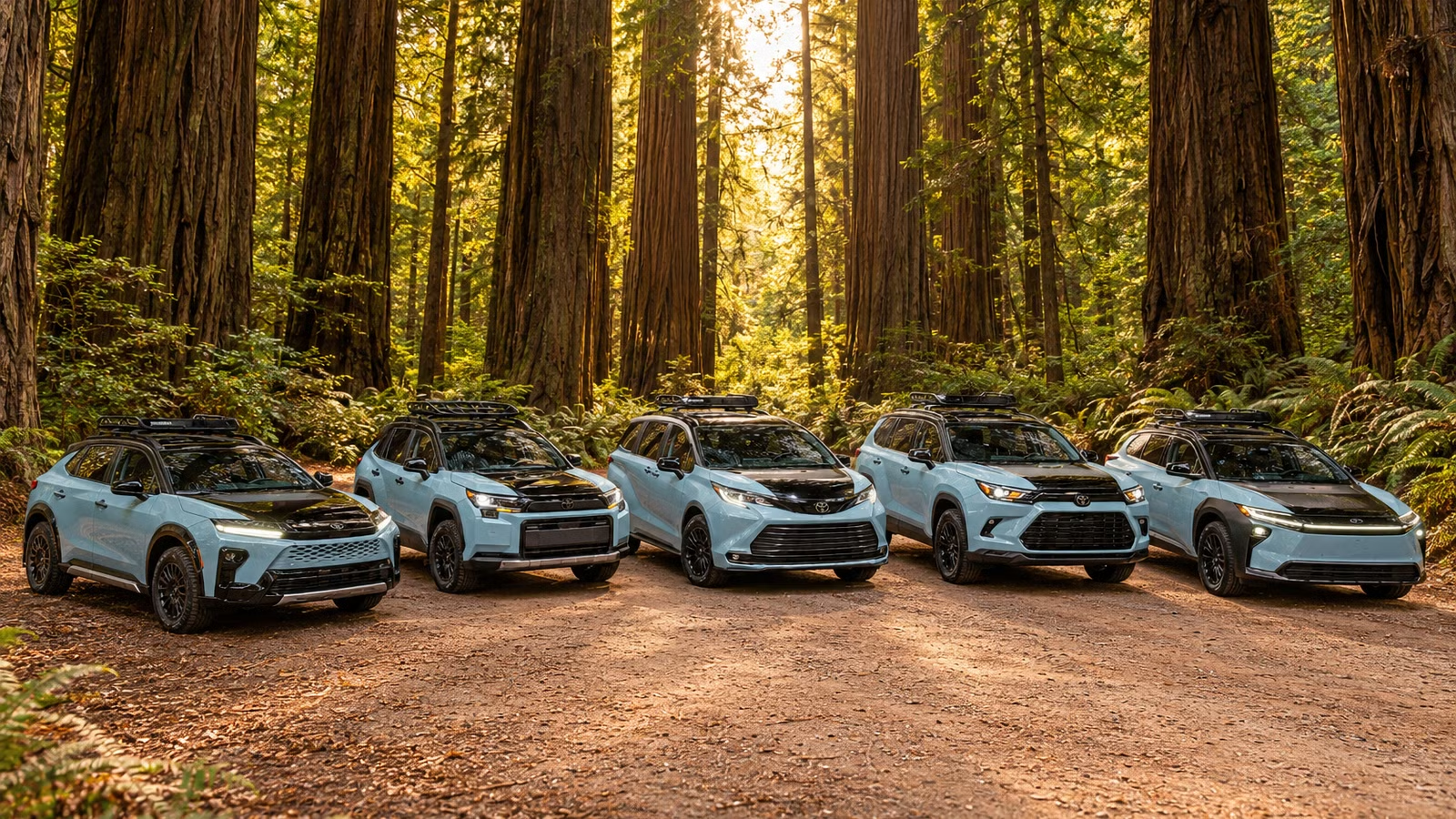
Toyota is bringing five new concept vehicles to the 2026 SEMA Show, and all of them share one idea: everyday vehicles can handle a little more dirt without losing what makes them practical. The Woodland concept family reimagines the RAV4, Sienna, Grand Highlander, bZ, and Crown Signia with lift kits, all-terrain tires, and a unified rugged look, built by Toyota’s CALTY Design Research studio.

Rather than a single off-road special, Toyota is treating this as a design language that can stretch across its whole lineup, from a plug-in hybrid compact SUV to a three-row family hauler to its battery-electric bZ. The message is straightforward: adventure readiness doesn’t have to mean buying a truck.
A Shared Look Across Five Very Different Vehicles

Each Woodland concept wears the same visual signature. Think lift kits, wide over-fenders, satin-black wheels, all-terrain tires, roof racks, and cross bars, all finished with two-tone paint on the roof and hood. Every vehicle in the lineup is painted in Horizon Blue, a color Toyota says pulls from its 1960s palette used on models like the Stout, Crown, and Corona.
That consistency is the point. Toyota wants the Woodland treatment to read as a coherent sub-brand rather than five unrelated show cars, something buyers could recognize whether they’re looking at a minivan or an electric crossover.
Plug-In Hybrid, Hybrid, And Electric Power All Get The Same Treatment
The lineup spans Toyota’s full electrified range. The RAV4 Woodland Plug-in Hybrid Concept and Sienna Woodland Concept show how the brand’s electrified and family-focused models could take on a more adventurous role without sacrificing the usability owners already expect from those nameplates. The Woodland bZ Concept pushes the same design language onto a battery-electric platform, suggesting Toyota sees rugged styling as compatible with its EV push rather than exclusive to gas-powered trucks.
The Grand Highlander Woodland Concept and Crown Signia Woodland Concept round out the group, each offering what Toyota describes as a distinct take on refinement and versatility within the same adventure-ready framework.
Concept Status Comes With The Usual Caveats
These are prototype vehicles built with parts and accessories that Toyota doesn’t sell through its dealer network. That means warranty coverage, vehicle performance, safety, and street legality could all be affected on a production equivalent, and Toyota hasn’t said whether any of this makes it to showrooms.
Still, the breadth of the lineup is notable. Showing the treatment on a plug-in hybrid, a minivan, a three-row SUV, a battery-electric crossover, and a premium sedan all at once suggests this is less a one-off SEMA stunt and more a design exercise Toyota could draw from across multiple vehicle lines going forward.

Related posts


Latest Post


No Comments