
The First American Muscle Car Is Still Trading For Less Than A Used Civic
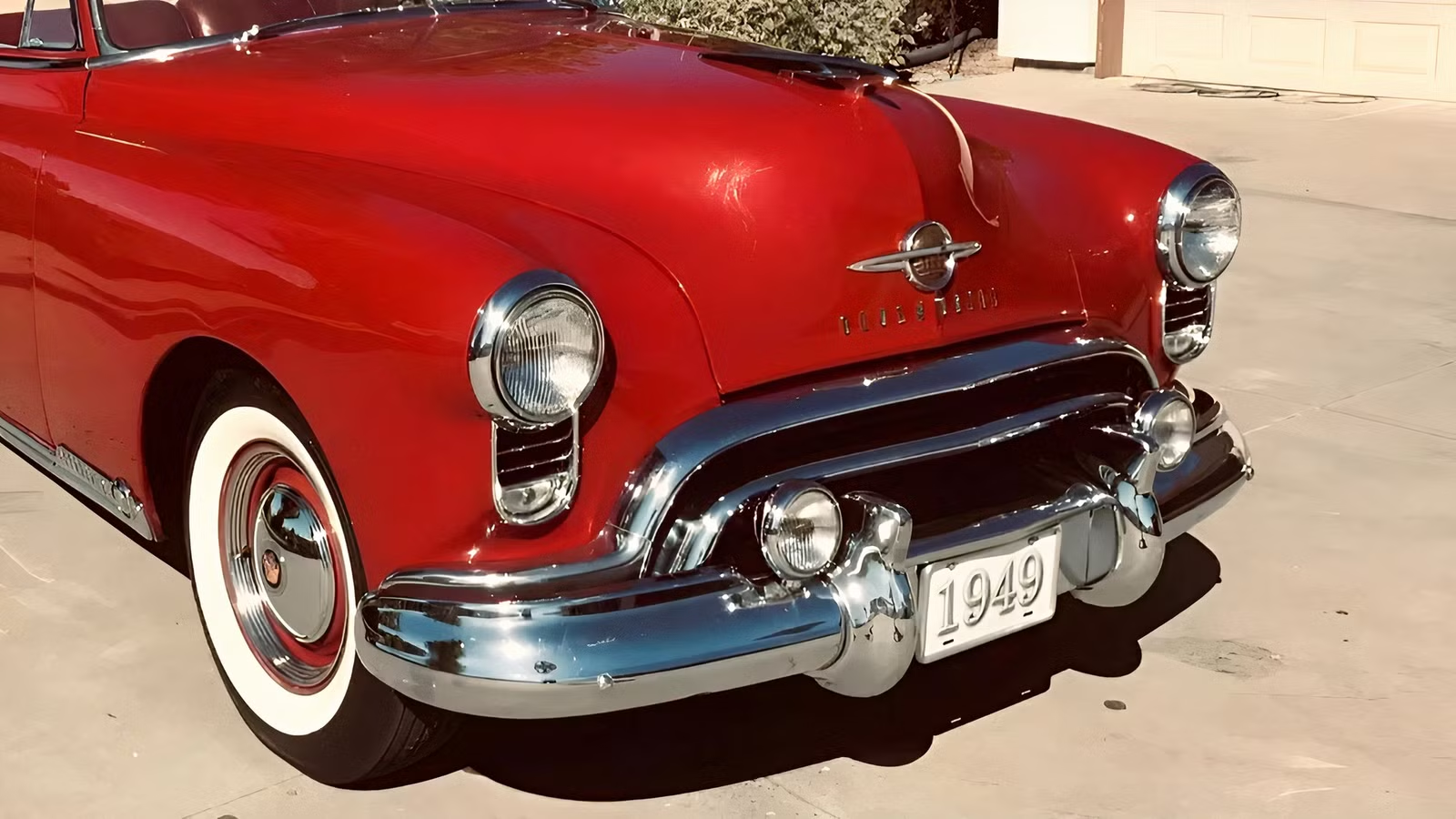
The first muscle car was the 1964 Pontiac GTO. There, we just saved you roughly ten minutes of reading, you’re welcome. Actually, what if that’s not true? What if the entire narrative we’ve been spoon-fed about the first muscle car of the 1960s isn’t actually true? What if the real answer is far more complicated and nuanced than most auto-centric documentaries give it credit for? Well, strap in, because the true first American muscle car, depending on your definition, might not be a Pontiac after all. At the very least, it was still in the GM family.
Oldsmobile After World War II: A Brand Ready to Dominate

If there aren’t any passages in business textbooks about how Oldsmobile set itself up for greatness in the immediate aftermath of World War II, there really ought to be. For four brutal years, the company was forced to halt all civilian automotive production, burdened with producing tens of millions of rounds of ammunition, anti-tank guns, and metal forgings for things like aircraft and tanks. At the end of the war, Oldsmobile was free to return to the civilian market, but it was clear that several years of total war production didn’t give the American auto industry enough time to think about the future.
For the first few years after the war, it was more or less expected that the entire industry would revert to producing pre-war cars while each OEM figured out where to go from there. This led to a handful of newcomers like the Tucker Motor Corporation trying to fill the void with novel cars like the Model 48. The less said about Tucker right now, the better. Research it only if you have a high tolerance for institutional frustration. Meanwhile, Oldsmobile resumed production in October 1945, warming up the entry-level Special Sixty Series and the mid-range Dynamic Seventy Series, both with old-fashioned flathead straight-six and straight-eight engines, plus the C-body Custom Cruiser Ninety-Eight.
For the first two model years after the war, the public at large gave Oldsmobile enough slack to tolerate the automotive equivalent of leftover meatloaf while the company dove headfirst into developing for the 1950s. A novel styling profile, cleverly christened “Futuramic,” was directly inspired by the smooth styling lines and aerodynamic profiles of the early jet age. It was sleek, it was stylish, and when it debuted with the 1948 C body 98, the public at large absolutely adored it. Better still, Oldsmobile had the perfect engine to pair with the new styling, one that made the old straight-eights look antiquated by comparison.

The Rocket V8: A Muscle Car Engine Before the Term Existed

What hasn’t been said about the Oldsmobile Rocket V8 that hasn’t already been said? It was the LS motor when the design team for that program was still in diapers. It was an engine intended to power luxury cruisers, but somehow managed to have the presence of a sports car motor all the while. Most of all, it was the precursor to the muscle car V8, a decade and a half before auto journalist Brock Yates coined the term in 1964.
With its 90-degree deep-skirt iron block, overhead valves, five-bolt main bearing crank, and tolerances for up to 12.5:1 compression ratios with experimental heads, the original 303-cubic-inch Rocket V8 was future-proofed long before that was a common industry term. Even if production compression was closer to 7.25:1, the fact that the block could handle more without failure was nothing short of remarkable for the era. Back when stock car racers used cars that were, in fact, stock, the Rocket 303 was a force to be reckoned with in the discipline we now call the NASCAR Cup Series. Sure enough, early Strictly Stock Division icons like Red Byron, Curtis Turner, and Bob Flock used the Oldsmobile Rocket V8 to great effect in its first year of sanctioned racing. Those ex-moonshiners-turned-pro-racers no doubt appreciated the near-instant low-end torque and 135 hp at the crank of the Rocket V8, leveraging it to win 10 of 19 races in 1950 and claim an overall victory at the Carrera Panamericana.
Old

On the dealership side, the Oldsmobile 98 with its Rocket V8 was the flagship product at Oldsmobile. It was a massive platform, one of the most luxuriously appointed and overbuilt GM products in the fleet that didn’t wear a Cadillac emblem. Put simply, it matched the postwar euphoria of the era perfectly, and it was one of the first aspirational luxury cruisers that newly returned GIs could admire at a dealership and hope to own. The only problem was simple: the 98 was way too big and heavy to ever be all that fun to drive. With that said, Oldsmobile had another platform with an engine bay big enough to accommodate the new rocket motor, and it was considerably smaller and lighter.
The 1949 Oldsmobile 88: The Muscle Car Formula 15 Years Early

The 1949 Oldsmobile 88 is a fascinating piece of automotive history, but not just because it paired a nimble body with reasonable dimensions with an engine powerful enough to make it fun to drive. It was also a prime example of what an OEM can do with limited resources but enough ingenuity and determination to produce something truly remarkable. You see, the 88 didn’t exactly fit into Oldsmobile’s plans at first. Rather, it was fashioned from two existing elements. The first was the Rocket V8 we know and love, and the other was the relatively humdrum entry-level ‘Olds 76 series.
Compared to the rest of the Oldsmobile fleet, the 76 series was decidedly unremarkable, lacking the aspirational feel that defined the rest of the lineup. Sharing internals and an A body platform with the Chevy Fleetline, the 76 series was the third generation in a 70 series lineage stretching back to 1939. It was one of the warmed-up cars carried over from the pre-war years, and sported a similar Futuramic styling update to the rest of the ‘Olds lineup in 1949. Sporting a 257-cubic-inch straight-six engine, it was the only time in history the company offered a hardtop body style with a relatively prestigious nameplate with a six-cylinder motor. The looks and the charm were there, but the engine was seriously lacking.

How do you fix that? If your answer was to discard the straight-six, drop in a Rocket V8, and swap the 76 badge for 88, then you would be exactly right. The result was a car bursting at the seams with power and torque, but without a massive roll-heavy body weighing it down. Suddenly, each of those 135 hp could be fully exploited, unencumbered by excessive weight. The results were zero to 60 in a respectable 12 to 13 seconds and a top speed that almost touched 100 mph. By the standards of the early 1950s, it even handled competently, thanks to coil spring suspension at all four corners. Paired with instant low-end torque, NASCAR drivers who raced 88s simply mashed the throttle, turned the wheel, watched the rear end step out, and countersteered with ease. Of course, with four-wheel manual drum brakes, stopping was utterly terrifying. Still, by the standards of the day, a two-door hardtop Oldsmobile 88 was the closest thing to a BMW M3 you could find. Or, more appropriately, it was a proto muscle car.
Spawning a Lineage That Lasted Decades

The 88 ultimately spawned a lineage that far outlived the Rocket V8 that made it great. By the time the legit first muscle car age came around, the car was back to being the massive luxury cruiser that the 98 it tried to differentiate from was. Through the years, the Rocket V8 grew as large as 455 cubic inches, a substantial 7.5 liters, and maintained its luxurious character even as the EPA and two successive fuel crises brought an end to the first muscle car era. The last Oldsmobile 88 with a Rocket V8 left the production line in the 1985 model year, having ironically shrunk back down to a 307-cubic-inch displacement that nearly matched the 303 cubic inches it started with.
From there, the 88 line went front-wheel drive, and in a cruel twist of fate, adopted 3800-series V6s from Buick as its primary power plant. Few outcomes could be considered a more ironic fate for the nameplate. The last Oldsmobile 88 left the line on January 6, 1999, and the Oldsmobile brand would cease operations entirely in 2004. Through it all, the 88 was the car that shepherded the brand through ups and downs that some carmakers could only dream of. Today, the Gen-I 88, particularly two-door hardtops and coupes, are collector’s items for sure, but not the kind that demand insane money.
In fact, coupe variants routinely fetch as little as $16,000 at public auction, sedans in running order can sell for less than $5,000, and convertibles can be had for just over $30,000. That is far short of Pontiac GTO money, and one can only assume the proto-muscle-car title does not carry as much cachet as the acknowledged article. Of course, that assumes you don’t consider the original 88 a muscle car, and there are surely plenty of enthusiasts of a certain age who would debate that point vigorously. Highly restored woody wagon variants have sold for figures approaching six digits, but they represent a different collector category entirely.
Source: Hagerty, General Motors

Related posts
Latest Post


No Comments