
This Cheap Parallel-Twin Is Embarrassingly Good At Everything
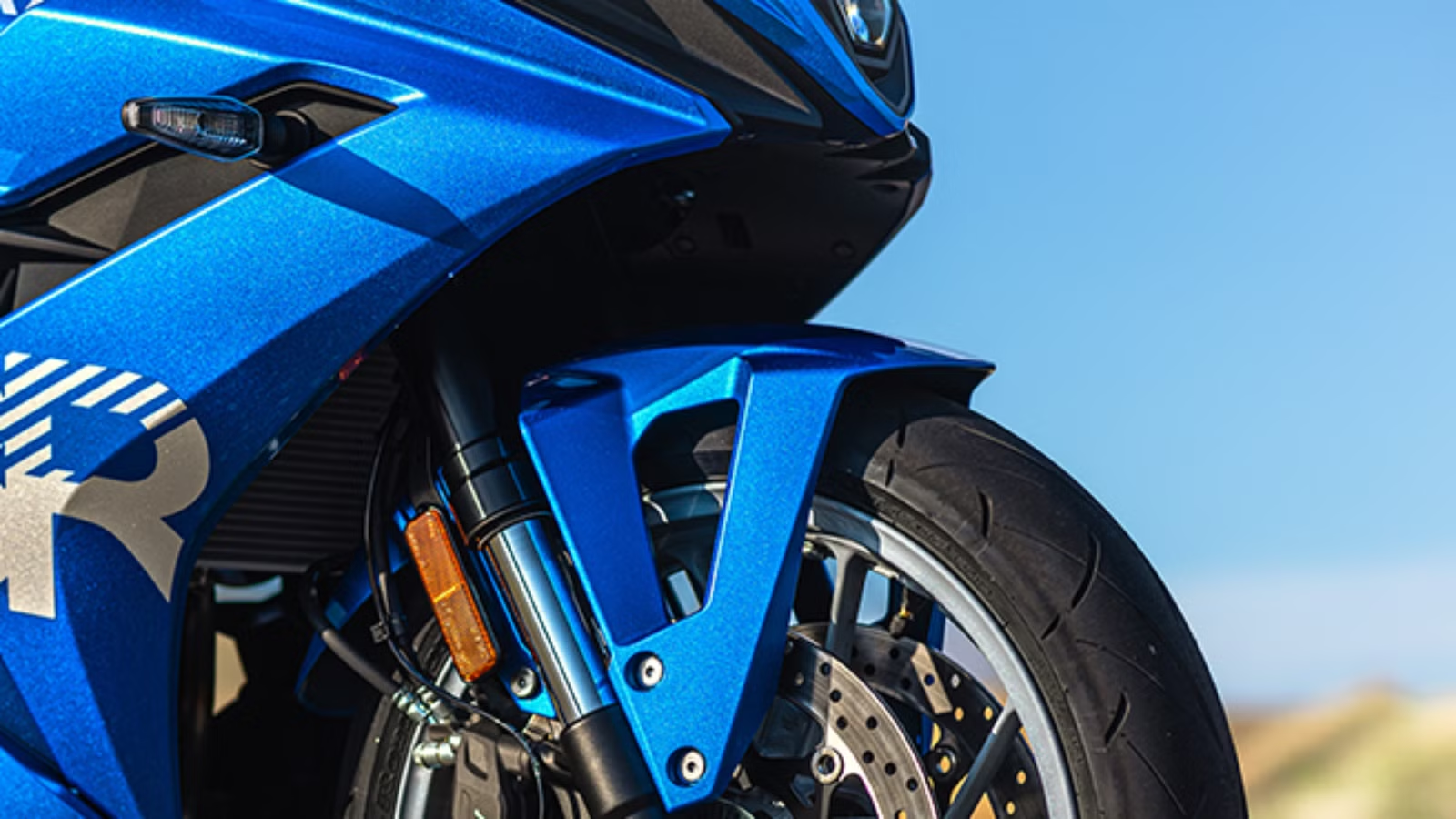
The middleweight sportbike class has swapped its 600cc inline-fours for 270-degree parallel twins that sell for less than $10,000. Four of the segment’s core models now sit within $500 of each other, between $9,199 and $9,699. One manufacturer pushed the shared-platform logic further than anyone else, building eight separate model lines around a single 776cc twin.

The faired version of that platform costs under $9,700 and was homologated for national championship racing within months of launch. The rest of the class spent 2026 cutting prices and adding electronics to defend the same buyer.
The Middleweight Class Abandoned The Inline-Four
A 270-degree-crank parallel twin in a steel frame, priced under $10,000, is now the default recipe for a middleweight sportbike. That crank layout produces a firing interval close to a 90-degree V-twin, pushing peak torque lower in the rev range. It also lets one engine cover an entire model range.

Yamaha demonstrated the economics first by running one CP2 twin through the MT-07, XSR700, Ténéré 700 and YZF-R7. Honda followed with a shared twin in the Transalp and CB750 Hornet.
Kawasaki’s Ninja 650 opens the 2026 class at $7,599 without ABS and $8,199 with it, ahead of the Honda CBR650R at $9,199, the Triumph Daytona 660 at $9,395 and the Yamaha YZF-R7 at $9,399. Aprilia’s RS 660 sits clear of everything at $11,749.

Honda cut the CBR650R by $700 for 2026 and made its E-Clutch system standard, which leaves it the cheapest inline-four sportbike on sale. Every other bike in that price band runs two or three cylinders.
Suzuki still lists the GSX-R600 at $12,199 and the GSX-R750 at $13,249 for 2026, and neither has received a meaningful mechanical update in over a decade. Both cost thousands more than the twins now filling the same showroom space.
Roughly $2,100 separates the cheapest Japanese option from the most expensive European one, so price alone settles very little. The more useful measure is how many jobs each bike covers for the money, and Suzuki built its entire middleweight range around that idea.
Suzuki’s 776cc Parallel-Twin Powers Eight Different Motorcycles

Suzuki’s GSX-8R carries a 2026 MSRP of $9,699, with a $700 destination charge on top. The engine at the center of it is a 776cc liquid-cooled DOHC parallel twin with an 84.0 mm x 70.0 mm bore and stroke, a 12.8:1 compression ratio and a 270-degree firing order.
Suzuki’s Cross Balancer sits inside that engine, a patented system making its first appearance on a production motorcycle. It exists to keep the package compact and light while smoothing out the vibration a parallel twin generates.

Claimed output is 82.9 PS at 8,500 rpm and 78 Nm at 6,800 rpm, which converts to roughly 82 hp and 57.5 lb-ft. In the US, Suzuki doesn’t publish the power output at all.
Cycle World put a 2024 model on its in-house Dynojet 250i and recorded 72.75 hp at 8,120 rpm and 51.73 lb-ft at 6,630 rpm at the rear wheel. The same dyno read 74 hp and 52.3 lb-ft from the 2023 GSX-8S, and 72.2 hp and 50.2 lb-ft from the 2023 V-Strom 800DE, with all three curves running nearly identically.

Eight 2026 models share this engine: the GSX-8R, the GSX-8S at $9,249, the GSX-8T at $10,649, the GSX-8TT at $11,149, the V-Strom 800, the V-Strom 800DE, the SV-7GX and the SV-7GXV. That covers a sportbike, a naked, two retros, two adventure bikes and two crossovers.
None of those applications required a fundamentally different tune, which is the clearest evidence of how flexible the engine is. A motor that works in a road-focused sportbike and a spoked-wheel adventure bike is doing more jobs than most engines are asked to handle.

Fueling runs through two 42mm throttle bodies and a ride-by-wire system managed by a 32-bit dual-processor ECM. A CAN-bus harness ties the sensors together.
Showa Suspension And Nissin Brakes Belong On More Expensive Motorcycles

A Showa SFF-BP inverted fork handles the front, with 41mm inner tubes and 5.1 inches of travel. The 8R uses a 37mm fork piston, 17mm larger than the one in the GSX-8S.
That fork is not adjustable, and the Showa link-type monoshock at the rear offers preload adjustment only. Both are omissions that keep the price down.
Braking comes from Nissin radial-mount four-piston calipers on twin 310mm front discs, with a single-piston caliper on a 240mm rear disc. ABS is standard at both ends. Dunlop Roadsport 2 tires are fitted in 120/70ZR17 and 180/55ZR17 sizes.

The frame is a steel backbone design with a bolt-on steel subframe and an aluminum swingarm, all carried over from the GSX-8S. The faired model changed the suspension and handlebars rather than the chassis underneath.
Standard electronics cover a five-inch full-color TFT display, a three-mode drive mode selector, four-mode traction control, a bidirectional quickshifter, the SCAS slipper and assist clutch, Easy Start and Low RPM Assist. The traction control runs three intervention levels plus an off setting, and each drive mode alters power delivery without capping peak output. Full LED lighting includes stacked hexagonal headlights.

There is no IMU, no cornering ABS, no cruise control and no smartphone connectivity. Those omissions matter more in 2026 than they did at launch.
Curb weight is 452 lbs, with a 31.9-inch seat height, a 57.7-inch wheelbase, 5.7 inches of ground clearance and a 3.7-gallon tank. Warranty coverage runs 12 months with unlimited mileage.

Suzuki quotes 67.23 mpg on the WMTC cycle, and independent road tests have landed well short of it. Against a 3.7-gallon tank, realistic range lands somewhere between 125 and 200 miles.
But It Is Not The Cheapest Bike In Its Class

The GSX-8R launched at $9,439 for 2024, moved to $9,669 for 2025 and sits at $9,699 for 2026. That is a $260 increase across three model years, and none of them brought a mechanical change.
Both the 2025 and 2026 updates were paint and graphics. Suzuki has left the engine, frame, suspension and electronics untouched since launch. The 2026 colors are Metallic Triton Blue, Pearl Tech White and Glass Blaze Orange.
Against Suzuki’s own GSX-8S at $9,249, the 8R asks a $450 premium. That buys a wind-tunnel-developed fairing, Showa suspension in place of the 8S’s KYB units, and forged aluminum clip-ons. It is also the cheapest route into a faired Suzuki sportbike by a wide margin.

Yamaha’s 2026 YZF-R7 undercuts it by $300 at $9,399, and it arrived with the platform’s first major overhaul since 2021. The package now includes ride-by-wire, a six-axis IMU, cornering ABS, cornering traction control, slide control, wheelie control, launch control, cruise control, a five-inch TFT, a revised frame and spin-forged wheels.
The R7’s claimed 73 to 74 hp at 8,750 rpm and 50 lb-ft at 6,500 rpm both fall short of the Suzuki’s figures, and the 8R has 87cc more displacement plus roughly 1.7 lb-ft more measured torque. The trade is mass, a claimed 36 lbs heavier than the R7 with a full tank.
The $700 destination charge pushes the real number close to $10,400 before tax and dealer fees. Sub-$10,000 pricing describes the sticker rather than the check.
It Won A National Championship Race In Its Second Weekend

MotoAmerica homologated the GSX-8R and GSX-8S for its Twins Cup class ahead of the 2024 season, replacing the SV650 that had defined the category since Chris Parrish won the inaugural title in 2018.
Rocco Landers took pole and the GSX-8R’s first Twins Cup win at Road Atlanta in April 2024, in only the bike’s second race weekend of competition. Wet conditions on Sunday kept him from doubling up, and he finished eighth in race two.
Suzuki Italy built a single-make GSX-8R Cup into the CIV championship for 2025, running five rounds, and Michel Agazzi clinched the inaugural title at Modena. His prize was a wild card entry into the Twins Cup season opener at Daytona in March 2026.
A $9,699 road bike that has not changed mechanically since launch is now competitive in national championship racing on two continents. Very few motorcycles at any price can make that claim.
Sources: Suzuki, Cycle World

Related posts

Latest Post


No Comments