
The Toyota Family Hauler Quietly Outselling Its Previous Year… And It’s Not The Highlander Twins
Toyota is already a major automaker in the United States, so any growth in the brand will be impressive. As of the end of September, Toyota had sold 1,613,846 vehicles, a 1.2 percent increase from the same nine-month period last year.

Leading the charge for Toyota’s continued growth are its hybrid models. We’ve previously reported on how hybrid vehicles have become a driver of growth for any brand in the United States, especially with high gas prices. Toyota has the most diverse hybrid lineup in the United States, so it’s unsurprising that it’s the most popular hybrid brand as well.
That popularity isn’t just limited to its SUVs, mind you. As new car prices rise, Toyota’s hybrid sedans are also fueling the comeback of sedans in general. But perhaps the most surprising of all is this hybrid family hauler that usually doesn’t receive much attention but has lately been a growth driver for Toyota.
Right Cars At The Right Time

High fuel prices have fueled hybrid demand in the United States, and the technology that was supposed to be just a stopgap solution is now the fastest-growing drivetrain type.
Going All-In On Hybrids Paid Off

Toyota’s recent redesigns have seen its newest models ditch the pure internal combustion engine (ICE) variants altogether. It may alienate those who simply want an ICE car without electrification, mostly out of fear of ownership complications down the line, but the magic of Toyota’s hybrids is that they’re already proven to last long and be just as easy, if not easier, to maintain than pure ICE cars.
Take a look at the Camry. This is one model that has ditched the pure ICE variant, and yet its sales have only grown ever since. The new RAV4 also went all hybrid, but that model is so popular, its wait list can rival the demand of a high-end supercar. Don’t want a Toyota? A sporty Honda hybrid alternative is also available, and even that is selling extremely well. Hybrids have become a here-and-now technology, and if your lineup doesn’t have a hybrid, then you’re severely missing out.
The Toyota Sienna Is Growing Nearly Twice As Fast As The Highlander It Replaced In Family Garages

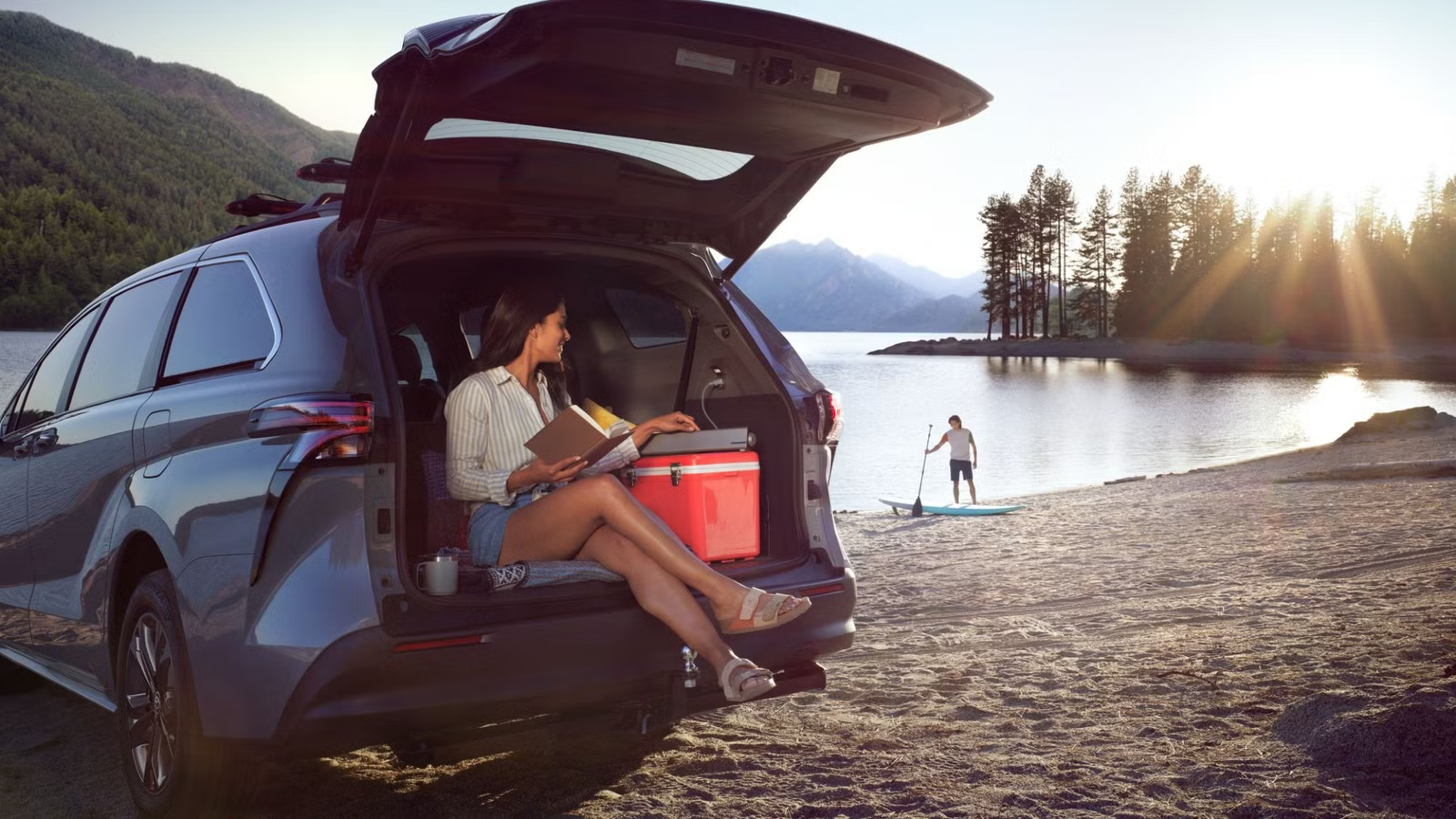
While we’re raving about hybrid sales growth, there’s a nameplate that has been lurking in the shadows of SUVs that has seen surprising sales growth. That model is none other than the Toyota Sienna.
11.7 Percent Sales Growth

As of the end of September, Sienna sales stood at 84,770 units, which represents an 11.7 percent sales growth versus the same nine-month period last year. Though this is not the fastest-growing nameplate among its hybrid family, it is one of the fastest-growing nameplates in general. As a nameplate, it has already outsold the Toyota Highlander by nearly twice as much. 42,950 units of this midsize SUV have been sold, which is almost unchanged from the year prior. Production of this SUV is scheduled to end in December as its fully electric successor hits the market in 2027 for the 2028 model year.
The Sienna’s sales growth is reflected in the ongoing resurgence of the minivan segment. The Chrysler Pacifica continues to be the segment’s bestseller with 97,999 units sold (including Voyager sales). The Sienna is in second, while the Honda Odyssey is in third place with 65,986 units sold.
Among the five bestselling minivans, the Odyssey is one of two models that have seen a decline, though its seven percent decline means that its standard 3.5-liter V-6 engine is still proving to be good enough for a good chunk of buyers. Meanwhile, the Kia Carnival also has a hybrid, which has helped fuel its 20.2 percent sales growth. Rounding out the top five is the fully electric Volkswagen ID.Buzz, which has flopped spectacularly with just 2,913 units sold—a 40 percent decline from last year.
The Sienna Offers More Space Than The Grand Highlander For Less Money — And It’s Hybrid-Standard


The 2026 Toyota Sienna starts at $41,320, which is a bit less than the Grand Highlander’s base price despite being the more spacious vehicle. At most, the Sienna offers a whopping 195.9 cubic feet of total interior volume versus the Grand Highlander’s still impressive 153.3 cubic feet. Oh, and the hybrid version of the Grand Highlander costs more than the non-hybrid version, too.
But of course, the standard 2.5-liter fourth-generation Toyota Hybrid System (THS IV) powering the Sienna is also helping its appeal. The overall minivan segment has been growing over the past nine months of 2026, and while the Chrysler Pacifica continues to be the segment’s bestseller, the Sienna is perhaps only held back by less inventory.
Toyota is great at keeping inventory in check, but that also means when demand suddenly rises, a wait list often forms. Such was the case last year, when some dealers even resorted to markups, according to Wards Auto. Still, Toyota is keen to narrow that gap, as they are offering attractive lease deals that are even more competitive than what Chrysler is offering, as reported by our sister site CarBuzz.
Why Minivans Are Resurging

To understand why the minivan segment is experiencing a resurgence, we have to take a look at what market forces are influencing these decisions.
High SUV Demand, High Prices

Why are minivan sales rising? Well, simple. They’re more affordable than the equivalent SUV. As mentioned, the Sienna and its standard hybrid powertrain starts at $41,320, whilean equivalent Grand Highlander starts at $42,260 or an even higher $45,610. In fact, the SUV segment in general is the major contributor to the rise in average transaction prices. Kelley Blue Book’s latest report says that average new car transaction prices as of September 2026 stood at $50,562, the second all-time highest on record.
This is fueled by the midsize SUV’s average price of $50,630 (+2 percent), the full-size pickup’s average price of $67,573 (+1.5 percent), and the subcompact SUV at $31,213 (+1.5 percent). Unfortunately, the shift toward more affordable vehicles is also making the compact car more expensive, with the average price now sitting at $27,977 (+3.2 percent).
With three-row SUV prices still on the rise, the minivan segment is now starting to become appealing to families. This is reflected in Cox Automotive’s most recent June 2026 data for the average transaction price in each segment. The minivan segment’s average transaction price is $48,908, while the midsize SUV’s average transaction price is $49,792.
Minivans Were Only Unpopular For Their Image

An ad for a minivan tends to focus on family and quality time, while an ad for an SUV often showcases the vehicle being driven over mud and rocks, as a well-dressed, active family steps out of the vehicle and evokes a lifestyle of excitement while camping in the woods. Families who bought a minivan because it’s cheaper than an equivalent three-row midsize SUV are now realizing the value of their purchase.
Automatic sliding doors eliminate the risk of children swinging the doors and hitting the neighboring vehicle, and if all you want is a lounge-like interior with a pair of captain’s chairs and a footrest, a minivan is the best and sometimes the only option. Just a few swipes through TikTok about minivan life will have you thinking that a minivan isn’t as uncool as you initially thought.
Sources: Toyota, Cox Auto, KBB, Ward’s Auto

Related posts





Latest Post


No Comments