
The Touring Bike That Owners Never Stop Talking About
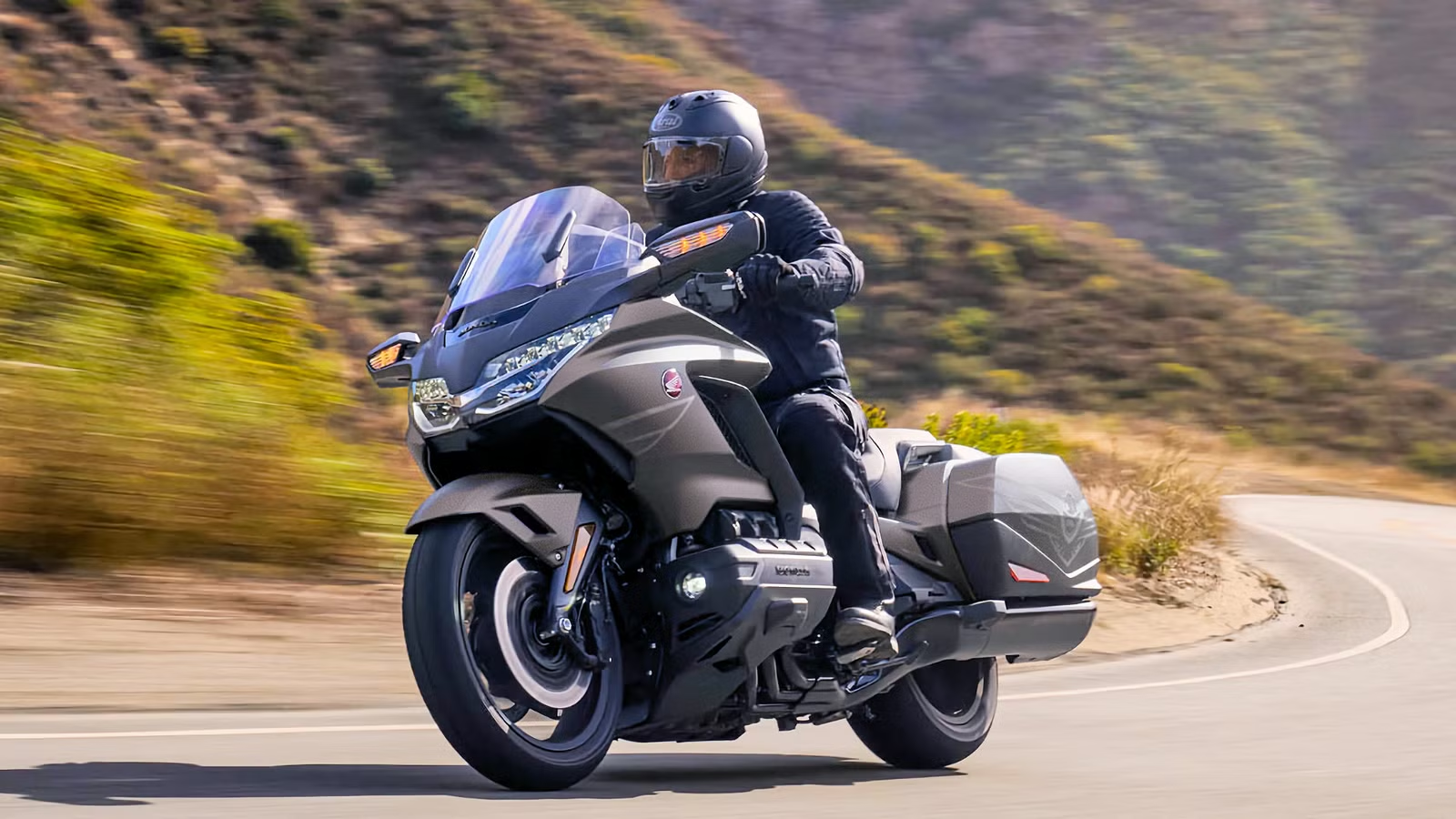
Some motorcycles are bought, ridden, and eventually replaced. Others become part of a rider’s identity, remembered not just for what they do but for how they make every mile feel. The best touring bikes belong to that second category. They are machines that create stories, carry memories, and inspire a level of loyalty that goes far beyond any brand preference.

For many riders, that relationship lasts so long the motorcycle stops feeling like a purchase and starts feeling like a lifelong companion. That’s the essence of long-distance touring, and one Japanese motorcycle has spent decades proving exactly why owners never seem to let it go.
Why The Best Touring Bikes Inspire Lifelong Loyalty
In the world of two-wheels, brand loyalty can be fierce, but the devotion found in the touring community is almost unmatched. The best touring motorcycles are rarely judged by performance figures alone. Their true value only becomes apparent after hundreds of miles in the saddle, when rider fatigue, weather conditions, luggage capacity, and engine refinement matter far more than anything else. These are motorcycles built to make the journey itself enjoyable, regardless of how far the destination may be.


Unlike many other segments, touring motorcycles are long-term investments. When a rider invests in a flagship touring machine, they are committing to a lifestyle built around exploration. Owners often spend years traveling on the same machine, covering tens of thousands of miles. The best touring bikes become trustworthy companions. They earn their reputation by consistently delivering stress-free journeys and naturally become difficult to replace.
Flagship Touring Motorcycles Become More Than Just A Way To Travel

The finest luxury tourers eventually transform how a rider perceives distance. They become trusted companions for life’s biggest adventures, whether that’s a cross-country road-trip or countless weekend escapes. Riders begin associating memories with the motorcycle itself, creating an emotional attachment that few others can replicate. That emotional connection is why flagship touring motorcycles often develop loyal owner communities.
When a motorcycle consistently delivers calm, control, and convenience over thousands of miles, it stops being ‘the bike in the garage’ and becomes ‘the bike that defines the garage’. So what does it actually take to earn that kind of devotion — and has any motorcycle truly cracked it?
The Honda Gold Wing Has Earned A Reputation Few Motorcycles Can Match
Five Decades of Refinement, Two Models, One Philosophy

The motorcycle in context is Honda’s legendary Gold Wing that has spent decades defining what luxury touring should feel like. Since its debut in 1975, the Japanese manufacturer has continuously refined this platform instead of reinventing it, resulting in one of the longest-running and most respected nameplates in the motorcycling world. It has become the undisputed king of interstate travel, celebrated globally for its engineering excellence and loyal owner community.

For 2026, Honda offers two primary versions of the Gold Wing in the US market – the standard Gold Wing, with prices starting at $25,500, and the more comprehensively equipped Gold Wing Tour starting at $29,500, before destination charges. Although both motorcycles share the same engine, chassis, and Honda’s premium Japanese engineering, the Tour is designed for riders who regularly travel with a pillion and substantial luggage, and also gets more features for the added cost.
Six-Cylinder Refinement Unlike Anything Else On The Road

At the heart of the Gold Wing’s legendary status is its 1,833cc liquid-cooled horizontally opposed six-cylinder engine. Pushing out 125 horsepower at 5,500 RPM and 125.4 pound-feet of torque at 4,500 RPM, this flat-six powerplant produces linear power from low RPMs, making highway overtakes almost effortless even when carrying a passenger and fully loaded luggage. Moreover, the Gold Wing’s exceptional vibration-free smoothness and relaxed character suit its long-distance riding aspirations.
For transmission duties, riders can choose between a crisp six-speed manual gearbox or Honda’s renowned seven-speed automatic Dual Clutch Transmission (DCT). The DCT version is more appealing as it removes the burden of constant gear shifting without diluting the touring experience.

Also, the transmission’s Walking Mode makes maneuvering this hefty 800-pound+ touring motorcycle far less intimidating, especially in tight parking situations. That combination of refinement and convenience is a big reason the Gold Wing has carved such a unique status in motorcycling.
Designed To Make Cross-Country Travel Feel Effortless

The Gold Wing’s greatest strength isn’t simply its engine. In fact, it is the way every major component works together to reduce rider fatigue over long distances. Its upright ergonomics provide a naturally relaxed riding position, while the broad, supportive seat with a low seat height of 29.3 inches allows riders to spend hours in the saddle. Wind protection is equally impressive thanks to Honda’s electrically adjustable windscreen, allowing riders to quickly adapt airflow for changing temperatures or highway speeds.
Suspension duties are handled by Honda’s advanced double wishbone setup at the front that separates steering forces from suspension movement, reducing front-end dive during braking while improving stability. Combined with the Pro-Link rear suspension, it remains remarkably composed despite its substantial size.

Braking performance is equally confidence-inspiring, with dual 320mm front discs and a single 316mm disc at the rear, with dual-channel ABS. The Gold Wing’s long-distance capability also benefits from its 5.5-gallon fuel tank combined with impressive fuel efficiency, which gives it an impressive touring range between fill-ups.
Luxury Features Create An Experience Rather Than Just A Ride

Stepping into the cockpit of the Gold Wing is akin to sitting in the cabin of a luxury car, thanks to a vibrant seven-inch full-color TFT display that integrates full Apple CarPlay and Android Auto connectivity, allowing seamless access to navigation, music playlists, and communication.
Other highlights include integrated built-in speakers, Honda’s Smart Key keyless ignition, heated grips, and even heated seats (on the Tour model). Further enhancing convenience and safety are Electronic Cruise Control, Hill Start Assist, and Honda Selectable Torque Control, all offered as standard, along with four riding modes: Tour, Sport, Rain, and Econ.
Why The Honda Gold Wing Has Built One Of Motorcycling’s Most Loyal Followings
The luxury touring segment may not be the largest in terms of number of players, but it is certainly one of the most competitive. The Honda Gold Wing shares the space with impressive alternatives like the BMW K 1600 GTL, BMW K 1600 Grand America, Harley-Davidson Road Glide Limited, and Indian Roadmaster. Each offers its own strengths, whether it’s distinctive styling, V-twin character, or premium touring amenities.
The Gold Wing has earned a kind of devotion that few motorcycles can match because it does exactly what a serious touring bike should do. While rivals like the BMW K 1600 family, Harley-Davidson Road Glide Limited, and Indian Roadmaster all bring their own character to the luxury touring class, Honda leans hardest into refinement, smoothness, and user-friendly convenience.

The BMWs often appeal with sharper performance and a more sporting edge, while Harley and Indian tend to trade on style and American touring tradition. The Gold Wing, however, keeps winning riders over with its simplicity, and that is what creates long-term loyalty for this Japanese tourer.
Source: Honda

Related posts

Latest Post


No Comments