
The Sports Car With BMW Straight-Six Power And Toyota Longevity
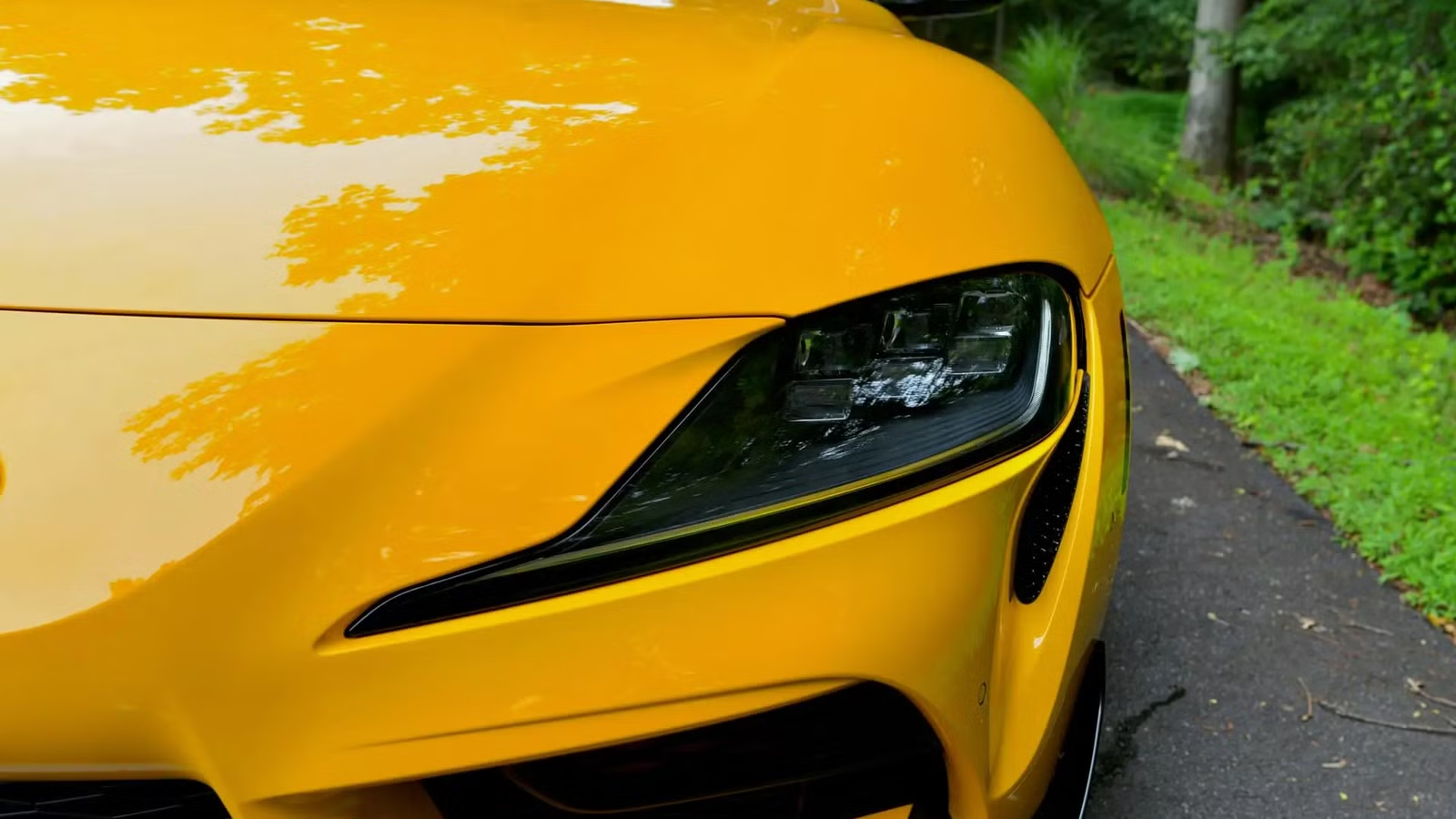
A modern sports car can borrow its most important mechanical component from another manufacturer and still raise a harder question: whose engineering philosophy ultimately defines the car? The issue becomes especially interesting when the borrowed hardware comes from a company associated with performance, while the finished vehicle carries a badge associated with long-term durability. Reviving a dormant sports-car nameplate under those circumstances was always going to invite scrutiny. The engine could deliver the required performance, but the real test was whether the manufacturer could make shared hardware serve its own expectations for driving character, durability, and ownership. The real test was whether the manufacturer could make shared hardware serve its own expectations for driving character, durability, and ownership.
The Modern Sports Car Had A Problem Toyota Couldn’t Ignore

Modern rear-wheel-drive sports cars are difficult to justify as standalone engineering programs. They require extensive work in crash structures, electronics, suspension, steering, body engineering and powertrain integration, yet their sales volumes are usually far below those of mainstream vehicles. Developing every major component internally can make the economics of a low-volume performance car increasingly difficult.
The technical requirements had become more demanding, too. A contemporary sports car had to satisfy modern safety and emissions standards while offering the refinement and electronic sophistication expected from a new vehicle. The old formula of combining a powerful engine with a relatively simple rear-drive chassis was no longer enough. Sharing development work offered a way to distribute some of those costs without abandoning the sports-car formula.
There was also a legacy problem. The dormant performance nameplate had been absent from the market since 2002, leaving expectations built around a front-engine, rear-wheel-drive layout and six-cylinder power. Bringing it back meant satisfying those expectations while working within the realities of modern sports-car development.

One German Powertrain Offered An Unusual Solution

A formal agreement reached in 2013 established joint development of architecture and components for a mid-size sports vehicle. The arrangement allowed the companies involved to share development work while retaining the freedom to create vehicles with distinct identities. For the Japanese manufacturer, access to an established rear-wheel-drive performance foundation avoided the need to develop every major component independently.
The resulting powertrain brought together the characteristics required by the new sports car: a longitudinally mounted turbocharged inline-six, direct injection and substantial torque. Using an established engine also meant the project did not have to begin with a clean-sheet powertrain designed specifically for a relatively low-volume application.
The compromise was unavoidable. Borrowing the hardware would inevitably raise questions among enthusiasts familiar with the nameplate’s earlier generations. The more important question was what happened after the hardware had been selected.
The Toyota GR Supra Put BMW Power To A Different Test

The fifth-generation Toyota GR Supra arrived for the 2020 model year with BMW’s B58 3.0-liter turbocharged inline-six. In its original U.S. specification, it produced 335 horsepower and 365 lb-ft of torque, sent to the rear wheels through an eight-speed automatic transmission. Toyota quoted a 4.1-second 0–60 mph time, giving the revived sports car the performance expected of a modern flagship.
The relationship extended beyond the engine. The Supra and BMW Z4 emerged from the same broader collaboration and were assembled at Magna Steyr in Austria. The shared mechanical foundation quickly became the center of enthusiast criticism, with the BMW connection often overshadowing the question of what Toyota had actually engineered.
Toyota’s development targets provide a more useful way to assess the finished car. The company specified a 2,470-mm wheelbase, a 1.55 wheelbase-to-track ratio, a low center of gravity and an ideal 50:50 front-to-rear weight distribution. Those targets formed part of the car’s own development brief rather than simply being consequences of adopting another manufacturer’s components.
Toyota Had More To Change Than The Badge

The chassis is where the division of responsibility becomes tangible. The Supra used double-joint MacPherson struts at the front and a five-arm multilink rear suspension, while the body structure and suspension mounting points were developed around the rigidity and response required for the intended handling balance. The hardware was not simply dropped into an existing shell and left untouched.
Packaging was equally deliberate. The short wheelbase, wide track and low center of gravity were treated as fundamental elements of the car rather than incidental dimensions inherited from the shared architecture. The resulting proportions were intended to produce a particular balance between agility and stability.

Development extended to roads and circuits including the Nürburgring, with Toyota GAZOO Racing involved in the program. Chief engineer Tetsuya Tada emphasized the relationship between driver and car as part of the development philosophy, placing sensitivity and response alongside outright performance.
The work continued after launch. For 2021, output increased from 335 to 382 horsepower, accompanied by chassis revisions including structural bracing and damper changes. Later updates brought further steering and suspension development, followed by a six-speed manual transmission for the higher-output version. The shared foundation remained, but the vehicle continued evolving according to Toyota’s performance objectives.
The B58 Was Built To Survive More Than A Few Hard Runs

The durability argument is strongest when it stays within what the evidence establishes. The B58 was already an established production engine before entering the Supra, giving the project a mature turbocharged inline-six rather than a powerplant created specifically for a single low-volume application.
A 40,000-mile long-term evaluation provides useful real-world evidence. The test car recorded no unscheduled maintenance during its first 10,811 miles and accumulated relatively few mechanical problems during the full evaluation. The engine therefore demonstrated strong observed durability under extended use, although the ownership experience exposed other complications.
The same test also showed why durability should not be confused with inexpensive ownership. Scheduled maintenance reached $1,046 by 40,000 miles, while an adaptive-cruise radar repair added another $811. The evidence supports good observed durability, but it does not establish the same maintenance profile as an ordinary Toyota.
German Pace Comes With A Toyota-Sized Catch

The servicing experience exposed the limit of the Toyota reliability argument. Some Toyota dealerships did not have the BMW-related service items required by the Supra, while one dealer obtained the appropriate oil from a nearby BMW dealer. Sourcing suspension hardware also contributed to a delay when the car required an alignment.
Current reliability assessments require similar restraint. The 2027 model is predicted to be more reliable than other new cars, although that prediction is based partly on data from similar models rather than a large body of model-specific reliability data. Current owner-review data gives the 2026 car a 3.2-out-of-5 overall rating and 3.0 for reliability. Neither establishes a systemic reliability problem, but neither supports treating Toyota’s broader reputation as proof of conventional Toyota ownership.
Why The Supra’s Shared Hardware Became Its Strength

The original objection was understandable: a Toyota sports car with a BMW engine appeared to challenge the identity that had made the nameplate valuable. The development record presents a more complicated picture. BMW supplied major mechanical foundations, while Toyota established the Supra’s packaging targets, chassis priorities, structural requirements, tuning and development program.
The lesson extends beyond this particular car. Modern sports-car economics increasingly encourage manufacturers to share platforms, engines and other expensive components. Established hardware can make a low-volume performance car viable, but it does not automatically determine the character of the finished vehicle.

The fifth-generation Supra therefore does not need its BMW origins disguised. They are part of how the car came to exist. Its significance lies in what Toyota did after accepting that compromise: it defined the dimensions, weight distribution, chassis behavior and development targets around its own idea of a sports car.
BMW supplied the foundation. Toyota decided what that foundation had to accomplish. The result was not a return to the self-contained engineering philosophy of the fourth-generation car, but a more modern proposition: A Toyota did not need every component to originate inside Toyota to remain recognizably Toyota.
Sources: Toyota Global Newsroom, Toyota USA, and BMW

Related posts


Latest Post


No Comments