
The Retro Roadster With Kawasaki Engineering And Ducati Character
Shop for a naked roadster with any real ambition, and you’ll hit the same wall eventually. Do you buy the bike that starts every morning without complaint, or the one that makes your pulse spike the second you thumb the starter? A Ducati Monster promises soul but asks for patience at the dealership. A Triumph Speed Twin splits the difference without fully committing to either extreme. A Kawasaki Z900RS nails reliability and retro looks but rarely gets anyone’s heart racing at a red light. Most riders eventually pick a side and just live with the compromise.
The Naked Bike Buyer’s Impossible Choice

It’s a trade-off baked into the industry’s DNA. Italian exotics earn their reputation for handling feel and visual drama the hard way — through chassis geometry and componentry that’s been fussed over by people who care more about the corner than the commute, but that same obsession has historically come with unpredictable electronics, finicky quality control, and dealer networks that make routine maintenance an event.

Japanese roadsters solved the opposite problem decades ago: bulletproof engines, sorted fuel injection, and dealerships in every mid-sized city, at the cost of a certain manufactured, focus-grouped sameness. A Speed Twin gets closer than most, but it’s still fundamentally a parallel-twin playing dress-up, not a genuine exotic. Somewhere in Rimini, though, a small Italian workshop stopped trying to build reliability from scratch and simply imported it instead.
The Bimota KB4RC Offers Kawasaki’s Engineering And Ducati’s Character


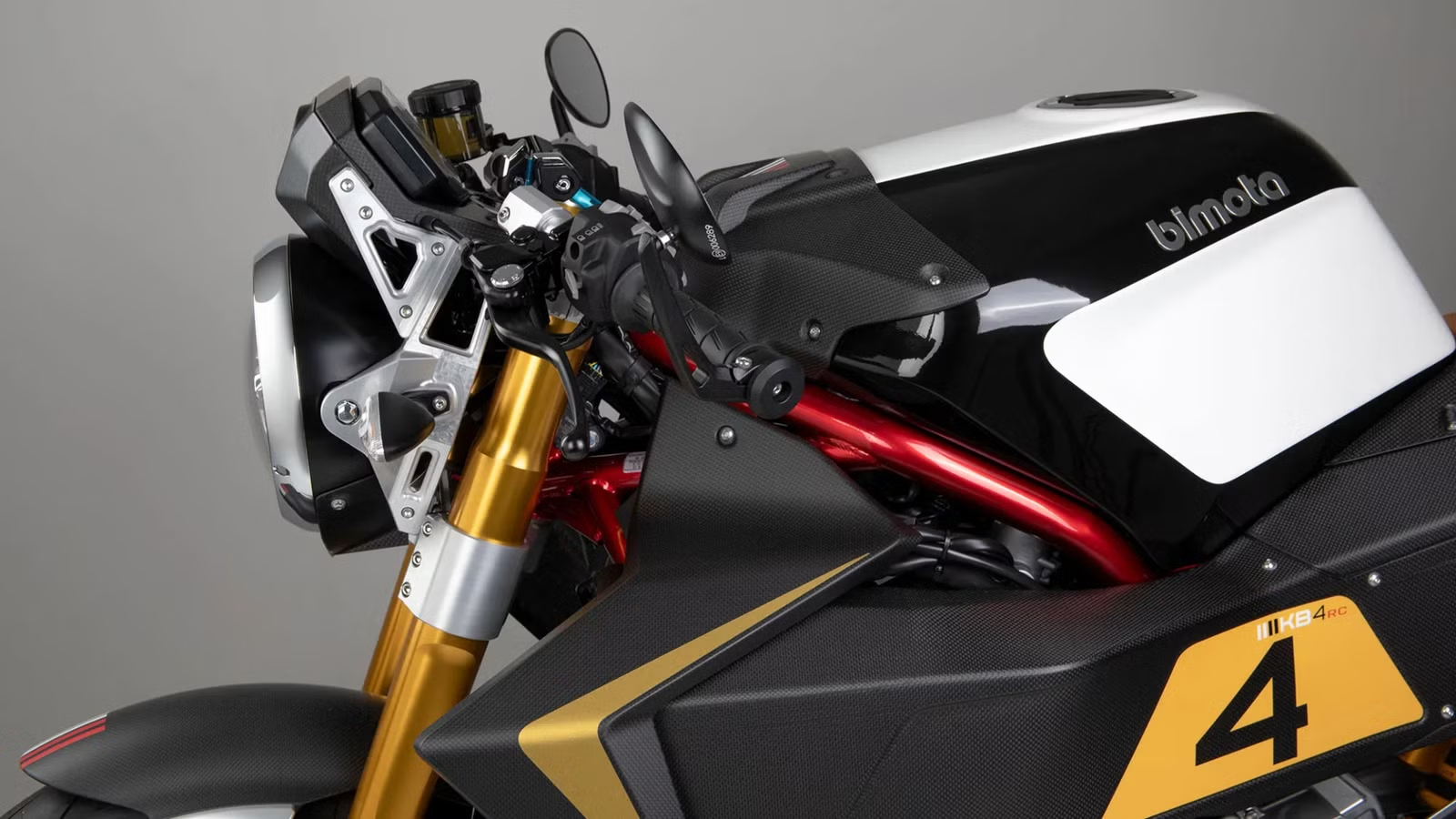
That workshop is Bimota, and the bike is the KB4RC — nicknamed “RaceCafé” internally, the stripped-down, naked cafe-racer sibling to the fully-faired KB4. It’s the closest thing the current motorcycle market has to a cheat code: Italian chassis soul and visual flair wrapped around mechanicals that don’t leak oil, throw a check-engine light, or strand you sixty miles from the nearest dealer. Bimota describes it as a machine built around “Racing Freedom,” combining a compact chassis, a 142-horsepower Kawasaki engine, and the company’s characteristic obsession with detail. Bimota also says the KB4RC is designed and assembled by hand in Rimini.
That is where the “Kawasaki engineering and Ducati character” idea starts to make sense. The bike does not actually use a Ducati engine, nor is it a Ducati underneath. The character comes from a different source: the way Bimota takes a relatively familiar engine and surrounds it with an exotic chassis, premium components, and dramatic styling. It is closer to the philosophy behind classic Bimotas than a simple parts-bin exercise.
A Kawasaki-Backed Rebirth For A Nearly Bankrupt Marque

Bimota has never been a conventional motorcycle manufacturer. Founded in Rimini in 1973, the company built a reputation by engineering sophisticated chassis around engines from larger manufacturers. Its history included Ducati-, Yamaha-, Suzuki- and Kawasaki-powered motorcycles, with the engine source reflected in model naming such as DB, YB, SB and KB. The problem was that exotic engineering and low-volume production are not always a great business model. Bimota went through repeated financial and operational difficulties, eventually becoming a much smaller concern.
That changed in 2019 when Kawasaki established a joint venture and took a 49.9 percent stake, with Kawasaki supplying components and technology for future Bimota motorcycles. The significance goes beyond ownership. Bimota could retain its Italian design and chassis philosophy without having to develop every engine and electronic system itself. Kawasaki, meanwhile, gained a way to apply its production technology to motorcycles that could be considerably more exotic than anything carrying a conventional Kawasaki badge. The KB4RC is one of the clearest expressions of that relationship.
Kawasaki Engineering Under The Carbon Bodywork
1,043cc Inline-Four Muscle: Smooth, Torquey, And Reliable

Under the KB4RC’s carbon bodywork sits a 1,043cc DOHC inline-four lifted from the Kawasaki Ninja 1000SX, tuned to make 142 horsepower at 10,000 rpm and roughly 82 pound-feet of torque at 8,000 rpm. It’s a proven, high-mileage engine platform with a torque curve that favors real-world usability over bragging rights. A quick-shifter comes standard, along with cornering ABS, traction control, and selectable ride modes, all managed through a Kawasaki-sourced TFT dash that looks — and functions — like it belongs on a mainstream neo-retro roadster, because it essentially does.
Reliability Bimota Never Used To Have

This is perhaps the most significant benefit of the Kawasaki connection. Older Bimotas became famous partly because they were rare, expensive, and mechanically unconventional. That exclusivity was part of the attraction, but it could also make ownership complicated. The post-2019 Bimota formula changes that by allowing the company to use Kawasaki-sourced powertrains and electronics.
Bimota Spirit, the U.S. dealer, specifically describes the KB4RC’s Kawasaki-sourced electronics as providing modern function, reliability and ease of use. That does not magically turn a hand-built Italian motorcycle into a mass-market Japanese commuter, but it does remove one of the biggest uncertainties surrounding an exotic low-volume machine. In other words, the owner gets the drama without having to invent the drivetrain.
Ducati-Bred Handling Character Bimota Won’t Abandon
Race-Grade Hardware: Öhlins And Brembo Stylema

The KB4RC uses a steel trellis frame with the engine as a stressed member and its radiator mounted behind the seat, which shortens the wheelbase to roughly 54.7 inches and pulls mass forward over the front wheel. Suspension is fully adjustable Öhlins — a 43mm FG R&T NIX30 inverted fork up front and a nitrogen-charged TTX36 shock with a remote reservoir out back. Dual 320mm discs get squeezed by radial Brembo Stylema four-piston calipers, and the whole package rolls on forged OZ Racing wheels.
The DB1 Legacy Written Into Every KB-Series Bimota

Bimota has named its models after donor engines since the 1970s — SB for Suzuki, YB for Yamaha, KB for Kawasaki, and DB for Ducati, a lineage that traces back to the DB1 of the mid-1980s, the bike widely credited with cementing Bimota’s reputation for chassis work that outclassed the engines bolted into it. The KB4RC runs a Kawasaki heart, but the handling philosophy underneath it is still the same one Bimota built its name on: take somebody else’s engine and build a frame around it that the factory never would have.
Visual Styling: Neo-Retro Art In Carbon And Leather
Stripped-Back Roadster Aesthetics

Strip away the KB4’s fairing and what’s left is arguably the more honest bike. A single round retro headlight sits flanked by carbon-fiber winglets and cooling ducts, with the trellis frame and mechanicals left exposed rather than hidden. The tail section is trimmed down to a minimal cowl, and the seat is real hand-stitched leather rather than molded vinyl — a detail that costs Bimota real money to produce and tells you exactly what kind of buyer this bike is chasing.
Modern Electronics Beneath A Vintage Silhouette

Underneath that vintage look is a thoroughly modern electronics package. A six-axis Bosch IMU feeds lean-angle data to Kawasaki’s cornering-sensitive traction control (KTRC) and cornering ABS (KIBS), while selectable power modes and the Kawasaki Cornering Management Function (KCMF) quietly manage chassis behavior mid-corner. A bi-directional quick-shifter (KQS) and electronic cruise control round out a spec sheet that would look right at home on a modern superbike, all hidden behind a headlight shape that predates most of it by half a century.
Exclusivity And Limited Production

Every KB4RC is hand-assembled in Bimota’s Rimini workshop in genuinely limited numbers, which makes it as much a rideable art piece as it is a canyon carver — a bike equally at home under a garage spotlight or being leaned hard through a mountain switchback. That exclusivity is about to extend to American soil.
Bimota confirmed this week that it’s returning to the U.S. market after more than a decade away, with North Carolina-based Bimota Spirit — founded by longtime enthusiast Bob Steinbugler — serving as the brand’s exclusive U.S. dealer. The KB4RC is expected to arrive stateside later this year, alongside its faired KB4 sibling, giving American riders their first real shot at a bike that’s spent years being an Italian and European market secret.
Source: Bimota

Related posts

Latest Post


No Comments