The Reliable American Engine That’s Set To Become Even More Popular In 2027
8 minutes reading
Monday, 28 Sep 2026 14:00 0 47 autotech
The V-8 engine has a longstanding presence in the U.S., servicing both muscle car and pickup truck segments for decades. The American V-8 represents a deep-seated cultural obsession with raw horsepower, open-road freedom, and heavy-duty capability. In recent years, there has been a slight dip in popularity, but this this is likely to change in 2027.
Strict emissions mandates and shifting market priorities have transformed the automotive landscape. Automakers are replacing large-displacement engines with turbocharged six-cylinders, hybrid setups, and electric powertrains that deliver high output with greater efficiency. However, America’s favorite truck is getting access to an iconic V-8 option across its entire range.
Ford holds a central place in the history of the eight-cylinder engine. The manufacturer popularized the layout for everyday drivers, embedding it into the core of American driving culture. Over the decades, these V-8 units became synonymous with work-truck capability and muscle-car performance.
Today, consumer demand for this iconic configuration remains remarkably strong, despite higher running costs. Americans continuously prove that they demand good linear power delivery, heavy-duty towing capacity, and distinctive exhaust note that define the traditional naturally aspirated design. While industry competitors pivot toward smaller forced-induction alternatives and electrified drivetrains, Ford retains a firm dedication to eight-cylinder engineering.
The brand continues to invest heavily in its V-8 lineup across both performance cars and commercial trucks. High-displacement gas options and high-output turbo-diesel engines continue to anchor its flagship offerings.
The 2027 F-150 Features The Coyote V-8 Across The Range
2027 Ford F-150 Lariat Front 3/4Ford
The 2027 Ford F-150 range introduces several key updates across the lineup, featuring refreshed grille designs, new wheel options, expanded driver-assistance capabilities like BlueCruise with Towing, and a new workwear-inspired Carhartt edition. Under the hood, a new twin-turbocharged 3.0-liter EcoBoost V-6 replaces the previous 2.7-liter entry engine to serve as the standard powertrain.
The defining highlight of the 2027 lineup is the expanded availability of the 5.0-liter Coyote V-8. After previously restricting the engine to higher-end configurations, Ford restores the naturally aspirated eight-cylinder to the luxury King Ranch and Platinum models. The Coyote V-8 is now available across the entire core F-150 trim catalog, spanning from the base XL work truck to the flagship Platinum.
Ford’s decision to offer this engine on every standard trim level finally provides a direct answer to buyers who favor traditional displacement over forced induction. This strategy reinforces the automaker’s commitment to the V-8 architecture, maintaining a high-output, naturally aspirated option in a light-duty truck market that has been dominated by turbocharging and electrification.
The Coyote Complements The F-150’s Platform
Ford
The 5.0-liter naturally aspirated V-8 engine delivers 400 horsepower at 6,250 RPM and 410 pound-feet of torque at 4,250 RPM. When properly equipped, this setup allows the full-size pickup truck to achieve a maximum conventional towing capacity of 12,800 pounds. Paired with a 10-speed automatic transmission, the V-8 powertrain propels the truck from 0 to 60 MPH in 5.4 seconds, with an electronically limited top speed of 105 MPH.
During the first half of 2026, Ford sold 357,801 F-Series pickup trucks, maintaining its position as America’s top-selling truck line. While overall sales declined 13.1 percent compared to the same period in 2025 due to supply chain and aluminum shortages, high customer demand persisted across the range.
The 5.0-liter Coyote V-8 typically represents close to 25 percent of total F-150 sales, positioning it as a steady pillar alongside Ford’s turbocharged EcoBoost V-6 models and PowerBoost Hybrids. However, total V-8 delivery volume experienced additional constraints during the 2026 model year because Ford temporarily dropped the 5.0-liter engine option from luxury trims like the King Ranch and Platinum, restricting the powerplant to lower and mid-tier trim configurations.
A Simple Design With Advanced Materials
Ford
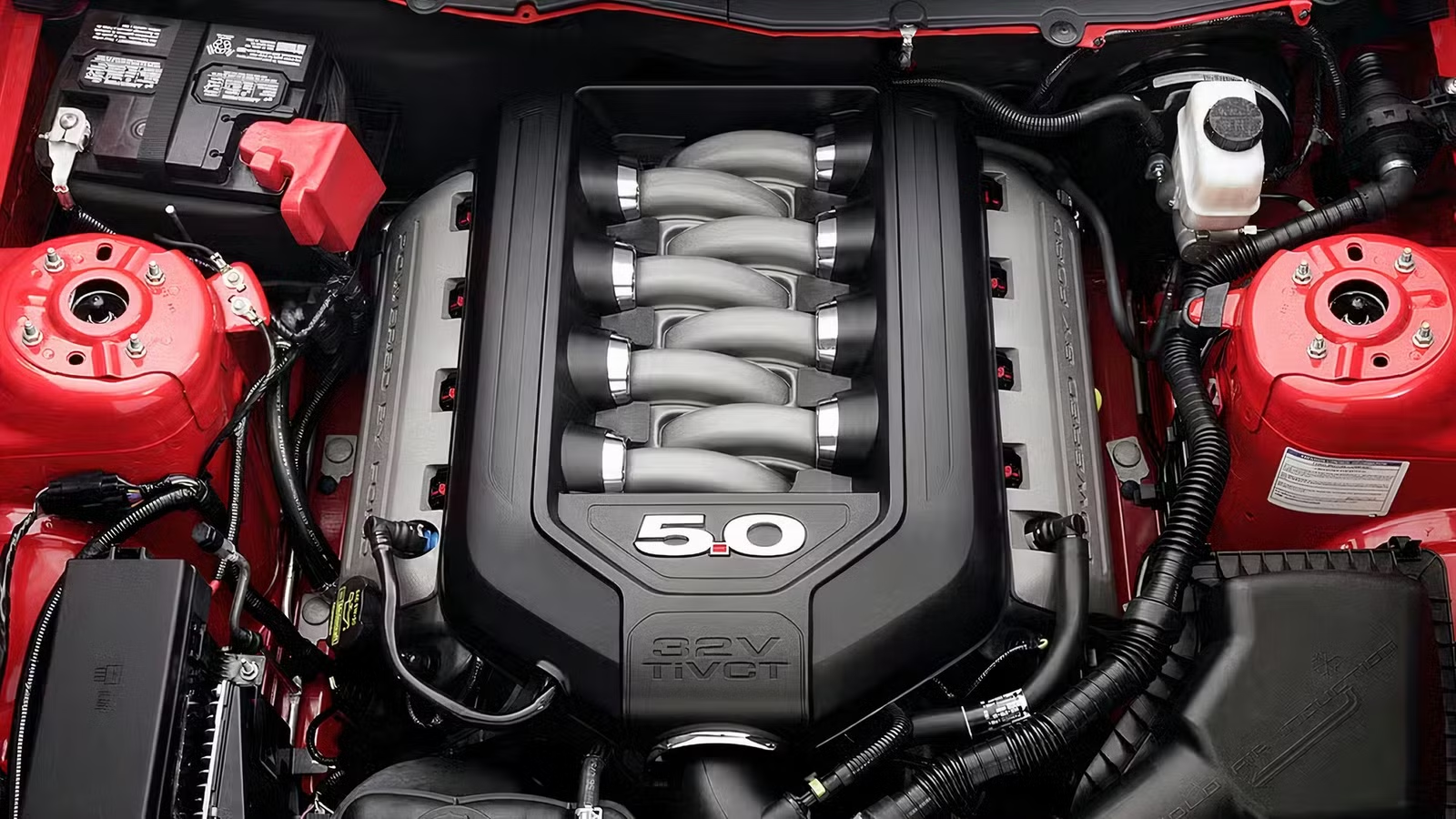
The Ford 5.0-liter Coyote V-8 remains a popular engine option, despite the design being more than 15 years old. The Blue Oval adopts a naturally aspirated design that relies on atmospheric pressure and exceptional volumetric efficiency to generate high output. The engine features Twin Independent Variable Camshaft Timing, built into a dual overhead camshaft architecture with four valves per cylinder.
This technology compensates for a lack of forced induction by continuously adjusting the intake and exhaust valve operation independently, optimizing airflow, combustion, and power delivery across the rev range. The Coyote also maintains a high compression ratio toward the upper rev limit, thanks to a high-pressure direct injection system that works alongside low-pressure port injection. This enables high horsepower figures without relying on forced induction components. However, the torque output is slightly lower by comparison.
A top-view shot of a Ford Mustang Coyote EngineMecum
The Coyote is made from a lightweight aluminum block and matching aluminum cylinder heads to minimize total weight. A deep-skirt block design with cross-bolted main bearing caps provides structural rigidity for high-RPM operation. Internal components include a forged steel crankshaft paired with sintered powdered-metal connecting rods, ensuring structural strength under severe stress. Modern iterations feature Plasma Transferred Wire Arc thermal spray cylinder liners, which replace heavy traditional iron sleeves to reduce engine weight while increasing cylinder bore size and aiding heat dissipation.
Despite its age, the Coyote remains highly competitive thanks to its instant and linear throttle response. It also benefits from a distinct exhaust note that turbocharged engines cannot replicate. Without the additional thermal stresses, higher exhaust back pressure, and more complex piping associated with forced induction, the V-8 maintains mechanical simplicity and high long-term durability. Ford also applies continual updates, showcasing its dedication to the technology. This includes dual throttle bodies, improved intake runners, and direct injection. These allow the engine to produce competitive horsepower figures while meeting current vehicle emissions standards.
The Coyote Is An Engine You Can Trust
Ford
New Ford F-150 models featuring the 5.0-liter Coyote V-8 carry standard factory warranty coverage consisting of a three-year or 36,000-mile bumper-to-bumper limited warranty alongside a five-year or 60,000-mile powertrain warranty. Under normal driving conditions, Ford establishes primary service intervals every 7,500 miles or 12 months, which include synthetic engine oil and filter changes, tire rotations, and multi-point safety inspections.
Cabin air filter replacements follow every 15,000 to 20,000 miles, engine air filter changes occur every 30,000 miles, and spark plug replacements are scheduled at 100,000 miles for the naturally aspirated engine. Routine annual servicing expenses average around $500 to $800 during initial warranty years, with total 10-year cumulative maintenance and repair costs estimated at approximately $11,200.
The 2026 Ford F-150 Sets A High Standard For The 2027 Model Year
Ford
The 2026 Ford F-150 is available in both traditional ICE and hybrid PowerBoost formats. These benefit from solid capability standards, making them popular choices if you want a full-size pickup truck that balances heavy-duty performance with modern efficiency. iSeeCars groups the full-size truck category together, with the model line maintaining a notable presence among long-lasting vehicles that cross the 200,000-mile threshold.
J.D. Power, grouping all drivetrain options, backs this with an 86/100 quality and reliability score, together with 81/100 for the driving experience, 88/100 for resale, and 79/100 for the dealership experience, bringing its consumer-verified overall score up to 84/100.
Low-angle front 3/4 shot of 2025 Ford F-150 Platinum in black parked off-roadFord
According to Edmunds, the entry-level XL Regular Cab is the baseline model for ownership, with an expected five-year True Cost to Own of $66,858 over 60,000 miles. Included in this is $5,713 on maintenance, $1,147 on repairs, $17,974 on depreciation, and $20,547 on fuel. Changing over to a mid-tier SuperCrew configuration increases this 5-year ownership cost to $70,600, which includes $5,870 in maintenance, $1,147 for repairs, $16,869 for depreciation, and $20,547 for fuel.
According to CarEdge, the F-150 will cost around $67,314 over five years to own, including $23,265 on depreciation, $13,125 on fuel, and $2,940 on maintenance. According to RepairPal, the Ford F-150 carries an average annual repair and maintenance cost of $788, compared to the $936 average for full-size trucks. The lineup receives a RepairPal reliability rating of 3.5 out of 5.0.
How Much Ford’s 2027 Coyote F-150 Models Will Cost
Ford
Pricing for the 2027 Ford F-150 equipped with the naturally aspirated 5.0-liter Coyote V-8 spans a wide bracket depending on the selected configuration and luxury level. The line opens with the utility-focused base XL trim, which carries a starting price of $40,585 including destination charges, with the optional V-8 engine addition raising the baseline entry cost to roughly $42,630.
The luxury-oriented flagship Platinum trim brings the 5.0-liter engine back into its standard order guide for the first time in years, carrying a base price of around $71,595 before added packages. This $29,000 price gap reflects a significant expansion in equipment, transitioning from the base XL’s rugged vinyl flooring, manual adjustments, and halogen lighting to the flagship Platinum’s premium leather upholstery, multi-contour heated and ventilated massaging seats, advanced dual-zone climate controls, multi-speaker Bang and Olufsen audio systems, and full hands-free BlueCruise driver-assist functionality.
Base Trim Engine
3.0-liter Twin-Turbo V6
Base Trim Transmission
10-speed automatic
Base Trim Drivetrain
Rear-Wheel Drive
Base Trim Horsepower
325 HP
Base Trim Torque
400 lb.-ft.
Base Trim Fuel Economy (city/highway/combined)
16/24/19 MPG
Make
Ford
Model
F-150
Segment
Full-Size Pickup Truck
Sources: Ford, iSeeCars, J.D. Power, Edmunds, CarEdge, and RepairPal.













No Comments