
The Rarest Boss Mustang Was The One Ford Engineered Hardest
Sure, every Boss Mustang is technically an incredibly rare muscle car, but some are much harder to find than others. That means not every model year gets the same amount of respect. For example, the rarest and most carefully engineered Boss Mustang variant is often overlooked.

There are actually nine iterations available, each specifically built to dominate the track. Today, we’re taking a closer look at the racing pony with the fewest surviving models. Despite being harder to find, other variants have much higher premiums.
However, this racing-oriented Ford Mustang deserves more respect because it didn’t fall short under the Boss moniker. This Boss Mustang lived up to its heritage and reputation with plenty of power and speed. Ultimately, people overlook it for a surprisingly superficial reason, even though it’s considered one of the last great muscle cars.
The Boss 302 and Boss 429 Get All The Attention

Two Ford Mustang Boss models that receive the most attention are the Boss 302 and 429. The Ford Boss 302 Mustang was built in 1969 and 1970 to homologate Ford’s 302 cubic-inch (5.0-liter) V8 engine for the Trans-Am racing series. It produces 290 horsepower and 290 lb-ft of torque. It accelerates from 0 to 60 mph in about 6.5 seconds with a quarter-mile time of 14.5 seconds and top speed of 137 mph.
The Boss 302 Mustang stood out with superior handling as rivals were primarily built to accelerate in a straight line. It features a unique aerodynamic design by legendary designer Larry Shinoda. The car also boasts deleted fake side scoops, a functional front chin spoiler, and an available rear deck wing.

The Boss 429 entered the scene from 1969 to 1970. It was built to homologate its 429 cubic-inch (7.0-liter) Semi-Hemi V8 engine for NASCAR racing. It produces 375 hp and 450 lb-ft of torque. It accelerates from 0 to 60 mph in about 6.1 seconds, crushes a quarter-mile in roughly 13.6 seconds, and has a factory-limited top speed of 118 mph.
The Boss 429 stands out because it was only built to legalize its massive V8 engine for NASCAR. This engine only fits in Mustang models that were hand-modified. Plus, the battery was moved to the trunk, and the power brake booster was thinned for clearance. Most importantly, it has a distinctly aggressive style with the largest fully functional hood scoop ever used on a Mustang and a matte-black chin spoiler.
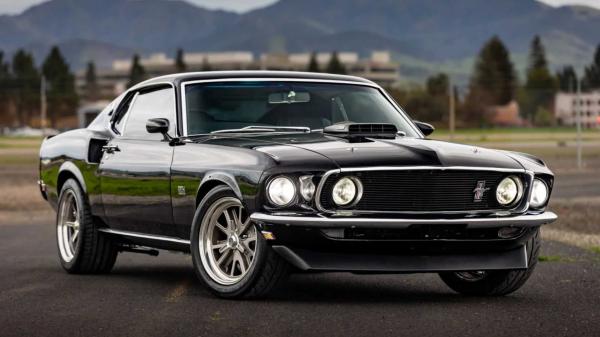
1969 Ford Mustang Buying Guide: Mach 1, Boss 302, Boss 429, And GT500
The 1969 Ford Mustang represents the moment the Mustang reached its full potential—where design, performance, and identity aligned perfectly.
The Boss 351 Mustang Came A Little Later

Most collectors are so busy hunting for the Boss 429 or 302 that the Boss 351 Mustang often gets pushed to the back burner. But it arrived in 1971 with a larger body and total redesign to continue proving Ford’s racing dominance. It didn’t disappoint on the racetrack and is considered to be one of the last true muscle cars.
The Boss 351 has a 351 cubic-inch (5.8-liter) Cleveland V8 engine with 330 hp and 370 lb-ft of torque. The engine has a heavy-duty four-bolt main block, canted-valve Cleveland-style heads, a solid-lifter camshaft, adjustable rocker arms, a specific 715 CFM carburetor, and a compression ratio of 11.0:1 or 11.7:1 depending on factoring ratings.
Ford Mustang Specs
|
Car |
Engine |
HP |
Torque |
0-60 MPH |
|
Boss 302 Mustang |
302 ci V8 |
290 |
290 LB-FT |
6.5 seconds |
|
Boss 429 Mustang |
429 ci Semi-Hemi V8 |
375 |
450 LB-FT |
6.1 seconds |
|
Boss 351 Mustang |
351 ci Cleveland V8 |
330 |
370 LB-FT |
5.8 seconds |
It can accelerate from 0 to 60 mph in about 5.8 seconds and features a 13.5-second quarter-mile time with a top speed of 124 miles per hour. Seriously, this rare Boss Mustang is considered to be one of the fastest and best-performing first-generation models. The build combines lightweight small-block handling with the blistering straight-line performance of big-block V8 engines.
The Boss 351 was discontinued after one model year due to corporate racing budget cuts and withdrew from factory-supported racing. This left no reason to continue building homologated racing engines. Plus, it faced low sales due to rising emission standards and skyrocketing insurance premiums. Only 1,806 models were built, and roughly 630 survive today. Meanwhile, 8,641 Boss 302 models were made, with about 3,000 to 4,500 surviving examples. Then 1,359 Boss 429 models were produced, and the vast majority are believed to have survived.
The Boss 351 Is Built Differently

Because the Boss 351 has a lighter engine, it’s incredibly agile. It features a lighter weight and 3.91:1 gearing that helps it get off the line much faster than the Boss 429 thanks to combining these features with its high-revving nature. While the Boss 429 tips the scales at between 3,560 and 3,870 pounds, the Boss 351 only rings in at 3,281 to 3,452 pounds. Also, the engine in the Boss 429 weighs 680 pounds and highly contributes to its front-heavy balance.
The Boss 351 Mustang is paired with a Ford Toploader four-speed wide-ratio manual transmission controlled by a Hurst T-handle shifter. It has a Ford nine-inch nodular rear axle equipped with a rugged Traction-Lok limited-slip differential. Also, the Ford Competition suspension system includes power-assisted front disc brakes with floating calipers and 10×2-inch widened rear drum brakes.
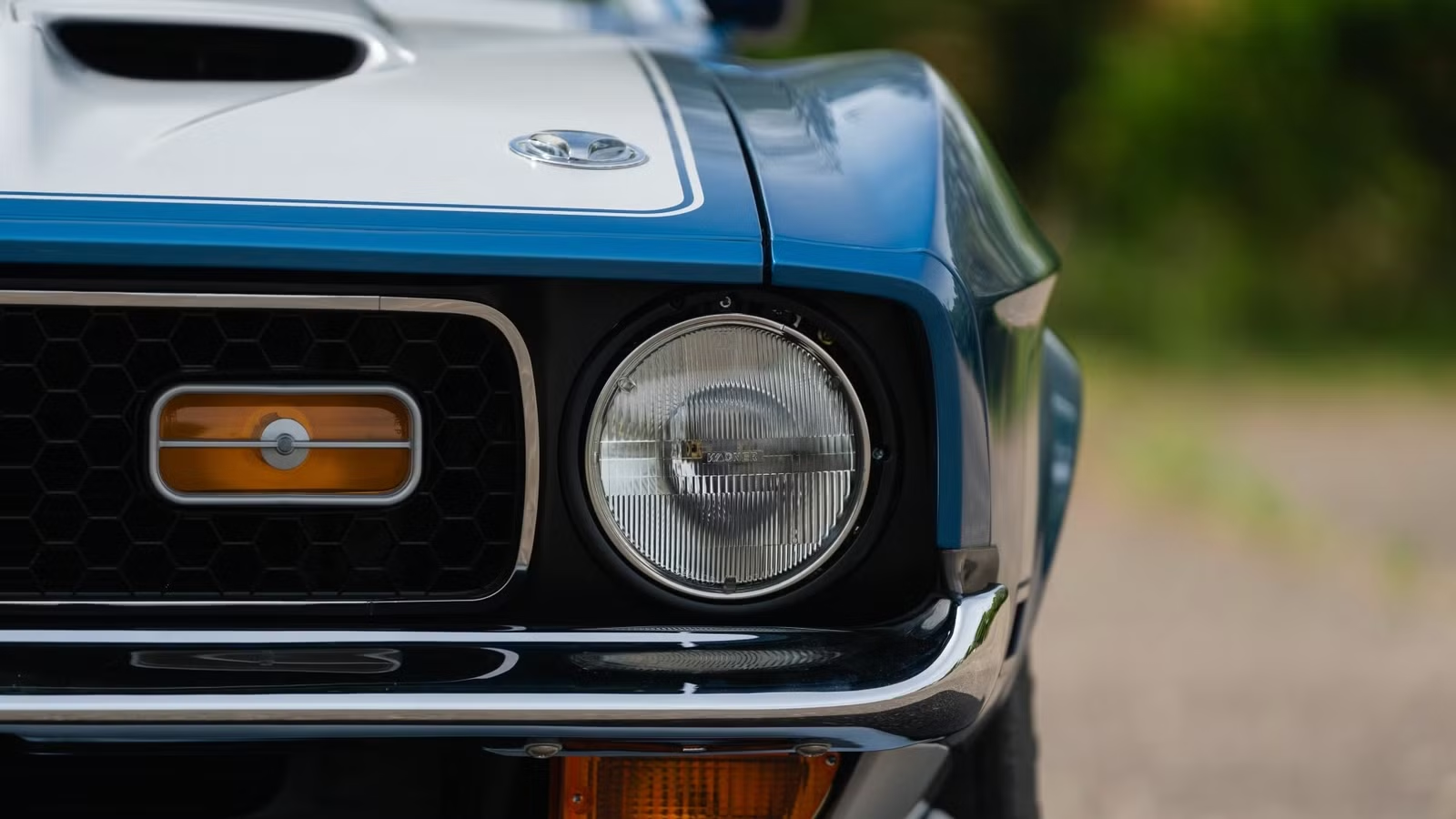
This car rides on 15×7-inch stamped steel wheels wrapped in F60-15 Goodyear Polyglas tires. To balance the larger chassis, Ford engineers added functional NACA hood ducts, a color-keyed front chin spoiler, and a Mach 1 honeycomb grille. Its look is completed by matte black hood sections, hockey stick accent stripes on the sides, and Boss 351 lettering on the rear fenders.
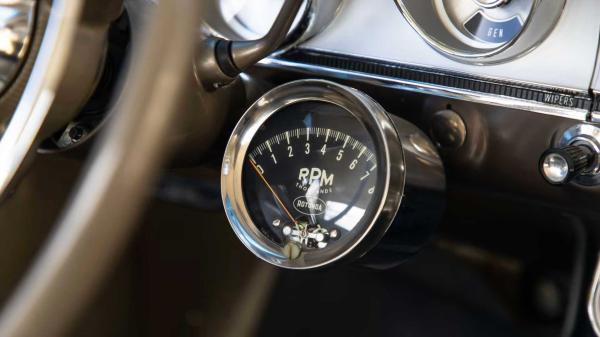
Ford’s Forgotten 10-Second Car With The Brand’s Most Powerful Big Block Under The Hood
A forgotten Ford from the ’60s packs a supercar punch in a sleeper body
Here’s Why The Boss 351 Gets Overlooked

You would expect the best-performing Boss Mustang model to get a little more attention and respect. However, the Boss 351 has a controversial style. It’s longer and wider than others. It looks heavy and takes away from the compact and agile style of the original 1965 model.
It has a long hood and a sloping fastback roofline that’s paired with thick rear pillars. This limits outward visibility. The muscle car also felt large and unwieldy from behind the wheel. Less visibility didn’t help this perception at all. Drivers felt more confident in the more agile models from 1969 and 1970.
Also, the 351 engine is viewed as being high maintenance. In street-trim, it has a solid-lifter high-lift camshaft that requires manual valve adjustments approximately every 15,000 miles. Plus, it requires high-octane premium fuel. On top of that, sourcing compatible aftermarket components is difficult due to the block’s unique cylinder head dimensions.

You can find a 1971 Ford Mustang Boss 351 for about $25,000 to over $125,000 based on its condition, mileage, and quality. However, the Boss 302 frequently fetches between $40,000 and over $150,000 at auction, while models in pristine condition go for nearly $400,000. Then the Mustang Boss 429 goes for between $300,000 and over $600,000.
Source: How Stuff Works, Hagerty, Hemmings

Related posts
Latest Post


No Comments