
The Plymouth That Humbled Chevelles For Half The Sticker Price
The muscle car wars have never really ended — they’ve just changed battlegrounds. But if you want to understand how a lightweight compact from a second-tier brand once made the big-block establishment look overpriced and overweight, the Plymouth Duster 340 is your case study. It arrived at exactly the right moment, cost a fraction of the competition, and could embarrass cars with far larger engines. Half a century on, it still makes a compelling argument for the idea that less can be more.
A Cloud Was Forming Over The Muscle Car Golden Era

It could be argued that the muscle car era had gotten a little out of control by the end of the ’60s. With young buyers snapping up these V8 monsters in their masses in the mid ’60s, manufacturers were quickly upping the ante, bringing out street machines with weapons-grade V8s primarily designed for the racetrack. Suddenly, having a gigantic two-door with 400 to 500 hp under the hood seemed like a pretty normal way of going to the store. But there were clouds brewing. The rock ‘n’ roll Chevy Chevelle SS and Pontiac GTO may not have noticed it, but insurance companies were starting to bump up rates, while rising gas prices were making it ever harder to justify a muscle car with poor fuel economy. Something needed to change.
Plymouth Had An Idea To Get Buyers Back In The Showrooms

The US economy was slowing in the late ’60s too, which meant that buyers probably weren’t quite so keen to spend their hard-earned cash at car dealers in return for the latest, most over-the-top model. Plymouth noticed this and formulated a two-pronged attack. The first offering was the budget-friendly Road Runner, which was based on Plymouth’s low-end midsize Belvedere trim. Arriving for the 1968 model year, almost all the frills were stripped from the car, and the wildest that owners could go was adding air conditioning and a radio.
But that didn’t really matter when you had a standard 335-horsepower, 383-ci V8 under the hood, with the option to spec a 426 Hemi for a few hundred dollars more. The cut-price Road Runner looked good and it sold well, and Plymouth realized there was a market for people who wanted power and speed but weren’t too bothered about luxury or a prestigious badge. The next step was a giant killer…

The Plymouth Duster 340 Was A Muscle Car Bruiser’s Worst Nightmare

In a world where small hatchbacks with huge power and all-wheel-drive sedans can run rings around supercars in the right conditions, the idea of downsizing seems obvious. But in the muscle car world of the ’60s, size really did matter. Bigger engines, bigger cars, bigger hype — everything just got larger and larger (aside from the mpg figure). Plymouth recognized that it could spruce up the run-of-the-mill Valiant line, borrowing the chassis and floorpan, suspension, and drivetrain, plus some of the styling, and grafting on a two-door fastback silhouette. The resulting Duster could be bought with a couple of slant sixes and a 318-ci V8, but the one to go for was the 340.
Fun Fact: Plymouth expected the Duster to take over as its entry-level sporty coupe after the Barracuda moved to the larger E-body platform for 1970.
The Duster Combined Power With Low Weight

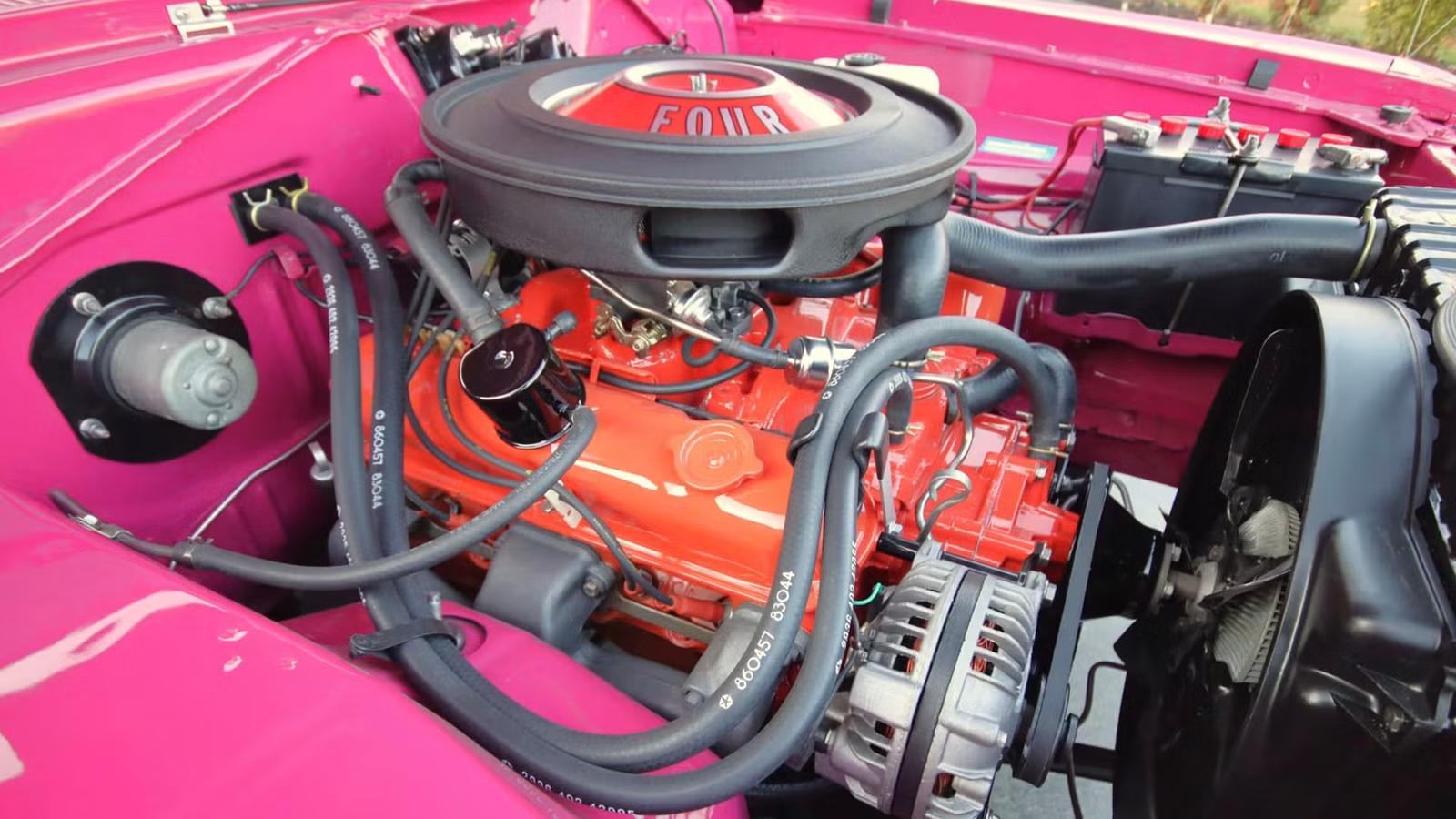
Equipped with a four-barrel carburetor, dual exhaust, high-flow heads, and a forged crankshaft, the 340 pushed out a healthy 275 horsepower and 340 lb-ft of torque. That might not sound like a lot, but the car tipped the scales at around 3,110 lbs, which meant the real-world performance was genuinely surprising. Transmission choices were either a 3-speed automatic or a 4-speed manual. The Duster 340 package also included an upgraded suspension made up of .87-inch diameter front torsion bars, a .88-inch front anti-roll bar, stiffer rear leaf springs, and heavy-duty shocks. Plymouth then added front disc brakes and 14-inch Rallye wheels wearing E70-14 tires. Black stripes and an optional trunk spoiler sharpened the car’s appearance. Plymouth was on to a winner.
Why The 340 Small-Block Became A Mopar Legend

More than five decades later, many Mopar fans still consider the 340 Chrysler’s finest production small-block, and for good reason. Rather than simply enlarging the 318, engineers gave it a forged steel crankshaft, high-flow “X” heads, large valves, an aggressive performance camshaft, and breathing capabilities that encouraged drivers to explore the upper reaches of the tachometer.
Those ingredients helped the 340 earn a reputation as one of the hardest-revving and most responsive American V8s of the muscle car era. Its time at the top was short, however, as the 360 replaced it for 1974. Although the 360 offered more low-end torque, the 340’s stronger internals and higher-revving character made it the more revered performance engine.
The Duster Was Cheaper And Almost As Effective As Big Block Cars

While one test clocked the Duster at a low 15-second quarter mile, that result appeared to be an anomaly caused by transmission and clutch problems. The Duster 340 was frequently quoted as covering the quarter in the low-14-second range, including by Hemmings, which meant it could stand up to cars that were much bigger and more expensive. The Duster was said to be almost 400 lbs lighter than the fearsome Chevrolet Chevelle SS, which came with a mighty big-block V8. The Chevelle, says Hemmings, will cover the quarter mile in 14.41 seconds — putting it squarely on a par with the Duster 340.
But here’s the twist. When new, the Duster 340 was a genuine bargain, undercutting the Barracuda fastback and the Chevelle 396 SS at the same time. With options added, the price of a Chevelle could climb to nearly double what a no-frills Duster 340 commanded. And in many ways the Duster was well suited to being basic, letting its performance do the talking.
Fun Fact: The Duster was such a sales success that Dodge quickly asked Chrysler for its own version. The result was the 1971 Dodge Demon, which shared nearly all of the Duster’s mechanicals but wore unique front-end styling and Dodge badges.
How The Duster Took On The Compact Muscle Car Wars

By 1970, Detroit was beginning to rethink the traditional muscle car formula. Rising insurance premiums, looming emissions regulations, and higher ownership costs made big-block intermediates harder to justify. Instead, automakers discovered that a lightweight compact fitted with a powerful small-block V8 could deliver similar real-world performance for less money. The result was a new class of compact “giant killers,” and the Duster 340 quickly became one of its leading players. However, it wasn’t alone.
The Duster 340 faced stiff competition, including from Chrysler’s own showrooms. Dodge had already demonstrated the potential of the lightweight A-body by fitting the Dart GTS with the 340 V8 in 1968, followed by the more affordable Dart Swinger 340 a year later. When the Duster became an instant hit, Dodge quickly responded with the 1971 Demon 340, essentially a mechanical twin wearing a different nose and Dodge emblems to appeal to a separate group of buyers.

Competition was just as fierce across town. Chevy’s Nova SS had already established itself with available 327, 350, and even 402 cubic-inch V8s, while Ford’s Maverick Grabber gained a 302-cubic-inch V8 rated at 210 gross horsepower for 1971. Even AMC joined the fight with the 1971 Hornet SC/360, packing a 285-hp 360 V8 and marketed as a more insurance-friendly alternative to traditional muscle cars.
Despite the crowded field, contemporary comparison tests repeatedly placed Chrysler’s 340-powered cars among the class leaders. Their combination of strong acceleration, predictable handling, and relatively low weight proved that compact muscle cars were legitimate performance machines in their own right.
How The Duster 340 Evolved From 1970 To 1973

Few muscle cars had to evolve as quickly as the Plymouth Duster 340. It arrived just as the American performance market entered one of its most turbulent periods, with emissions laws tightening, insurance costs climbing, and manufacturers scrambling to preserve horsepower. To keep up, Plymouth revised the Duster almost every year.
The original 1970 model set the benchmark. Sold as the Valiant Duster 340, it combined lightweight A-body underpinnings with Chrysler’s 275-horsepower, 10.5:1-compression 340 V8 and deliberately restrained styling. There were few graphics to advertise what lurked under the hood, making it a true sleeper capable of surprising much larger muscle cars. That combination of first-year status, the original Carter AVS carburetor, high-compression 340, and understated appearance has made the 1970 car the most historically significant — and arguably the most desirable — version among collectors.

In 1971, Plymouth gave the Duster 340 a more aggressive personality without sacrificing performance. The Valiant name disappeared, while the exclusive shark-tooth grille, full-length side stripes, optional blackout hood, and bold “340 Wedge” decal made it far less of a sleeper. Under the hood, compression slipped slightly to 10.3:1, but output remained at 275 gross horsepower thanks in part to a new Carter ThermoQuad carburetor, while Chrysler’s electronic ignition began appearing later in the model year.
Emissions regulations forced more substantial changes in 1972. Compression dropped again to 8.5:1, intake valves shrank from 2.02 to 1.88 inches, and a milder camshaft helped meet stricter standards. The industry-wide switch from SAE gross to SAE net ratings saw the 340 officially rated at 240 horsepower, though real-world performance remained respectable. The final 1973 model received a redesigned front clip, new taillights, and federally mandated 5-mph front bumpers before the legendary 340 gave way to the 360 V8 for 1974. While generally considered the least desirable of the four, it remains the last chapter in the original Duster 340 story.
The Duster 340 Is A Great Choice In 2026

The Duster 340 has gained more recognition of late, so it’s not exactly a forgotten muscle car, but it still makes a compelling case. It’s lighter, smaller, and more usable than a lot of monster muscle cars, yet it won’t be embarrassed at the lights. In total, 24,817 Duster 340s were built for 1970, says Hemmings, with 69,115 rolling out of the factory through 1973. The 1970 cars are officially called the Valiant Duster, but the Valiant name was dropped the following year. For 1971 the Duster 340 gained a “sharktooth” grille, though the switch to SAE Net ratings and a reduction in compression meant output was quoted at 240 hp on paper. In 1974, the 340 V8 was replaced by a 360.
The Duster Remains An Affordable Entry Into Classic Muscle Cars

According to Hagerty’s Valuation Tools, a 1970 Plymouth Valiant Duster 340 in good condition will set you back around $29,500, with 1971 cars commanding a little more at roughly $33,900. Values ease to around $28,200 for 1972 and approximately $26,100 for 1973. By comparison, a 1970 Chevrolet Chevelle SS 396 will cost around $70,500 in 2026 — more than double the price. The Chevelle is an icon, and the Duster 340 will probably always remain the underdog. But if you are just entering the muscle car hobby and want something affordable, genuinely unique, and capable of embarrassing a big-block classic, the 340 is well worth a look.
Sources: Hemmings.com; Hagerty.com

Related posts



Latest Post


No Comments