
The Parallel-Twin Adventure Bike Built For Riders Who Don’t Need 130 Horsepower
Adventure bike horsepower has reached sport-bike levels today. The latest and greatest in the big ADV space now make upwards of 150 horsepower. Those figures make sense on fast roads, with the bike brimmed with luggage and a passenger. But they become far less relevant on gravel, sand, rutted climbs, or a narrow trail where grip is harder to find.

And if that’s your flavor for an adventure, then the motorcycles for you to consider should be built around a different question. One that asks, just how much power makes an ADV genuinely easier to use? And the surprising truth reveals that half of that power is enough for most tasks. Yamaha’s answer has become one of the clearest examples of that approach.
More Power Does Not Automatically Make A Better Adventure Bike
The difference between a powerful large-displacement ADV and a superbike is that the former’s performance has to coexist with tall suspension, longer chassis geometry, luggage capacity, passenger accommodation, and tires designed to cope with mixed surfaces rather than purely smooth asphalt. On pavement, 130-plus horsepower delivers effortless speed. On loose ground, the limiting factor is usually the lack of traction.


Manufacturers have become very good at managing that mismatch. Modern flagship adventure bikes use sophisticated electronics to meter out their engine’s power delivery. The technology is impressive and often extremely effective, but it also highlights how much performance has to be managed once the conditions deteriorate.

A lighter middleweight ADV can sidestep part of that problem even before software becomes involved. Less power places fewer demands on the rear tire, while lower mass makes direction changes, corrections, and low-speed recovery easier as well as being less intimidating. It also lets the rider use more throttle more often instead of holding back from using full revs.

Around 70 horsepower therefore stops looking like a modest figure once the motorcycle is pointed away from a highway. It becomes enough to cover distances quickly while leaving the engine approachable when the road deteriorates. Yamaha has built one of its most enduring adventure motorcycles around this balance with a name that signifies its endurance capabilities in cross-country rallying.
The Yamaha Ténéré 700 Keeps Its Priorities Narrow

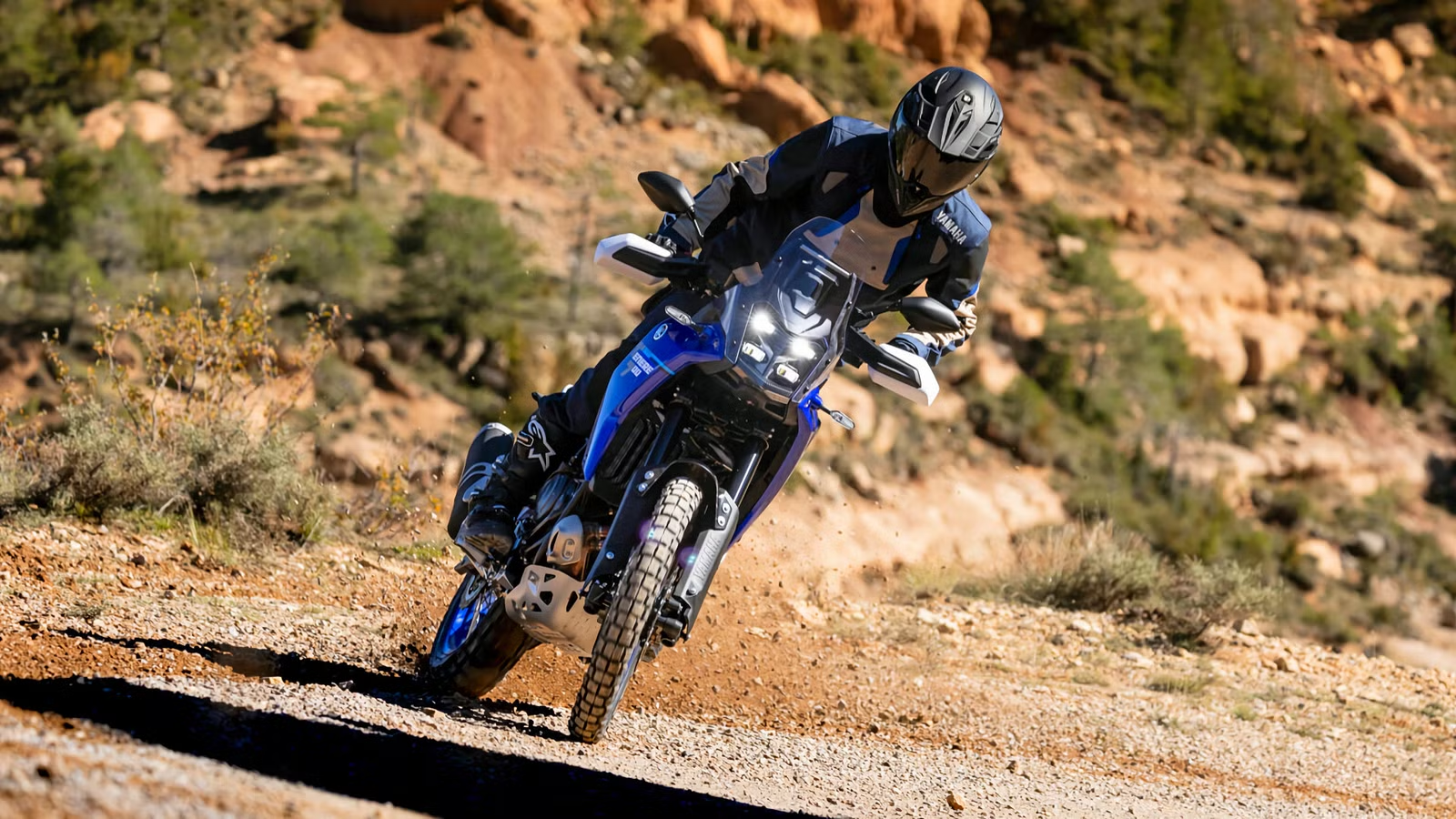
The 2026 Yamaha Ténéré 700 traces its basic layout back to the version that reached U.S. dealers in 2021. It uses a dedicated steel adventure chassis wrapped around Yamaha’s 689cc CP2 parallel twin. Yamaha substantially updated the bike for 2025 with electronic throttle control, selectable throttle maps, traction control, revised suspension, a new TFT display, and ergonomic changes. It also resisted turning it into a scaled-down luxury ADV. For 2026, the standard Ténéré 700 remains a relatively simple middleweight built around off-road-friendly proportions, usable performance, and hardware that does not require an extensive electronics menu to rein in.
The CP2 Twin Delivers Power Without Demanding Much Management

The 689cc liquid-cooled parallel twin uses a 270-degree crankshaft and produces 72.4 horsepower with 50.2 pound-feet of torque, which are modest numbers beside today’s heavyweight ADVs but entirely appropriate for a motorcycle built around traction and control. Yamaha revised the intake ducting for the 2025 model and introduced Yamaha Chip Controlled Throttle (YCC-T), which supports Sport and Explorer throttle maps.

Explorer softens response for low-grip conditions, while Sport gives the rider a more immediate connection without dramatically altering the engine’s character. The important point is that the bike does not need several reduced-power modes to make its output manageable. Riders can feed in a good amount of throttle on loose ground without instantly asking the traction control system to rescue their misjudged input. That also makes small corrections easier during climbs, slides, and slow technical riding, where precision matters far more than horsepower.
The Chassis Makes More Sense The Rougher The Route Becomes

Yamaha surrounds the CP2 engine with a high-tensile-steel frame designed specifically for the Ténéré. A 43mm KYB inverted fork provides 8.3 inches of travel, while the linkage-mounted rear shock offers 7.9 inches. Wire-spoke 21/18-inch wheel combos are typical sizes expected of machinery that’s intended to spend serious time off the pavement. Although the 459-pound wet weight is hardly dual-sport light, it remains manageable besides heavyweight alternatives that can push well beyond 500 pounds.

A narrow 4.2-gallon fuel tank and slim bodywork let the rider move around easily while standing, and the 34.4-inch seat height can make low-speed footing manageable for most except shorter riders. The suspension surely lacks the sophistication and travel offered by more expensive off-road-focused rivals. But for that you’d have to consider the Ténéré 700 World Raid, which offers fully adjustable 46mm KYB units. Nevertheless, the standard T7 Ténéré was engineered around rough-surface control first, so it’s more than capable with what it packs.
Yamaha Added Technology Without Burying The Rider In It

The 2025 update addressed one of the older Ténéré’s weak points by adding useful electronic support without changing how much intervention the rider has to tolerate. Traction control can be disabled, while the three-setting ABS lets riders slide around when needed. A 6.3-inch vertical TFT display adds smartphone connectivity and turn-by-turn navigation, while revised switchgear makes the menus easier to operate.

The standard bike still misses equipment such as cruise control and more advanced semi-active suspension found on pricier adventure tourers. But those omissions will matter to riders covering huge highway distances. For riders more interested in dirt-road capability, the Ténéré’s electronics function more as support equipment rather than the machinery’s central attraction. The motorcycle still works primarily because of its chassis, gearing, riding position, and adequate power suitable for the job.
The Tuareg 660 And 890 Adventure R Show What Spending More Buys

At $10,999, the Ténéré 700 undercuts the $12,499 Aprilia Tuareg 660 by $1,500. However, the extra money for the Aprilia gets you an 80-horsepower 659cc parallel twin, 9.4 inches of suspension travel at both ends, standard cruise control, a broader electronics package, and a claimed 449-pound wet weight. That makes it the more comprehensively equipped middleweight, particularly for riders who want stronger suspension performance and more touring convenience. The Yamaha’s appeal is narrower and cheaper, as its simpler specification still covers the essentials without asking the buyer to pay for capabilities they may not need.

The $16,299 KTM 890 Adventure R extends the difference to the Ténéré to $5,300. Its 889cc parallel twin produces 105 horsepower, while 9.4 inches of WP suspension travel and higher-spec chassis hardware give it considerably more off-road headroom. The extra performance is almost proportional to the price difference. Nonetheless, Yamaha gives up outright speed and premium hardware in favor of a motorcycle whose power, weight, and chassis remain easier to exploit across mixed terrain while coming in at the most attractive price point among its closest rivals.
Source: Yamaha

Related posts
Latest Post


No Comments