
The Nine-Passenger Wood-Paneled Wagon Hiding 378 lb-ft Of Muscle-Car Torque
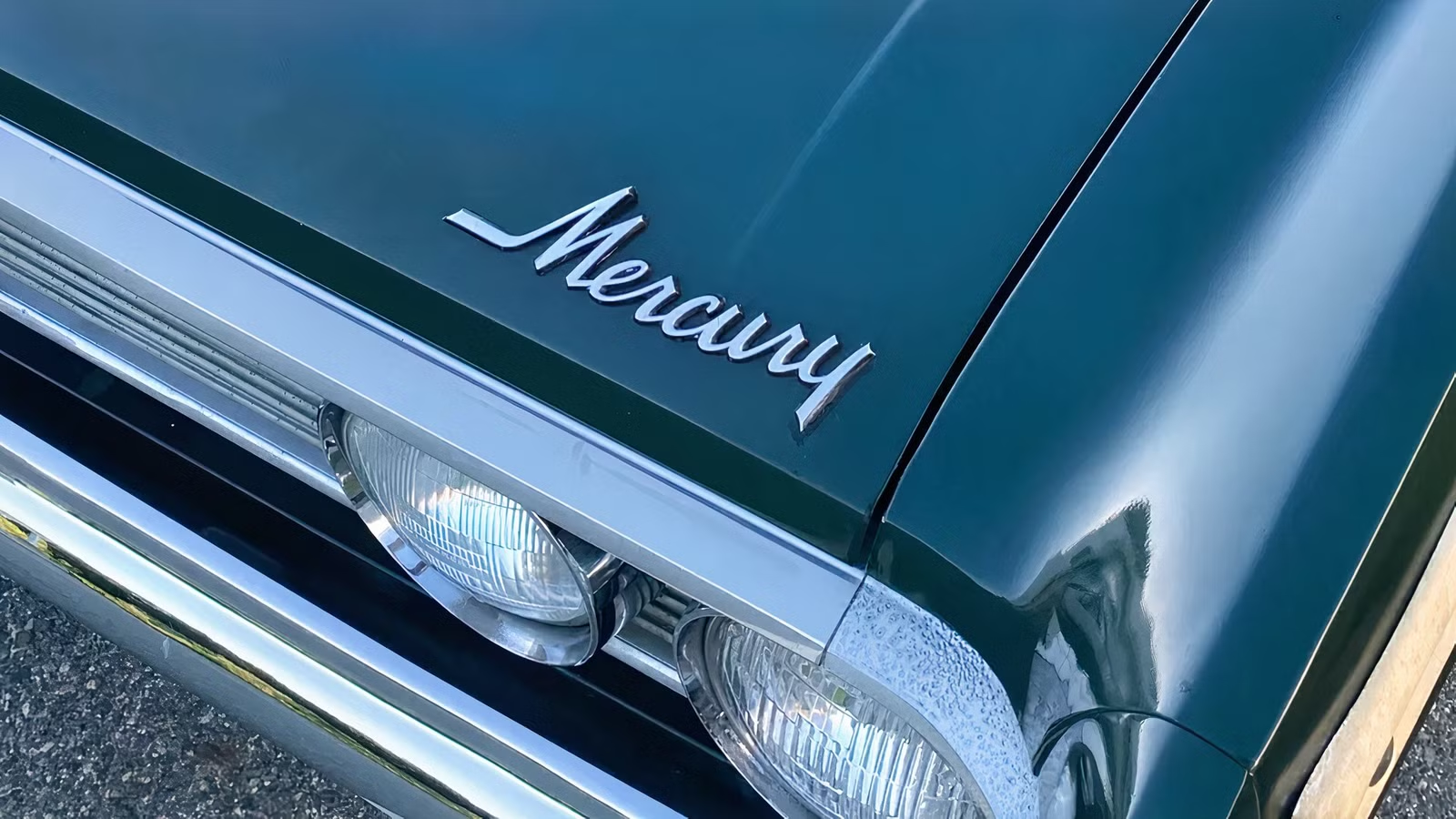
Back in 1960s America, a wood-paneled station wagon usually meant family vacations and enough cargo space to bring half the house along with you if you so desired. Space and comfort were the big points, essentially. Performance wasn’t the first thing on its neighbors’ minds.

That made one full-size American wagon particularly…unique, let’s say. Beneath its suburban bodywork sat a muscular V8 producing 378 lb-ft of torque, giving this family hauler considerably more muscle than its fake timber suggested.
Detroit Once Put Big-Block Torque In The Family Car
The classic American station wagon occupied a very different place in the automotive world during the mid-1960s. One thing these vehicles were definitely not designed around was fuel economy. A full-size wagon could stretch well beyond 200 inches, weigh more than two tons, and still be expected to carry a family across the USA without turning every freeway on-ramp into an endurance event.

Detroit’s solution was magnificently straightforward. Large cars got large engines, and family duty wasn’t considered a reason to hold back on displacement. A big V8 provided the low-end force needed to get all that steel moving while making long-distance highway driving far less strenuous than the wagon’s dimensions might suggest.
That philosophy produced some brilliantly strange combinations. A car designed around family practicality could end up with torque figures that would’ve looked perfectly respectable in a mid-’60s muscle car. Nobody had to call it a performance model, either. America simply hadn’t yet decided that the family wagon and the big V8 belonged in different corners of the showroom.
Mercury Dressed Its Family Hauler Like A Lincoln

Mercury’s full-size lineup received a substantial redesign for 1965, and its station wagons followed suit. The new cars rode on a 119-inch wheelbase and stretched 210 inches overall, so nobody was going to mistake one for compact transportation. This was classic Detroit scale, back when shrinking the family car would’ve sounded like giving up.
The styling moved noticeably upscale. Slab-sided bodywork borrowed visual cues from the Lincoln Continental, while the wagon’s roofline remained closely related to Ford’s Country Squire. Add simulated woodgrain and plenty of chrome, and the result looked like something that should have arrived at a golf club with matching luggage.
Polish And Brawn

Mercury also changed what was happening underneath. The previous leaf-spring rear setup gave way to a coil-spring live rear axle for 1965, helping the big wagon deliver the more polished ride expected from a Mercury. Body-on-frame construction remained, so there was still plenty of traditional American hardware beneath the newly tailored suit.
All of that was important because Mercury wasn’t trying to sell its top wagon as some stripped-out workhorse. This was supposed to be premium family transportation for North American buyers who wanted the practicality of a station wagon without giving up the appearance of luxury. The surprise was that Mercury backed up all that polished suburban presentation with an engine that could’ve made a much sportier car interesting.
The 1965 Mercury Colony Park Hid A 390 Under All That Woodgrain

All this leads us to the 1965 Mercury Colony Park, the company’s upscale full-size station wagon and one of the more entertaining sleepers to emerge from America’s wood-paneled era. Beneath its long hood sat a 390-cubic-inch FE V8, giving the Colony Park the sort of displacement that would sound at home in a conversation about classic American muscle cars.
The 2-barrel 390 was rated at 270 horsepower and 378 lb-ft of torque. The more important number for this story is the 378 lb-ft figure, because that’s where the Colony Park’s hidden performance case gets interesting.
For perspective, 378 lb-ft was substantial torque for a family wagon in 1965. The Colony Park wasn’t trying to chase high-rpm fun or advertise itself as a stoplight special. Its V8 simply made the kind of low-speed muscle a huge American car needed, with enough reserve to make moving its considerable bulk feel far less dramatic.
That’s what makes it a genuinely compelling classic station wagon today. The woodgrain and chrome suggest pure nostalgia, yet the mechanical spec tells you something else altogether. This was an American family car carrying genuine big-block shove under the hood, and Mercury didn’t feel the need to plaster racing stripes over it to make the point.
378 LB-FT Had More Than 4,000 Pounds Of Wagon To Move

Of course, the 390 V8 had plenty of Mercury to haul around. The 1965 Colony Park weighed roughly 4,500 pounds, making that 378 lb-ft figure more of a practical necessity. Load up a full-size American station wagon with passengers and luggage, and suddenly displacement starts looking like sensible engineering.
That curb weight also explains why torque matters more here than an attention-grabbing horsepower figure. A heavy rear-wheel-drive wagon needs strong low-end response to pull away cleanly and build speed without feeling labored. The Colony Park’s 390 was perfectly suited to that job, especially in an era when American buyers expected their family cars to handle long interstate drives with ease.
Solid American Engineering

Its size makes the entire package even more entertaining from a modern perspective. At 210 inches long, the Colony Park occupied serious road space, yet Mercury paired that bulk with an engine powerful enough to keep the experience from becoming sluggish. Somewhere beneath the fake timber was a very American engineering philosophy: if the car weighs a lot, bring more cubes.
The Colony Park Came From A Detroit We’ll Never See Again

The 1965 Mercury Colony Park wasn’t bargain-basement family transportation, either. Pricing at the time ran above $3,000, placing it above the average new American car and reinforcing its position as Mercury’s premium full-size wagon. People were paying for cargo room, but they were also buying a slice of Lincoln-flavored luxury with a big V8 attached.
Production figures also show that this wasn’t some obscure muscle-wagon experiment tucked away in a forgotten corner of Mercury history. The 1965 production breakdown lists 15,294 Colony Parks alongside 8,081 Commuter wagons. That made the wood-paneled Colony Park the stronger seller of Mercury’s two full-size wagon lines that year.
Unabashed Excess

The contradictions here fit together with surprising naturalness. The Colony Park looked like peak suburban America, complete with simulated timber and upscale trim, yet its 390 V8 produced a substantial 378 lb-ft of torque. Mercury didn’t need a special performance badge because the engine was simply part of making a huge American station wagon work properly.
That’s what makes the 1965 Mercury Colony Park such an oddity. This thing had genuine mechanical substance beneath the decoration. America once built family cars weighing more than two tons, stuffed big V8s under their hoods, and considered the whole arrangement entirely unremarkable. Looking back from today’s landscape, the excess of it all is genuinely charming.
Sources: Mercury

Related posts

Latest Post



No Comments