
The Naturally-Aspirated Lexus Sports Sedan Aging Better Than Every Turbo German Rival
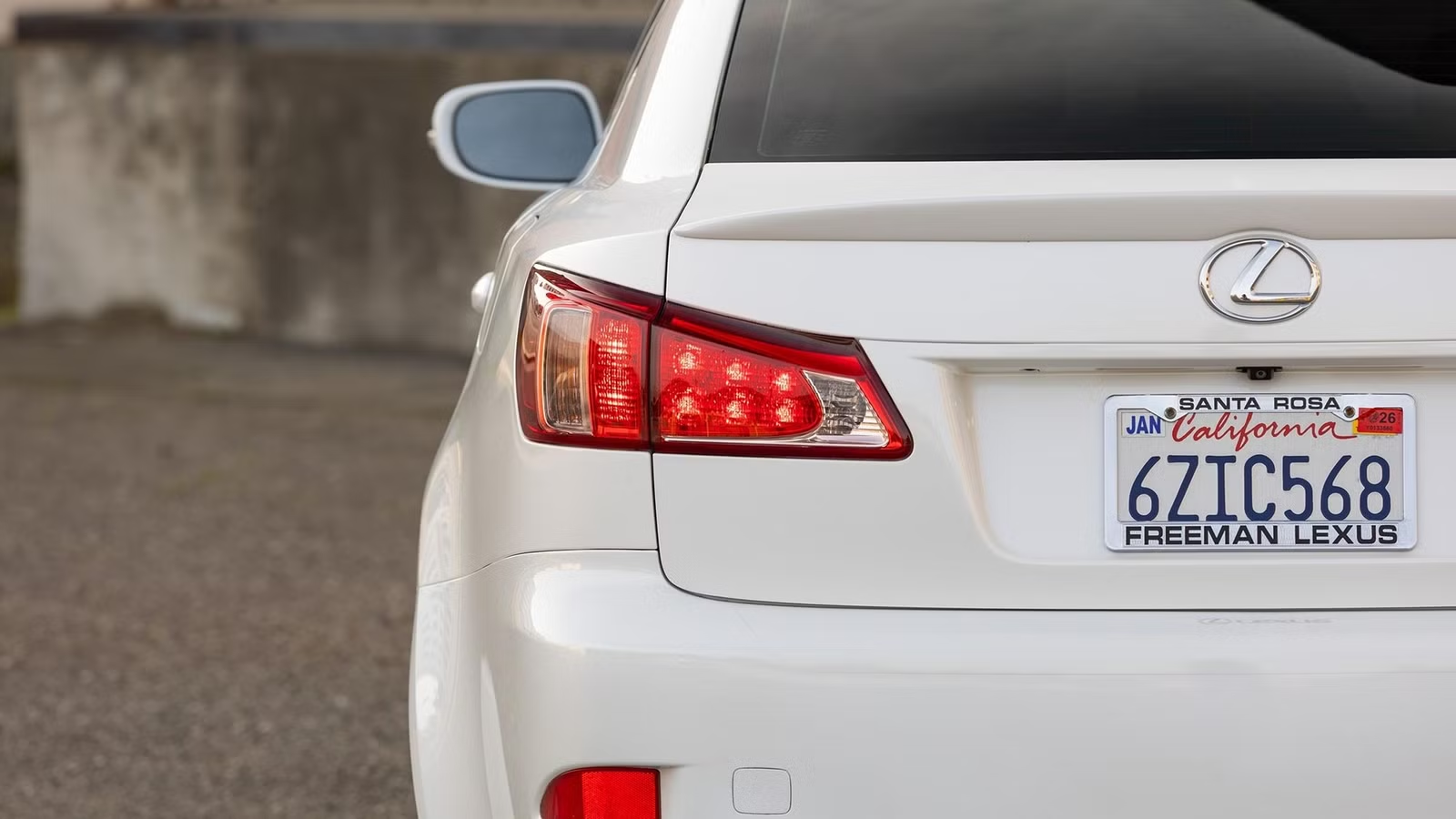
At some point in his automotive journey, an enthusiast looks for a German sports sedan. On paper, a used 2010s car makes a lot of sense: a twin-turbocharged engine, or even a supercharged V8, mated to a quick-shifting dual-clutch transmission. The performance and prestige of a European badge are undeniable, as is the cost of buying one used. But after six months, the reality of owning a decade-old, out-of-warranty European car sets in: a big expense is just around the corner. But what if an affordable Japanese alternative exists that auto enthusiasts and journalists overlooked? It’s a boring, sensible alternative to the exotic, but beyond the spec sheet, this sedan offers performance and reliability at an affordable price.
The High-Maintenance Trap Of Used German Performance

The 2000s and the 2010s are widely celebrated as the peak of modern analog performance. Luxury sports sedans from this era, like the BMW E90 335i and the B8-generation Audi S4, defined what buyers expected from an entry-level luxury sedan. They offered massive low-end torque and effortless power. These cars set the segment benchmark and shaped enthusiasts’ opinions of performance sedans.
That said, these performance cars carried a hidden expiration date that used-car buyers are paying for today. After 10 to 15 years of use, the complex mechanics and electronics that made them fun to drive in the first place start to fail. Turbocharger waste gates and high-pressure fuel pumps can fail without warning; direct-injection fuel injectors can start to leak and wash out cylinder walls; plastic cooling system components can turn brittle and disintegrate under immense heat year after year.
As a result, and predictably, the used market is flooded with bargain-priced European sport sedans that would cost an arm and a leg to fix and restore to their original factory spec. The basic long-term math of owning a decade-old turbocharged German car rarely works in your bank account’s favor. Enthusiasts who bought in expecting cheap weekend thrills quickly find themselves trapped in an exhausting cycle of diagnostic codes, tow trucks, and high maintenance budgets.

The Underdog That Failed On Paper

While European luxury was locked in a turbocharged arms race, a Japanese rival took the opposite approach with its entry-level luxury sedan. On paper, this sedan looked completely outclassed by its forced-induction competition. Where the BMW 335i delivered 300 horsepower and 300 lb-ft of torque, and the Audi S4 pushed 333 horsepower with 325 lb-ft of torque, this Japanese alternative offered a modest naturally aspirated 2.5-liter V6 producing just 204 horsepower and 185 lb-ft of torque.
When you plant your right foot on the gas in this naturally aspirated Japanese sedan, it does 0 to 60 mph in a modest 7.1 seconds with the rare manual transmission option, and 7.9 to 8.4 seconds with the automatic transmission and all-wheel-drive configuration. By class standards of its era, this sedan wasn’t just relaxed; it was genuinely slow. Contemporary automotive journalists described its power delivery as “breathless” and “adequate,” not sports-car worthy. Even on fuel economy, its 21 MPG city and 30 MPG highway rating matched its much faster European rivals.
Because of those unimpressive spec sheet numbers, almost every enthusiast buying guide dismissed the vehicle instantly. It was written off as an uninspiring commuter car in a sporty shell, but this Japanese sedan has more to it than meets the eye; the story lies beyond the spec sheet.
The Lexus IS250: Combined Performance and Reliability

The second-generation Lexus IS250 flips the decade-old ownership expenses debate completely on its head. For enthusiasts who demand real mechanical engagement, the 2006–2012 IS250 holds a unique place in the auto market as the very last manual-transmission Lexus ever sold in America. A clean six-speed manual IS250 gives you a rare combination: a rear-drive, naturally aspirated, three-pedal Japanese luxury sedan that remains extraordinarily affordable to run and maintain, and that flips the narrative.
The rear-wheel-drive chassis structure is anchored by double-wishbone front suspension and a multi-link rear setup. With a rigid frame and well-tuned damping, the IS250 chassis delivers a mechanical road feel that modern electric-steering luxury cars have completely lost. The IS250 was never engineered to win 0-to-60 sprints. It was designed to run flawlessly for decades with minimal fuss, making it a true unicorn on today’s used market.
With that said, no aging luxury car is entirely maintenance-free. The 2.5-liter V6 (4GR-FSE) relied on an early direct-injection design, so it still required routine intake valve carbon cleaning every 50,000 to 70,000 miles to keep idling and throttle response smooth. You’ll also need to budget for a water pump replacement around the 100,000-mile mark with the serpentine belt service, plus routine lubrication of the rear brake slider pins to prevent sticky calipers and premature pad wear. However, compared with replacing blown twin turbochargers, failing high-pressure fuel pumps, or glitchy German electrical modules, routine carbon maintenance is a small price to pay for long-term mechanical peace of mind.
Unlocking The Sleeper Potential

The IS250’s factory spec left one noticeable mechanical hurdle for spirited driving: an open rear differential. Trying to power out of tight corners often spun the inside tire instead of putting power down cleanly. Fortunately, the JDM enthusiast subculture uncovered a remarkable bolt-in upgrade: a direct Y38 Torsen limited-slip differential (LSD) sourced from the Toyota 86 and Subaru BRZ platforms, specifically for rear-wheel-drive (RWD) models.
Installing the limited-slip differential completely transforms how the IS250 handles corner exits. Paired with grippy tires and upgraded sway bars, this simple swap can unleash the inherent chassis balance Lexus engineers built into the car from day one. It turns an unassuming sedan into an eager back-road machine that lets the enthusiast drive at the chassis limit without exceeding speed limits or risking their license.
Why The Naturally Aspirated Formula Wins In The End

The appeal of the IS250 becomes even clearer when you look at how Lexus is shaping the IS lineup today. For the 2026 model year, Lexus streamlined its U.S. offerings by dropping both the entry-level turbocharged four-cylinder IS300 and the high-performance V8-powered IS500, leaving the naturally aspirated V6 IS350 as the sole remaining variant.
Through two decades of shifting automotive design trends, aggressive engine downsizing, and complex hybridization, the core IS identity has remained remarkably consistent: a smooth, naturally aspirated V6, rear-wheel-drive, and Japanese build quality. The second-generation Lexus IS250 never won headline comparison tests for sheer speed, and it never will.
But while its turbocharged European rivals age into high-risk liabilities, the humble IS250 has quietly transformed into an under-the-radar modern classic. It’s the definitive choice for smart enthusiasts who know real-world performance starts with turning the key and driving away every morning without worry.
Sources: ClubLexus, Lexus.

Related posts




Latest Post


No Comments