
The Motorcycle You Buy Once And Grow Old With
Adventure bikes have never been more relevant. In a world where riders increasingly want one machine that can handle the commute, the weekend blast, and the occasional dirt road detour, the small-bore ADV segment has quietly become one of the most hotly contested in motorcycling. Nearly every major manufacturer now has a credible entry-level ADV on the market, each one pitching itself as the sensible starting point for riders who want to explore. The trouble is, most of them are exactly that — starting points. Riders outgrow them, trade up, and move on.

But a handful of bikes in this class are genuinely worth keeping. Lighter than a middleweight and more capable than a dual-sport, they occupy a sweet spot that experienced riders are increasingly recognizing. The bike we think makes the strongest case for a lifetime of ownership is the latest adventure offering from Kawasaki.
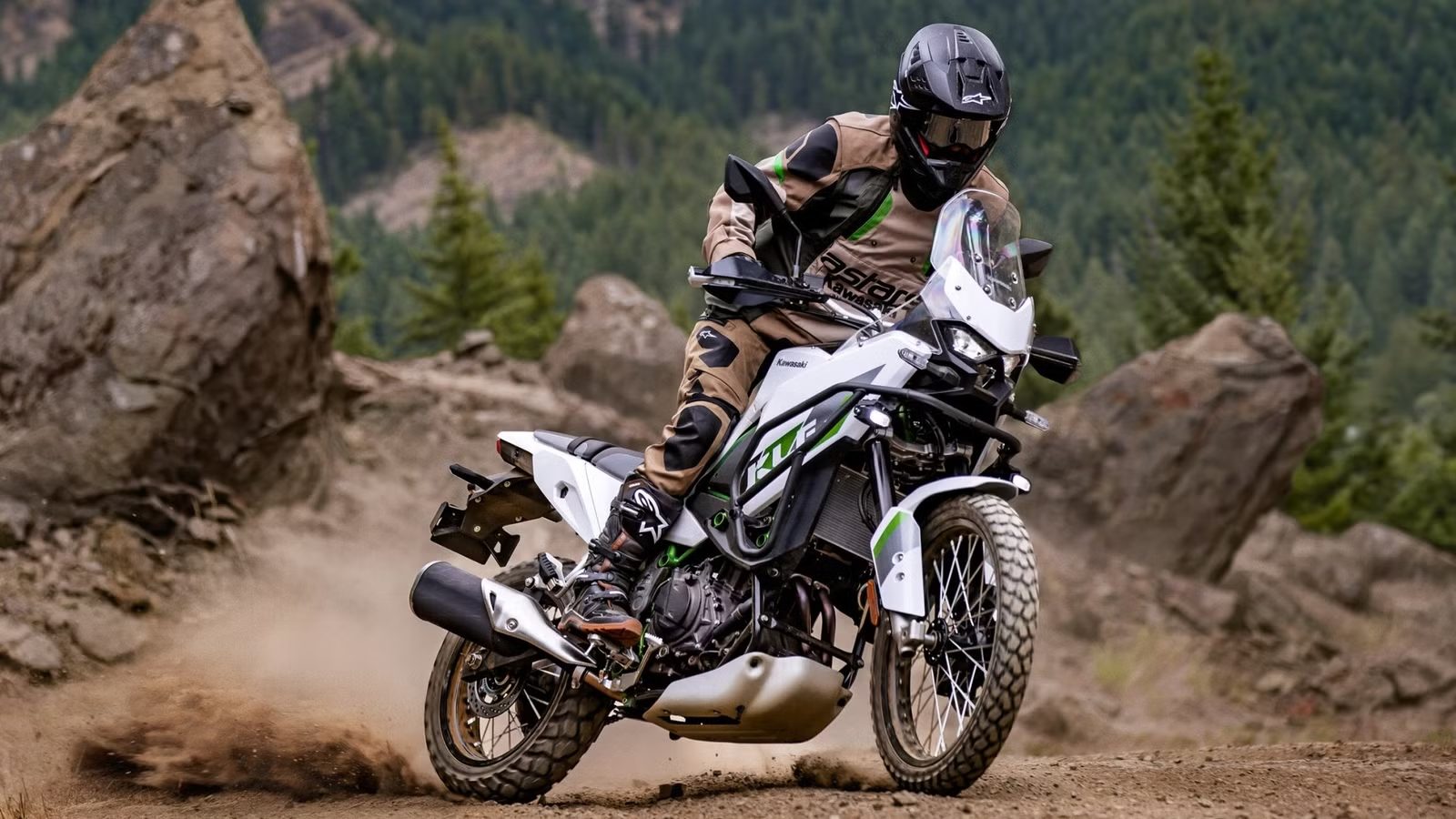
The 2026 Kawasaki KLE500 SE ABS Can Be Your Partner For Life
MSRP: $7,499
The KLE500 may not seem like a significant model to the outside observer, but it really does represent something of a watershed moment for Kawasaki. For years, the brand was content to plod along without a genuine adventure bike in its lineup — simply plugging the gap with a combination of outdated dual-sports, a small adventure tourer, and a middleweight touring bike. That’s changed now with the new KLE500, which promises to be a terrific option for a one-bike garage.


The Kawasaki KLE500 ticks almost all the boxes you’d expect from an adventure bike worth keeping long term. It pairs a reliable, adequately powerful parallel-twin engine with a lightweight trellis frame and long-travel suspension, and its ergonomics are genuinely designed with comfort in mind. The one notable shortcoming is its low ground clearance, which chips away at the bike’s off-road credentials. Even so, the KLE500 is the real deal — it just has to earn its place in a long list of equally capable small-bore adventure bikes in this fiercely competitive segment.
Kawasaki KLE 500 vs. The Competition

The Honda NX500 has been around for ages now — previously known as the CB500X — and is a like-for-like competitor in terms of size and weight. It differs in that it is more street-biased as an adventure tourer. But it is one of the few bikes in this space that you might genuinely consider keeping long term. As long as you are willing to accept its limitations, it is a fantastic light-duty tourer that is more comfortable than any of the other small ADVs.

Of all the Chinese bikes competing in this space, the CFMoto Ibex 450 is the one genuinely worth a look. It is reasonably comfortable for a relatively small bike and extremely competent off-road. KTM had a year to forget in 2025, but one bright spot to emerge was the updated 390 Adventure R. It is also relatively comfortable and boasts the best suspension and electronics package of any bike in this group.
The KLE500 Has A Reliable Twin

|
Engine Type |
Power |
Torque |
Transmission |
Weight |
|---|---|---|---|---|
|
451cc parallel-twin |
51 HP @ 10,000 RPM |
31.7 LB-FT @ 7,500 RPM |
6-speed, return shift |
430 Pounds |
The main reason we feel the KLE500 is a bike you could theoretically hold on to for a long time is its powertrain. With 51 horsepower on tap, it is both approachable for new riders and punchy enough to reach highway speeds without fuss. More experienced riders will also enjoy pushing its limits, particularly off-road. It delivers versatile performance that should feel at home in most riding conditions.
It’s A Proven Parallel-Twin

Crucially, this parallel-twin is not a new or unproven unit. It was introduced some years ago in bikes like the Ninja 500 and the Eliminator before making its way into an adventure chassis. It’s a well-sorted powerplant that should deliver years of service with minimal maintenance — a genuine feather in the KLE500’s cap, giving owners the confidence that this is a bike that won’t disappoint them over the years.
Issues With The Engine Layout
Kawasaki clearly ran into some difficulty with engine placement in the chassis. Getting a powerplant designed for street use to work effectively in an off-road-oriented chassis is one of the biggest challenges any adventure bike designer faces. It is a delicate balance between ground clearance and weight distribution, and it is fairly clear that ground clearance lost this particular fight. The KLE500 is noticeably limited in this department.
The KLE500 Proves That You Don’t Necessarily Need A Middleweight

The KLE500 manages only 7.3 inches of ground clearance — a disappointing figure for a bike that’s expected to venture off-road. But ground clearance is only one piece of the ADV puzzle. The KLE500 is built around a steel trellis chassis that is genuinely sporty and a real point of difference on the road, which should make it handle well and be rewarding to ride through a mountain pass.
Lightweight Build Matters More Than Ground Clearance

That frame also keeps overall weight impressively low, which arguably matters more than ground clearance once you’re actually off-road. You won’t be clearing logs, but the light weight makes the bike far easier to manage when the going gets tough, especially for less experienced riders. And if you do drop it, picking up a lighter bike is considerably less of an ordeal.
Plenty Of Suspension Travel For Light Off-Roading

The suspension offers a respectable amount of travel: 8.3 inches at the front and 7.7 inches at the rear. Up front, the bike gets a 21-inch wire-spoke wheel, paired with a 17-inch wheel at the back — an unusual combination. A 21-inch front wheel is more commonly paired with an 18-inch rear. Kawasaki’s reasoning isn’t explicitly stated, though the choice may be related to keeping seat height in check; that remains speculation on our part.
Neutral Ergonomics And All The Right Things In Place

Long-term ownership only works if the bike is comfortable to live with. Fortunately, the KLE500 doesn’t disappoint here, particularly thanks to its customizable seating options. It offers neutral ergonomics, with an elevated handlebar and slightly foot-forward pegs. Kawasaki says this makes riding both on-road and off-road easier, and even the seat has been designed to “minimize impediments” when moving around on the bike.

In terms of features, the standard KLE500 offers an LED headlight and taillight, an adjustable rally-style windscreen, an aluminum skid plate, and switchable ABS. It’s worth stepping up to the KLE500 SE ABS model, however, which adds some genuinely useful extras: a 4.3-inch TFT display with smartphone connectivity, LED turn signals, a taller windscreen for improved wind protection, metal-reinforced handguards, and a larger skid plate.

Compared to other models in the segment, the KLE500 does feel a little light on electronics. That’s not necessarily a criticism — keeping things simple will almost certainly benefit long-term reliability. The honest reality, though, is that some features modern riders have come to expect are simply absent here, and that will be a sticking point for some buyers.
Worth The Wait, But Far From Perfect

Put it all together and you can see why the KLE500 was worth the wait. That said, this is a bike that will resonate most strongly with riders who want a simplified, durable package built to last. Some will dismiss it as just another beginner bike, but that would be a mistake. This is genuinely a motorcycle someone could buy as their first and simply never need to replace. It strikes an excellent balance between street performance and off-road potential.

It certainly took Kawasaki a while to bring this bike to market, but as with most things the brand produces, it’s clear that considerable thought has gone into it. The low ground clearance remains a caveat for some, but it’s still not a dealbreaker. The KLE500 may be aimed at new and returning riders, but it will also appeal to adventure enthusiasts seeking a simple, lightweight ADV that isn’t a nightmare to pick up after a minor spill on the trail.
Source: Kawasaki, CFMoto, KTM, Honda

Related posts


Latest Post



No Comments