
The Motorcycle Triumph Fans Keep Coming Back To
Motorcycle loyalty is a strange thing. Riders can be fiercely attached to a brand one year and happily walk into a rival showroom the next. A new engine, better electronics, a sharper chassis, or simply a better deal can be enough to change minds. S&P Global Mobility found that brand loyalty for motorcycles and powersports had fallen to 50.4 percent in 2022 before recovering to 57.2 percent in 2024, showing just how volatile the industry is.

So what makes a rider return to the same badge instead of chasing the newest machine on the market? It’s usually a blend of things like an iconic moniker, regular updates, and growing with the times. A Triumph roadster serves as a brilliant example of that today.
Most Motorcycles Never Solve The Brand-Loyalty Problem
Most riders don’t repeat-buy within a single marque. They might start on a Japanese standard, move to a European adventure bike, then land on an American cruiser a decade later, chasing whatever fits the season of life they’re in. That’s not disloyalty so much as it’s just how the market works now — motorcycles are purchased based on price, performance, and current fashion, and all three of those things have short shelf lives.

A bike that’s the best value in its class this year probably won’t hold that title in three years, and a styling trend that feels fresh today reads dated by the next model cycle. Building genuine loyalty into a motorcycle is therefore unusually hard. It requires a bike willing to resist becoming a moving target, to stay itself while everything around it updates. Few manufacturers manage it consistently. Triumph has, and it’s done so with one bike in particular.
The Anchor Of Hinckley’s Modern Classic Lineup

Triumph has arguably become one of the strongest names in the modern-classic category because it understands this balance better than most. The Bonneville name dates back to Triumph’s legendary 1959 model, and today’s T120 remains deliberately connected to that history. While rivals reinvent themselves to chase relevance, Triumph’s dealers report repeat-customer rates around this one model that run noticeably above category norms — riders trading in a Bonneville for another Bonneville, or moving laterally into a stablemate, rather than walking out the door to a competing brand.
The Triumph Bonneville T120 Keeps Attracting Buyers Year On Year
Base Price: $13,995

The Triumph Bonneville T120 is the British brand’s halo product in its modern classic lineup, and a $13,995 starting price puts it in a strange, thin slice of the market. Kawasaki’s W800 undercuts it by roughly $3,300, but it’s a smaller-displacement, lower-spec machine built to a price point. BMW’s R 12 nineT starts closer to $16,295 and leans harder into premium boutique territory. Honda, for what it’s worth, doesn’t compete here at all anymore.
The T120 sits almost alone: enough displacement and hardware to feel substantial, not so much cost that it becomes a boutique purchase. It’s not the entry-level T100, and it’s not the sportier Speed Twin. Of everything in Triumph’s modern-classic range, the T120 is the one built to be a daily companion for the long haul rather than a specialist tool, and that generalist role is exactly why it ends up at the center of the loyalty pattern — it’s the bike people actually live with.
Why Owners Keep Returning

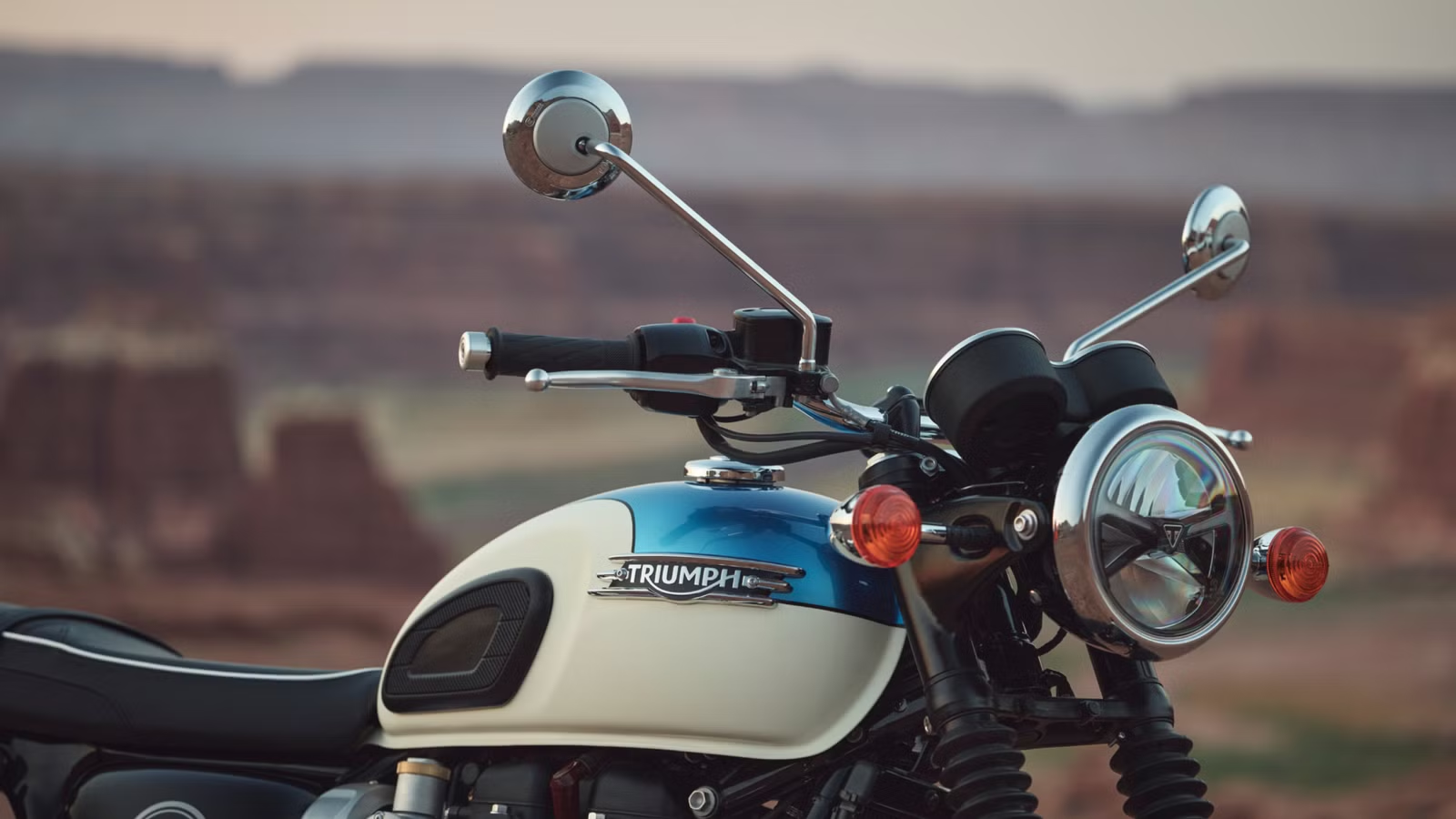
Talk to enough T120 owners and two words come up constantly: authentic and unkillable. The styling — chrome switches, a sculpted tank with knee cutouts, twin clocks on the bars — reads as period-correct rather than costume-party retro, and it hasn’t needed a redesign to stay convincing. Reliability does the rest of the work. Riders who’ve put 40,000-plus miles on one without a major failure tend not to go shopping elsewhere for their next bike.
That combination has made the T120 something like a reference point for the whole modern-classic segment in North America — the bike other manufacturers’ retro twins get measured against, whether they admit it or not. There’s a practical side to that loyalty, too. Since the platform changes gradually rather than getting reinvented every few years, resale values hold up better than most of the segment, and owners trading in a T120 rarely feel like they’re taking a bath on depreciation.
A Parallel-Twin Character That Hasn’t Aged Out

Triumph’s 1,200cc high-torque twin puts out 78.9 hp at 6,550 rpm and 77.4 lb-ft of torque at just 3,500 rpm. The SOHC 8-valve, liquid-cooled twin runs a 270-degree firing order, which staggers the pistons, so the engine fires unevenly rather than in a straight line. The payoff is a syncopated, almost lopsided exhaust note that owners describe as the bike’s signature — distinct from the smoother hum of a 360-degree parallel twin, without needing a V-twin’s extra cylinder-bank complexity to get there.
Engineering Updates That Refined The Ride

The current-generation engine isn’t a nostalgia act, sitting untouched since 2016. Triumph reworked the internals with a lighter crankshaft alongside an optimized clutch and balancer shafts, shedding rotating mass without touching the character riders already loved. The result is a throttle that responds more immediately and an engine that revs more freely than the outgoing version, even though peak power and torque numbers barely moved. Reduced rotational inertia also means smoother gear changes and noticeably less buzz through the pegs and bars once the T120 settles into 70-mph interstate cruising.
Ergonomics Built To Keep Riders On The Same Bike For Decades

A 31.1-inch seat height and genuinely upright ergonomics mean the T120 doesn’t ask riders to fold themselves into a sportbike crouch or stretch into a cruiser’s forward-set pegs. It’s a neutral position that works for a 45-minute commute and a 400-mile weekend equally well, and it accommodates two-up riding without turning into a compromise. Up front, 41mm cartridge forks pair with twin rear shocks carrying adjustable preload — nothing exotic, but tuned toward comfort over track-day sharpness. Lean-sensitive cornering ABS and traction control, standard as of this model year, quietly cover for it if the pace or pavement ever get away from the rider.
Premium Chassis Hardware And Braking

Up front are twin 310mm discs with Brembo two-piston calipers, backed by ABS. At the rear is a 255mm disc with a Nissin two-piston caliper. It is a substantial setup for a classic roadster. The aluminum-rimmed 32-spoke wheels also help keep the T120’s traditional appearance intact while contributing to manageable handling. Triumph’s previous updates reduced overall weight, and the resulting chassis is said to be more agile than the bike’s substantial 520-pound wet weight might suggest.
Modern Rider Aids Without Cockpit Clutter

None of this comes wrapped in a screen full of menus, either, which is essential for a bike built to feel timeless. The instrument cluster keeps a pair of analog clocks — speedometer and tachometer — with a small digital multi-function display tucked between them for trip data, gear position, and range. Cruise control comes standard, a genuine convenience on the interstate slogs American touring routes demand and something plenty of competitors still charge extra for.
A ride-by-wire throttle underpins switchable Road and Rain modes, adjusting delivery without changing the character riders bought the bike for. Switchable traction control and ABS round it out, there when needed and invisible when not. It adds up to a motorcycle that updates itself just enough to stay relevant without ever asking longtime owners to relearn what they love about it. Compare that to a competitor that swaps its entire platform every few years, and it’s easy to see why so many riders default back to the Bonnie T120 instead of shopping around.
Source: Triumph Motorcycles

Related posts



Latest Post


No Comments