
The Motorcycle That Shows Kawasaki Still Knows How To Build Driver’s Bikes
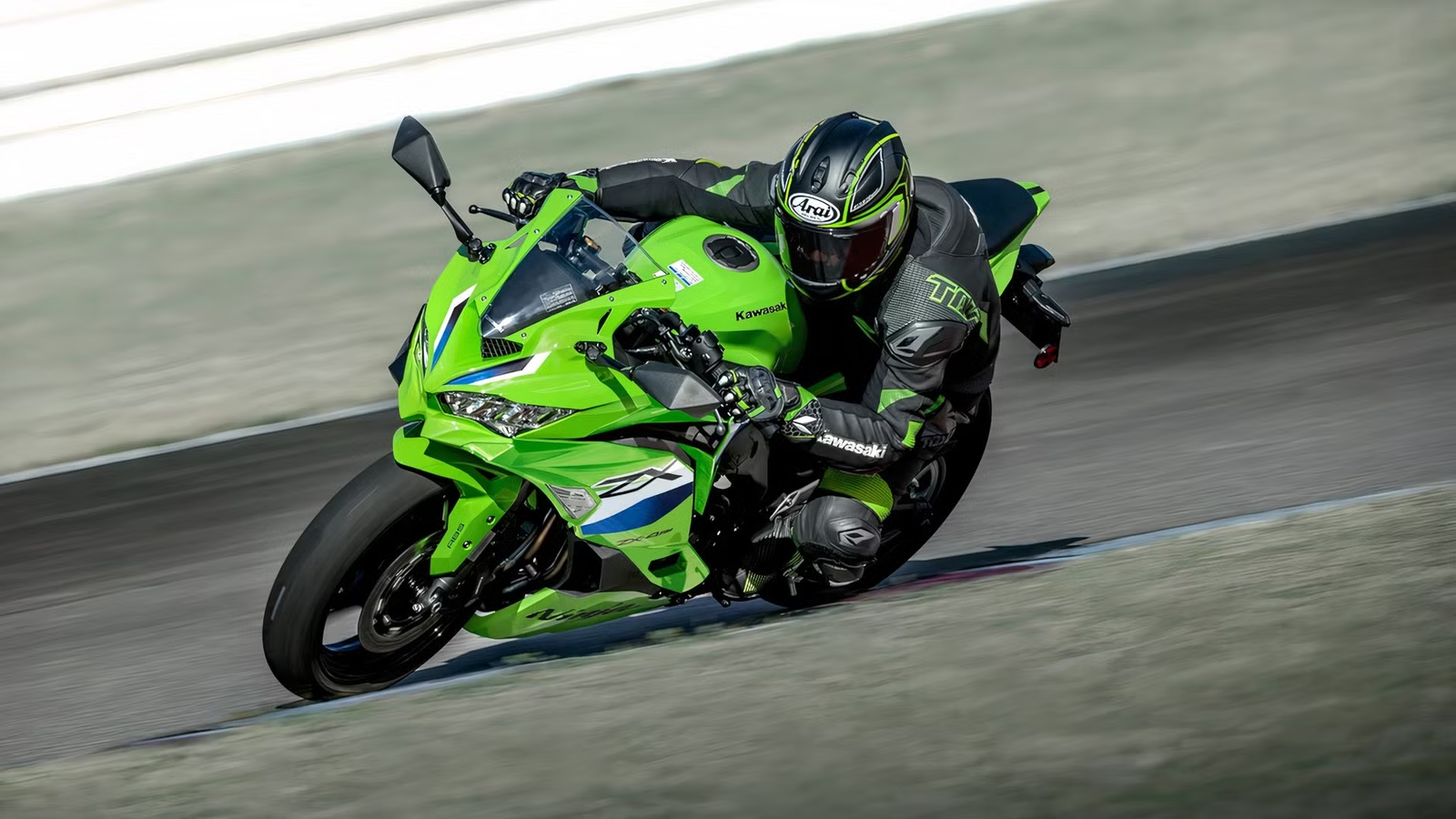
There’s an argument that modern performance motorcycles have become too good at their jobs. Big engines make effortless speed, sophisticated electronics manage the consequences, and numbers that once belonged to race bikes are now available with license plates and heated grips. None of that is bad, but it does make you wonder whether involvement has been pushed aside by outright capability. Kawasaki, of all companies, has a motorcycle that answers that question rather loudly.
Small-Displacement Performance Used To Mean Something Different

There was a time when choosing a smaller sports bike didn’t automatically mean settling for a basic parallel-twin built primarily around commuting, insurance costs, and beginner friendliness. Through the 1980s and 1990s, Japanese manufacturers built miniature performance machines with sophisticated multi-cylinder engines, proper sports bike chassis, and redlines that seemed absurd for their displacement. A 250cc or 400cc motorcycle could be engineered with the same enthusiasm normally reserved for something much larger.
Many of those bikes used screaming inline-four engines that made their best power high in the rev range, so extracting speed meant constantly interacting with the machine. Riders had to chase revs, work through close-ratio gearboxes, preserve momentum, and be deliberate with corner speed because there wasn’t a huge wave of torque waiting to fix a lazy exit. They weren’t necessarily intimidatingly fast in outright terms, but getting everything out of them required participation. That was exactly the point.
Four-Cylinder Screamers Are Getting Rarer Today

That recipe largely disappeared as emissions regulations tightened, development costs climbed, and manufacturers increasingly prioritized engines with stronger low-end and midrange torque. Modern 300cc and 400cc sports bikes became easier to ride, more economical, and far more useful in everyday traffic, but most also converged around relatively simple single-cylinder and parallel-twin layouts.

The screaming little multi-cylinder engines that once defined the class gradually became relics of another era. Kawasaki, however, decided there was still room for something less sensible. Rather than build another lightweight twin, it revived the high-revving inline-four formula and surrounded it with the chassis, suspension, braking hardware, and electronics you’d normally expect from a much larger supersport.
The Kawasaki Ninja ZX-4RR Dares To Challenge The Status Quo

That motorcycle is the Kawasaki Ninja ZX-4RR, and what makes it remarkable isn’t simply that its engine is unusual. Among today’s mainstream manufacturers, nothing else in the 400cc sport bike class follows the same formula. While rivals have largely standardized around singles and parallel-twins, Kawasaki offers a fully faired 399cc inline-four supersport. It’s effectively keeping an entire category of motorcycle alive almost by itself, which makes the ZX-4RR more than another small sport bike.
Its liquid-cooled, DOHC inline-four uses 16 valves, a 12.3:1 compression ratio, four 34mm throttle bodies, and a short-stroke 57.0mm by 39.1mm bore and stroke. Kawasaki rates it at 56 horsepower at 11,500 rpm and 26.5 pound-feet at 11,000 rpm. Power goes through a six-speed transmission, an assist-and-slipper clutch, chain final drive, and a standard bidirectional quick shifter. At $9,999, it costs substantially more than conventional entry-level sports bikes, but there’s little conventional about what you’re buying.
Proper Supersport Chassis Hardware Hides Under The Skin

Kawasaki didn’t simply install an exotic engine in a bargain chassis. The ZX-4RR uses a high-tensile-steel trellis frame with a 23.5-degree rake, 3.8 inches of trail, and a 54.3-inch wheelbase. Up front is a 37mm inverted Showa fork with separate-function big-piston internals, spring-preload adjustment, and 4.7 inches of travel. The rear gets a gas-charged Showa shock with a piggyback reservoir plus adjustable preload, compression, and rebound damping, with 4.9 inches of travel.
Braking hardware follows the same philosophy. Twin 290mm semi-floating front discs are grabbed by radial-mount four-piston monobloc calipers, while a 220mm disc and single-piston caliper handle things at the rear. ABS is standard. The 17-inch wheels wear a 120/70 front and 160/60 rear tire, keeping the package relatively narrow and agile. It’s serious enough for track use without turning the motorcycle into something exhausting to ride away from a circuit.
Compact Doesn’t Necessarily Mean Featherweight

At 414.5 pounds ready to ride, the ZX-4RR isn’t dramatically lighter than some larger-displacement motorcycles. Kawasaki also lists an estimated dry weight of 383.7 pounds. What matters more is how tightly everything is packaged. Seat height is 31.5 inches, ground clearance measures 5.3 inches, and overall dimensions come to 78.3 inches long, 30.1 inches wide, and 43.7 inches tall. The fuel tank holds 4.0 gallons.
The resulting proportions keep the bike approachable without turning it into a scaled-down imitation of a supersport. Kawasaki gave it the riding position, chassis geometry, braking hardware, and suspension adjustment to encourage riders to use what the engine offers. That combination is important because the ZX-4RR’s appeal isn’t based on winning a horsepower-per-dollar argument. Plenty of motorcycles offer substantially more outright shove for similar money. Few ask you to extract performance in quite the same way.
Modern Electronics Haven’t Been Left Out

The old-school engine character doesn’t mean living with old-school electronics. The 2026 ZX-4RR gets selectable power delivery, three-level traction control, ABS, and several integrated riding configurations. Its standard quick shifter works in both directions, letting riders keep the engine on the boil without constantly reaching for the clutch. There’s enough assistance to make the motorcycle easier to use aggressively, but its relatively modest output means the electronics aren’t constantly trying to restrain an absurd amount of power.
A 4.3-inch full-color TFT display handles instrumentation and includes smartphone connectivity. Kawasaki offers the 2026 model in Lime Green, Metallic Matte Graphenesteel Gray with Metallic Spark Black, or Pearl Robotic White with Metallic Spark Black. It’s a surprisingly complete package for something whose central idea is so wonderfully straightforward: give riders a small four-cylinder engine, enough chassis underneath it to exploit that engine, and plenty of reasons to keep shifting.
There’s More To Performance Than Going Faster
Motorcycling has no shortage of faster choices. Kawasaki itself will happily sell you machines with far more horsepower, while today’s middleweight class can deliver stronger acceleration without requiring nearly as much effort. But that’s precisely why the ZX-4RR matters. Its performance isn’t something you merely request with your right wrist. You have to go looking for it, carry revs, use the gearbox, manage momentum, and deliberately put the motorcycle where it works best.
That’s what makes the ZX-4RR such a convincing reminder that Kawasaki still understands the appeal of a driver’s bike, even if motorcycles technically have riders. The objective isn’t simply to reach the next corner as quickly as possible. It’s to make the stretch between those corners entertaining. In an era when adding displacement, horsepower, and electronic intervention is often the easiest route to better numbers, Kawasaki built something that asks more from its rider instead. And that’s exactly why it stands out.
Source: Kawasaki

Related posts




Latest Post


No Comments