
The Motorcycle That Makes You Forget About Riding Fast
New motorcycles broadly aim to make their mark on the same scoreboard: a 0-60 time, a horsepower figure, ride modes, and a promise that the motorcycle is ‘smarter’. Manufacturers lean on these quantitative differences as they are easier to compare, and that has quietly made “better” the shorthand for “faster”.

But speed was never the only thing a motorcycle could offer, and some of the most satisfying rides happen well under triple digits. There’s a version of riding that has nothing to do with outrunning anything. The appeal is in how a bike feels at 45 mph, not what it might theoretically do at 145. That’s a different kind of motorcycle. It does not ask “how fast can this go,” but “how good does it feel to simply be on it.”
Some Machines Aren’t Built To Impress You With Speed
Not all motorcycles are designed to be measured against a stopwatch. Some motorcycles are built around rhythm instead of urgency — a steady, predictable mechanical flow that never asks you to keep up with it. The whole experience is engineered around the ride itself. There’s no acceleration curve to chase and no lean-angle number to beat; the goal is simply time in the saddle that feels good on its own terms.

It’s a philosophy most motorcycle manufacturers have abandoned. In a world where new is a synonym for better, manufacturers focus on offering something motorcycle riders have not experienced before instead of honing the experience they are already used to. Royal Enfield has, however, bucked that trend.
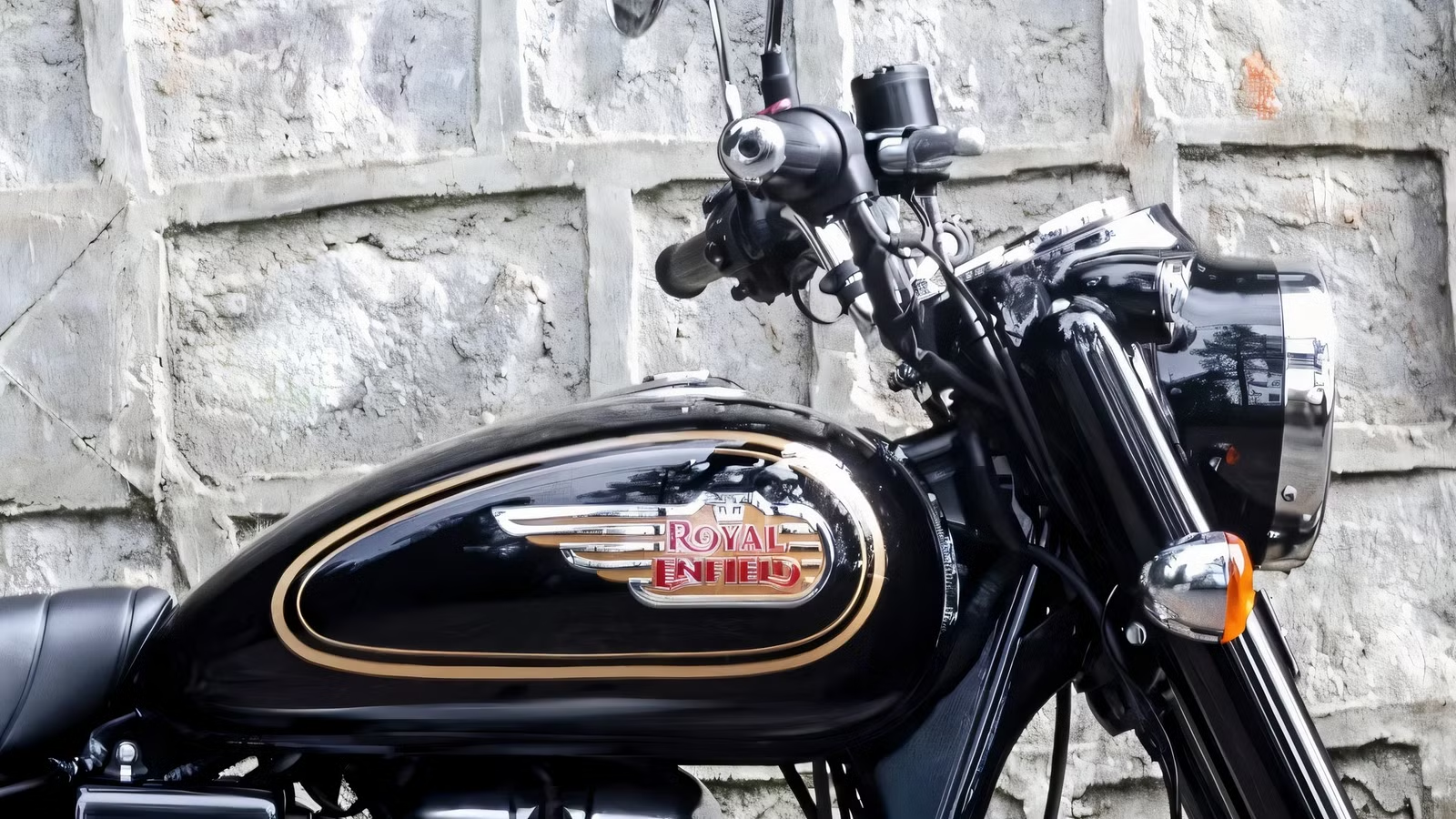
The Royal Enfield Bullet 650 Never Runs Out Of Patience

The 648cc parallel-twin engine on the Bullet 650 makes a modest 47 horsepower, and on paper that reads like a limitation. On the road, it reads like a personality trait. Peak torque might arrive above 5,000 rpm, but most of the shove can be felt lower in the rev band, and the power delivery stays gentle and linear from there. There’s no flat spot to manage, and no narrow power-band where the bike suddenly wakes up. It just pulls, evenly, whether that’s rolling away from a stop sign or holding a steady 55 on a two-lane road.
The patience isn’t limited to the powerplant. Royal Enfield kept the rest of the bike just as uncomplicated. No elaborate electronics suite to configure, no touchscreen to navigate before you can just ride, and the mechanical layout beneath the fuel tank is about as straightforward as a modern motorcycle can get away with. It’s a bike that behaves the same way in traffic as it does on a backroad, and doesn’t have moods depending on which mode it’s currently in.

The riding position reinforces all of it. It’s upright and relaxed, the seat is low enough to feel planted at every stoplight, and the controls don’t demand precision timing to use well. Nothing about the Bullet 650 asks you to hurry up.
The Bullet 650 Talks To You, Not At You

Modern motorcycles increasingly communicate through screens. The Bullet 650 communicates the old-fashioned way: through vibration, sound, and resistance from the handlebar you can feel in your hands. It delivers all the information directly, without translation, the way motorcycles did for decades before anyone thought to put a processor between the rider and the road.
No Notifications, Just Needles

The Bullet 650 features an analog speedometer and a small trip readout. The instrument cluster tells you your speed and leaves the rest of the ride to your senses, which turns out to be plenty of information for a bike with this kind of temperament. You end up reading the engine note and the vibration through the pegs more than you read the gauge anyway.
A Clutch And Throttle With Something To Say

The clutch pull is light but has a real feel to it, and the throttle isn’t tuned to be numb or overly assisted, and both give consistent, honest feedback. You can feel the Bullet 650’s engine load up as you roll on, feel exactly where the clutch engages, feel the small mechanical resistance that tells you a cable is doing the work rather than a sensor guessing at your intent. It’s the kind of mechanical honesty that’s gone missing from a lot of throttle-by-wire setups, where the connection between input and response doesn’t feel direct.
No Electronics To Rob The Connection

Barring dual-channel ABS, there’s zero electronic intervention on the Bullet 650. No ride-by-wire throttle mapping, no multiple power modes, and no layers of intervention between rider input and the rear wheel. What you give the bike is what the bike does. Such directness is often undervalued until you’re back on something more processed, and you notice how much of the ‘feel’ got filtered out along the way. The Bullet 650 doesn’t have anything to disable in a menu because there’s nothing there to begin with; the connection is the default state, not a setting you have to go looking for.
Wearing The Bullet 650’s Weight Like A Worn-In Jacket

At 536 pounds curb weight, the Bullet 650 is not a light motorcycle by modern standards, and Royal Enfield doesn’t disguise that. The semi-cruiser stance puts the weight low and centered, and combined with the wide handlebar and stretched-out riding position, the bike feels settled rather than cumbersome once it’s moving. It tracks straight, shrugs off small road imperfections, and never feels twitchy or nervous at cruising speed. That heft becomes part of the calm.
Where The Weight Actually Shows Up
The one place the Bullet 650’s weight introduces itself honestly is at parking-lot speeds. Tight, full-lock U-turns and slow-speed maneuvering require a bit more forearm effort and forward planning. It’s not unwieldy, but it requires strong and steady hands. It’s a reminder that the same mass making the bike feel so composed at 45 mph is still there when you’re walking it backward into a parking space or muscling it around in a crowded lot. Anyone switching over from a smaller or lighter machine will spend a few days recalibrating before they’re fully comfortable threading it through tight spaces, but it’s a small tax to pay for how planted the bike feels everywhere else.
Living With The Bullet 650, One Unhurried Mile At A Time

Starting at $7,799, the Bullet 650 makes its case through character rather than outright performance. Day to day, the Bullet 650 doesn’t ask for much. Service intervals are straightforward, and the mechanical simplicity that defines the ride also keeps maintenance approachable. The bike is just as happy running errands as it is on a weekend ride, and it rewards patience over aggressive riding.
Live with it long enough and the appeal stops feeling like a compromise and starts feeling like the actual point. There’s no itch to find an on-ramp and see what the bike can really do. What you feel at 45 mph is what you get, all the time, and that consistency turns out to be its own kind of reward. That’s the case for a motorcycle like this. Not every ride needs to prove something on a spec sheet. Sometimes the best version of riding fast is simply not thinking about speed at all — and the Bullet 650 is built entirely around that idea.
Source: Royal Enfield

Related posts




Latest Post


No Comments