
The Motorcycle That Explains Japan’s Dominance
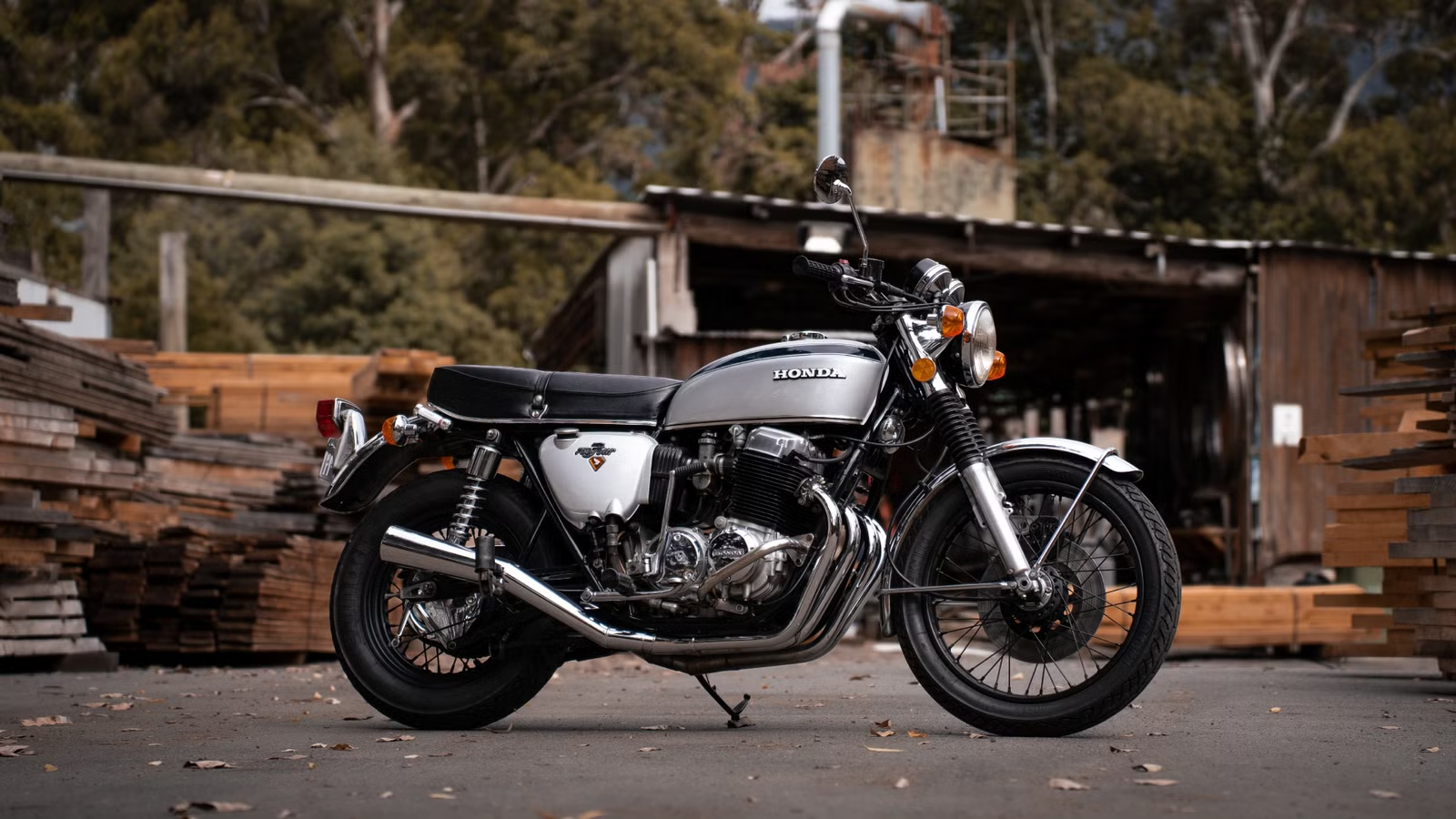
Today, the big four Japanese motorcycle manufacturers dominate the industry. With a wide selection of high-quality products at affordable prices, it is pretty easy to see why, but it was not always this way. It took a war and a series of unfortunate events for other manufacturers for things to turn out this way. Up until the early 60s, it was actually the British motorcycle industry that was the envy of the world. Here, we tell you how Japan eventually turned its fate and took over the two-wheeler world, thanks to a certain Honda.
The Collapse Of The British Motorcycle Industry

Once the dust had settled after the Second World War, much of Europe went through a long rebuilding phase. Motorcycles became a big part of this rebuilding phase, providing the masses with basic (somewhat) reliable transportation. Manufacturers sprang up and just as quickly went out of business all over the place. But while others struggled, the British motorcycle industry thrived. By the late 50s, they were at the peak of their powers, but cracks were already beginning to appear.
With labor costs rising, in part thanks to the demands of the unionized workforce, manufacturers were forced to cut corners in other areas. Chief among which was product development, as manufacturers seemed determined to churn out the same bikes they always did, almost in blind hope, rather than any form of strategy. Alarm bells should have been ringing when the first Japanese motorcycles arrived in the 60s, but they instead chose to leave the door wide open. One bike in particular rode straight through that door and brought down the house of cards.
The Original Honda CB750 Completely Changed The Game


By the late 60s, Japanese manufacturers had already proven that it was possible to mass-produce reliable motorcycles. But none of the established players thought that they would ever wade into the high-performance sector. This made the arrival of the CB750 that much more unexpected. Not only was it reliable, but it was also both fast and affordable. At the time, there was nothing else quite like it on the market, and it forced answers out of all the competition. For some, there was no answer.
This Inline-Four Set The Foundation For Japanese Dominance
Power: 67 Horsepower

By the time the CB750 came out, the inline-four engine configuration had already been used in other motorcycles, but nobody had been able to mass-produce it. The ability to do this gave not just Honda, but all the Japanese manufacturers a competitive advantage. While Honda was the first of the big four to offer a high-performance motorcycle equipped with an inline-four, the other three Japanese manufacturers were quick to follow.
Quality Shines Through

All of these bikes offered exceptional build quality for the price. It was this ability to replicate these high standards over and over again that really set them apart. While the European and American bikes of the time were generally well-made, the quality was inconsistent, and when compared to the Japanese equivalent, the price just seemed high. For customers with no brand affiliation, it became an easy decision to switch over to a Japanese-made motorcycle.
Then Came The Universal Japanese Motorcycle Years

All the way through the 70s, these UJMs dominated the industry. Each of the four Japanese manufacturers offered at least a couple of options, and while all the other manufacturers struggled to make ends meet, they went from strength to strength, with one exceptional bike after another. Today, it isn’t actually particularly hard to find one of these bikes, in running condition no less, for next to nothing. Parts are relatively easy to come by thanks largely to how incredibly popular they were at one time, and are not as difficult to keep on the road as some would have you believe.
Unfortunately, there was some level of collateral damage. The British motorcycle industry all but ceased to exist, largely thanks to these bikes that simply offered superior value. Several smaller European brands also went under, and Harley-Davidson also came within a whisker of disappearing. The glory days for UJMs would also come to an end by the early 80s, when more sporty motorcycles rose to prominence, and the birth of the fully-faired sport bike sounded the death knell. But that was simply the end of one Japanese dynasty, and the rise of another.
Honda Just Released A Modern Version

For a time, it seemed as though the UJM, or at least the concept of a UJM, was dead. But history has a way of repeating itself, and Honda just rolled back the years to give us a retro bike that doesn’t just look fantastic, but actually revives the whole value-based concept. The CB1000F cleverly calls back to one of the very best designs, that of the CB900F from the early 80s. Its distinct lines and livery are timeless, and won’t just appeal to retro fans, but to pretty much anyone in the market for a great street bike.
For just over $10k, it actually offers even more bang for the buck than the original (if you adjust for inflation). It might not be perfect, but all the elements are there, from its powerful inline-four to the exceptional build quality, and for modern riders, a long list of features. While the CB750 is able to illustrate why Japan has dominated the motorcycle industry for so long, it can’t possibly tell the full story. The modern version of that bike helps fill in a few blanks, though.

It serves to illustrate how Japan has figured out how to deliver precisely the right motorcycle at exactly the right time. For the most part, prices have been increasing throughout the industry, and just like the CB750 was exactly the right bike for the time back in the 70s, the CB1000F is the right bike for today. This is not just limited to street bikes, though. You can see it in pretty much every segment, with a high-value Japanese bike selling well in every corner of the market and pretty much every corner of the globe.
Source: Honda Global

Related posts

Latest Post


No Comments