
The Most Powerful Japanese Inline-Four Engine On The Market In 2026
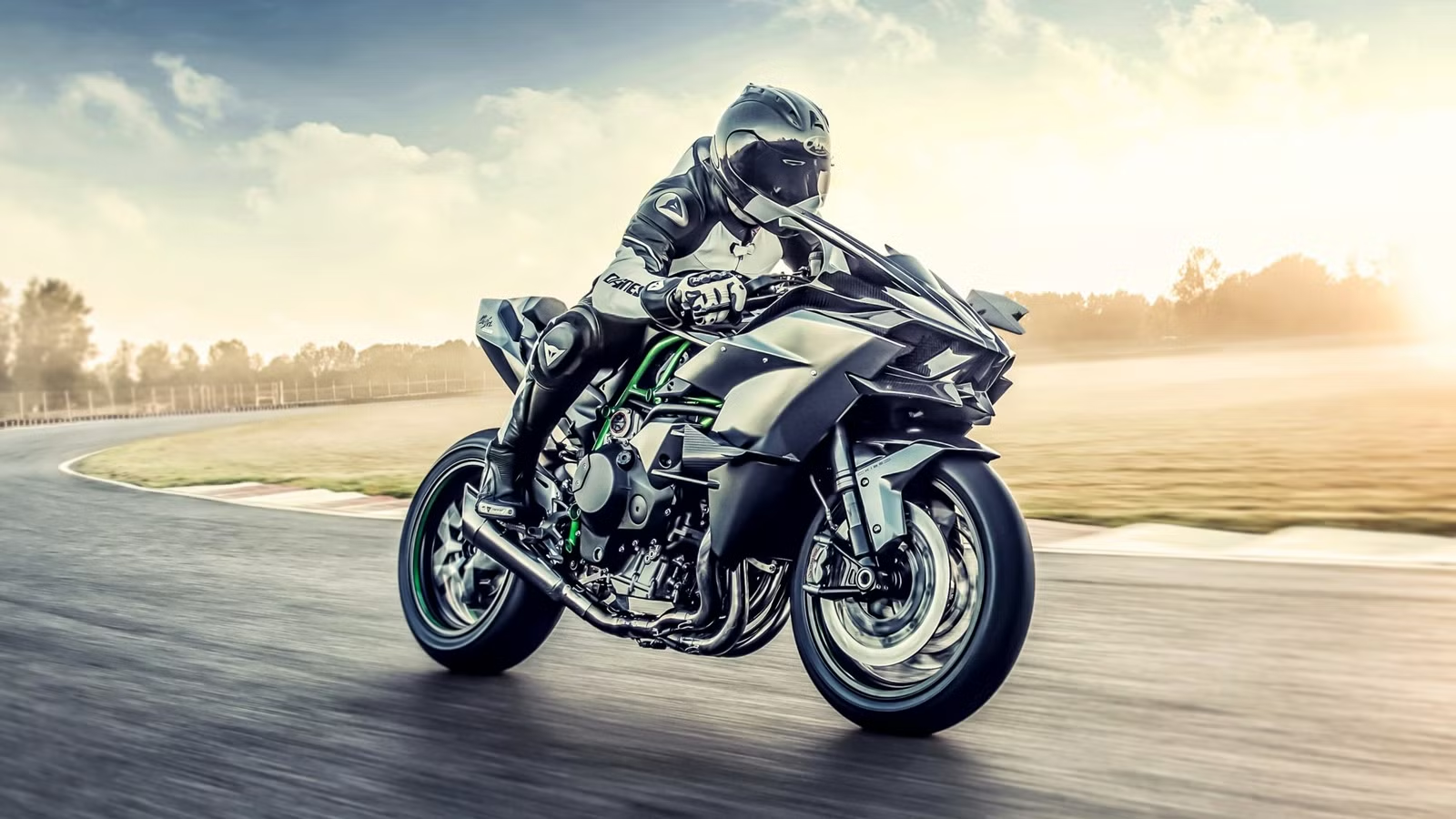
Few engineering decisions have shaped modern sportbike culture as profoundly as the inline-four engine. Japanese manufacturers have built their reputations on it for decades, and for good reason: the configuration delivers smooth, high-revving power, lends itself to straightforward maintenance, and enjoys deep aftermarket support. Kawasaki, Suzuki, and Honda all rose to global dominance with inline-fours at the heart of their flagship machines, and experienced riders continue to prize the layout for its linear power delivery and proven reliability.

Yet that very popularity breeds fierce competition, and sometimes a manufacturer has to do something extraordinary to rise above the noise. That’s exactly what Kawasaki did with its Ninja H2 lineup. Drawing on the full resources of parent company Kawasaki Heavy Industries, Team Green developed one of the most audacious motorcycle engines ever conceived: a 998cc inline-four mated to a centrifugal supercharger. The result is a powerplant that simply outmuscles everything else in the segment.
Kawasaki Ninja H2 R’s Mill Is The Most Powerful Japanese Inline-Four Engine Today
Horsepower: 322 HP; Torque: 121.5 Pound-Feet
Kawasaki’s 998cc four-cylinder engine is built with high-end performance in mind. The key to its character lies in a low compression ratio that raises thermal efficiency without sacrificing durability. Best suited to riders with competitive racing experience, this high-performance motor uses a lightweight dog-ring transmission to deliver smooth, precise, and instantaneous gear changes. Rather than sliding gears into mesh, the gears themselves remain stationary while the dog rings move to keep them engaged — a setup that virtually eliminates shift hesitation. A high-end hydraulic Assist & Slipper clutch further refines the package by minimizing rear-wheel chatter during aggressive downshifts.

For this motor to earn the title of most powerful factory-made inline-four on the market, KHI engineered it to deliver a truly unrivaled peak output. The 998cc displacement is just the starting point: a mechanical centrifugal supercharger force-feeds the engine approximately 200 liters of air per second at a pressure exceeding 2.4 atm, unlocking a staggering 322 horsepower at 14,000 RPM and 121.5 pound-feet of torque at 12,500 RPM. That translates to an impressive top speed of almost 250 miles per hour. For context, even the road-legal Ninja H2 — which runs a 90-horsepower deficit compared to the H2R — is more than most riders will ever need.
Kawasaki’s 998cc Four-Cylinder Supercharged Engine Highlights
- 322 horsepower @14,000 RPM
- 121.5 pound-feet of torque at 12,500 RPM
- Centrifugal supercharger
- 6-speed dog-ring transmission
- Hydraulic Assist & Slipper clutch
Advanced Underpinnings
Front Suspension: 43 mm inverted fork; Rear Suspension: Uni-Trak, Öhlins TTX36 gas-charged shock with piggyback reservoir
As powerful as Kawasaki’s 998cc supercharged engine is, the H2R demands an equally capable suspension and braking package to translate that output into usable performance. At the rear sits an Öhlins TTX36 gas-charged shock featuring a remote preload adjuster and piggyback reservoir, fully adjustable to give the rider precise feedback at any speed. Up front, 43mm inverted forks offer adjustable rebound and compression damping along with spring preload adjustability and top-out springs for a planted, communicative feel.
The braking system consists of dual radial-mount opposed four-piston Brembo Stylema front calipers clamping a pair of semi-floating 330mm discs for aggressive, immediate stopping power. The Brembo clutch and front brake levers were also specifically engineered to resist inadvertent activation from wind pressure at the extreme velocities the H2R is capable of reaching. Governing all of it is the hypersport-grade Kawasaki Intelligence Anti-Lock Brake System (KIBS).
Kawasaki Ninja H2R Underpinnings
|
Front Suspension |
43mm inverted fork with adjustable rebound and compression damping, spring preload adjustability and top-out springs |
|
Rear Suspension |
Uni-Trak, Öhlins TTX36 gas-charged shock with piggyback reservoir, 30-way compression and rebound damping adjustability, 16-way spring preload adjustability, and top-out spring |
|
Tire Size |
Front: 120/60 ZR17 V01F slick; Rear: 190/65 ZR17 V01R slick |
|
Brakes |
Front: Dual radial-mount, opposed 4-piston Brembo Stylema calipers, dual semi-floating 330mm discs, Kawasaki Intelligent anti-lock Brake System (KIBS); Rear: Opposed 2-piston calipers, single 250mm disc, Kawasaki Intelligent anti-lock Brake System (KIBS) |
|
Rake |
25.1 degrees |
|
Wheelbase |
57.1 inches |
|
Saddle Height |
32.7 inches |
|
Ground Clearance |
5.1 inches |
|
Weight |
476.3 pounds |
Ripe With All The Necessary Technologies
State-of-the-art electronics to keep you safe

On top of housing the most powerful four-cylinder engine on the market, the Kawasaki Ninja H2R is also among the brand’s most technology-intensive models ever produced. This motorcycle has been outfitted with key technological enhancements that helped the Kawasaki Racing Team (KRT) secure multiple championships. Chief among them is a compact IMU that monitors inertia across 6 Degrees of Freedom, tracking acceleration along longitudinal, transverse, and vertical axes while simultaneously measuring roll rate and pitch.
The IMU also enables an enhanced version of Kawasaki Traction Control (KTRC) that anticipates potential loss-of-grip situations and intervenes before excessive wheel slip can occur, maintaining ideal traction at all times. Kawasaki Launch Control Mode (KLCM) rounds out the core dynamic package. It’s a three-mode system that maximizes acceleration from a standstill by electronically managing engine output to minimize rear-wheel slip and front-end lift — all while allowing the rider to hold the throttle wide open. There’s plenty more to enjoy here, as you can see in the list below.
Kawasaki Ninja H2R Features
- Kawasaki Traction Control (KTRC)
- Kawasaki Launch Mode (KLCM)
- Kawasaki Intelligent Anti-lock Brake System (KIBS)
- Kawasaki Engine Brake Control (KEBC)
- Kawasaki Quick Shifter (KQS)
- Öhlins electronic steering damper
- Aerodynamic bodywork (for added downforce)
The Flagship Ninja, Truly
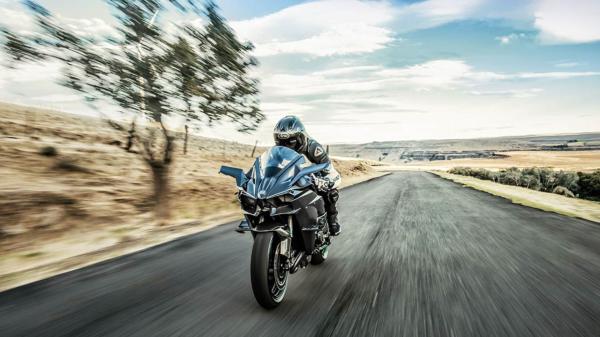
Kawasaki has been producing the Ninja since 1984, making it one of the company’s most enduring and successful sportbike nameplates. With a broad range of trims and configurations designed to suit riders at every skill level, the Ninja grew into one of the world’s most beloved sport bikes, equally adored by newcomers and seasoned enthusiasts. The Ninja H2R, however, occupies a category entirely its own.
The production of this limited-edition motorcycle draws on multiple collaborating divisions within KHI, each contributing expertise to create a supercharged machine that represents the absolute pinnacle of Kawasaki engineering. Available by order only, the Ninja H2R’s enormous power output is something best reserved for very experienced riders. In fact, the motorcycle is so extreme that it is not street-legal and can only be ridden on closed racetracks. For those who want supercharged thrills on public roads, the toned-down Kawasaki Ninja H2 offers a street-legal alternative.
Sources: Kawasaki

Related posts

Latest Post


No Comments