The Korean Luxury Sedan Nobody Recommends That Drives Better Than Its German Rivals
8 minutes reading
Wednesday, 17 Jun 2026 20:00 0 77 autotech
The recipe for the classic compact sports sedan has traditionally included a tight wheelbase, a mechanical limited-slip differential, a rear-wheel-drive bias that prioritized corner rotation, and enough road-feel in the steering wheel to keep you connected to the road. For decades, customers relied on the European establishment, which held a monopoly on this formula. If you wanted a premium sedan that communicated with your spine through a mountain pass, you bought from BMW, Mercedes, or anything German.
Today, however, that delicate balance seems to have shifted. Many of these vehicles that offered a luxurious yet tight and sporty experience have grown wider, heavier, and disconnected from the outside world, often due to overly insulated cabins and a heavy reliance on digital infrastructure and screen-heavy dashboards.
The Weight Of Legacy vs. The Reality Of Performance
BMW 540i M Sport rear 3/4 shotBring a Trailer
As the traditional giants of the sports sedan world have chased sales volume and tech-forward “lifestyle” branding, the cars that once defined driver connection feel muted and closer to the American land yachts of yesteryear. They are growing bigger, bulkier, and increasingly digitized. The tactile joy of a well-weighted rack has been replaced by “variable-ratio” software that feels like a video game controller. The mechanical honesty of a suspension that talks to you has been muffled by layers of over-insulation and “tech-office” aesthetics.
Brand heritage is one hell of a drug. It allows manufacturers to ride on the coattails of cars built thirty years ago while selling softened, mass-market products today. In the modern luxury market, a famous badge has become a mask for dynamic compromises. We are told we are buying a “racing pedigree,” but the reality is often a car designed to be as unoffensive as possible to as many people as possible.
How Modern Benchmarks Traded Agility For Digital Fluff
Mercedes interior with Disney+ on screenMercedes
The overarching trend in the segment is undeniable: bloat. Classic sports sedans, while still incredibly comfortable, have become “tech offices on wheels.” They are packed with features that are interesting on paper, like haptic sliders and driver-assistance systems that intervene the moment you try to explore the limit, but it’s hard to imagine the driver in this segment who is asking for these things.
The criteria for a real driver’s car haven’t changed. To this day, it is still a manageable wheelbase, an immediate steering rack, and a focus on mechanical balance over software intervention. Modern rivals have failed this test by adding weight and length to accommodate more “digital luxury,” resulting in a numb, clinical experience.
10 Performance Sedans That Outclass Sports Cars
This list celebrates ten extraordinary sedans that challenge the notion that conventional sports cars are the ultimate driving machines.
The Genesis G70 Is The Overlooked, Underappreciated Korean Luxury Sedan
A beauty shot of a 2026 Genesis G70 Prestige Graphite trimGenesis
When the G70 first came out, the industry was largely skeptical, but as the awards started piling up, it became clear that it wasn’t just winning on “value” but rather its pure dynamics. It surprised everyone because it did the one thing the incumbents forgot to do: it prioritized the person in the driver’s seat. However, it’s been over 10 years now since Hyundai announced Genesis as its standalone luxury division, and they have since managed to snatch up some of the best minds from BMW’s M division. While the establishment has traded agility for creature comforts, the Genesis G70 offers a level of tactile engagement and mechanical soul that its rivals have since engineered away. It is, quite literally, the car that used to be made in Germany.
The G70’s secret weapon wasn’t a marketing budget; it was a person. Genesis famously poached Albert Biermann, the former head of BMW’s M Division, to lead their vehicle performance wing. Biermann brought with him a philosophy that had been fading in Munich—the idea that a car’s foundation must be an incredibly rigid platform combined with a focus on how the car “feels” on a hilly country road, not just how it looks on a spec sheet. He didn’t just want the G70 to compete; he wanted it to out-handle the class staples by returning to the fundamentals of European tuning.
Dissecting the 3.3T V-6 Powerplant
Close-up shot of 2025 Genesis G70 engine bayGenesis
The heart of this “German-Slayer” is the twin-turbo 3.3-liter V-6. In a world where rivals are forcing highly strung, buzzy four-cylinders into their base and mid-tier models, the G70’s V-6 feels like a relic from a better era.
Base Trim Engine
2.5L I4 ICE
Base Trim Transmission
8-speed automatic
Base Trim Drivetrain
Rear-Wheel Drive
Base Trim Horsepower
300 HP @5800 RPM
Base Trim Torque
311 lb.-ft. @ 1650 RPM
Base Trim Fuel Economy (city/highway/combined)
21/29/24 MPG
Base Trim Battery Type
Lead acid battery
Make
Genesis
Model
G70
Delivering a linear 365 horsepower and 376 pound-feet of torque, the power delivery is “analog” in its predictability. There is no waiting for a hybrid system to decide how much torque to give you. It’s a punchy, effortless surge that makes the G70 feel more substantial and muscular than the smaller engines found in the competition. It doesn’t just go fast; it sounds and feels like a performance engine should.
The Japanese Sedan That Feels More Luxurious Than A Mercedes E-Class
This Lexus has left a lasting mark on the luxury world that continues to set the standard, even against elite German rivals.
On a technical backroad, the difference in philosophy becomes a difference in physics. Where a modern European car might feel clinical and isolated, the G70 feels alive.
The hardware tells the story. While rivals often lock performance brakes behind expensive “M-Sport” or “S-Line” packages, the G70 3.3T comes standard with high-performance Brembo units. Rather than locking this feature behind a specialized package, the customer receives a consistent, firm pedal feel no matter which trim they choose.
This is paired with an electronically controlled suspension that stays flat and stable in a tight corner but remains more tactile and communicative over broken pavement. It doesn’t crash over bumps like a full-on sports car, but it doesn’t eliminate the feeling either; it filters the feedback, telling you exactly what the tires are doing without punishing your spine.
Rear-Wheel Drive Bias And The “Drift Mode” Spirit
2026 Genesis G70 front 3/4 viewGenesis
Even in its AWD configurations, the G70 maintains a rear-drive soul. The engineers prioritized rotation—the sensation of the car pivoting around the driver. Thanks to a mechanical limited-slip differential (LSD), the G70 encourages driver engagement. In its “Sport+” mode, the car allows for a degree of slip that most modern stability control systems would kill instantly. It rewards the driver who knows how to use the throttle to point the nose, offering a “drift mode” spirit that makes overly engineered stability feel boring by comparison.
The Korean SUV That’s Threatening German Luxury Brands
A new challenger from South Korea is quietly shaking the foundations of the premium compact SUV segment long dominated by German luxury brands.
The Interior: A Masterclass In Tactile Luxury
If the exterior is about performance, the interior is about respect for the driver. Modern luxury cabins have become “glass-heavy,” replacing every button with a fingerprint-prone screen, which isn’t going to fool the customer much longer as anything else but a cost-saving measure disguised as “minimalism.”
Rejecting The “Screen-Only” Trend For Driver Focus
2026 Genesis G70 DashboardGenesis
The G70 not only rejects this trend, but it also keeps high-quality physical dials for the climate control and a tactile volume knob. The surfaces are adorned with quilted Nappa leather and real aluminum, creating the feeling of a boutique “private club” rather than a cold, screen-dominated cabin. It is an interior designed to be used at 60 mph, where you can feel for a button without taking your eyes off the apex.
The Courage To Choose Engineering Over Marketing
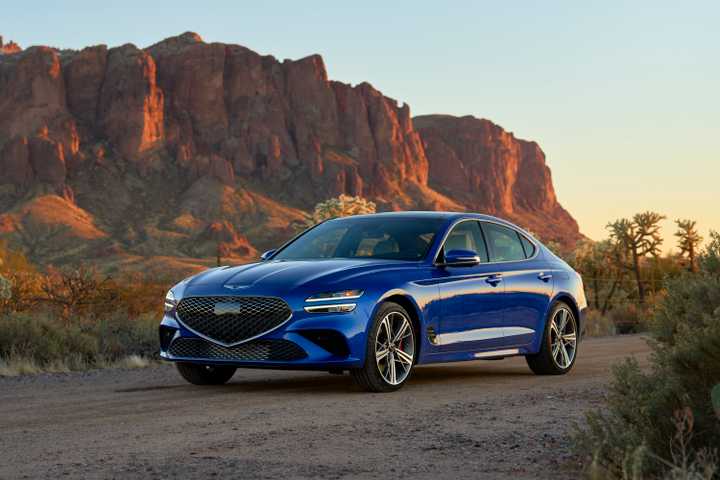
Front 3/4 shot of 2026 Genesis G70 3.3T parkedGenesis
The Genesis G70 is the enthusiast’s secret. In a world where most people buy a car to tell their neighbors how much they spent, buying a G70 is an admission of a different kind: it’s an admission that you care more about how a car carves through a corner than what people think of your key fob.
It is a lasting triumph of mechanical focus. The G70 doesn’t need the legacy of a hundred-year-old badge because its legacy is being written right now. To drive one is to realize that the spirit of the great European sport sedan hasn’t died; it just moved.




















No Comments