
The Kawasaki Cruiser Built At 699cc To Dodge A 45% Reagan-Era Tariff
Kawasaki’s move into V-twin cruisers came during an awkward period for Japanese motorcycle manufacturers. American buyers wanted the style, but a new import duty made larger engines more expensive to bring into the country. Displacement had become a pricing decision with a precise legal boundary.

The dividing line was 700cc. Above it, imported motorcycles faced an additional tariff that started at 45 percent in 1983. Manufacturers could absorb the cost, raise prices, or sell American customers smaller engines.
H2 Reagan’s Motorcycle Tariff Gave Japanese Manufacturers A Displacement Problem
Harley-Davidson had petitioned for protection against heavyweight motorcycle imports. The U.S. International Trade Commission concluded that rising imports threatened serious injury to the domestic industry. President Ronald Reagan approved temporary relief, establishing a five-year schedule of additional duties.

The measure covered motorcycles with engines displacing more than 700cc. That put the familiar Japanese 750 at a disadvantage, even though its engine was considerably smaller than Harley’s big twins. Reducing displacement offered manufacturers a way to keep selling motorcycles in roughly the same class without the additional duty.
H3 The Additional Duty Started At 45 Percent In 1983

The opening rate was an extra 45 percent above the existing import duty. It was scheduled to decline to 35, 20, 15, and finally 10 percent over subsequent years. Tariff-rate quotas also allowed limited numbers of qualifying motorcycles into the country at the ordinary rate.
Those percentages applied to import value, so a showroom price would not automatically jump by 45 percent. Manufacturers and distributors still had decisions to make about their margins. Nevertheless, shrinking an engine below the threshold removed a substantial cost before the motorcycle reached a dealer.
H2 Kawasaki Launched The 1985 Vulcan 700 With A 699cc V-Twin

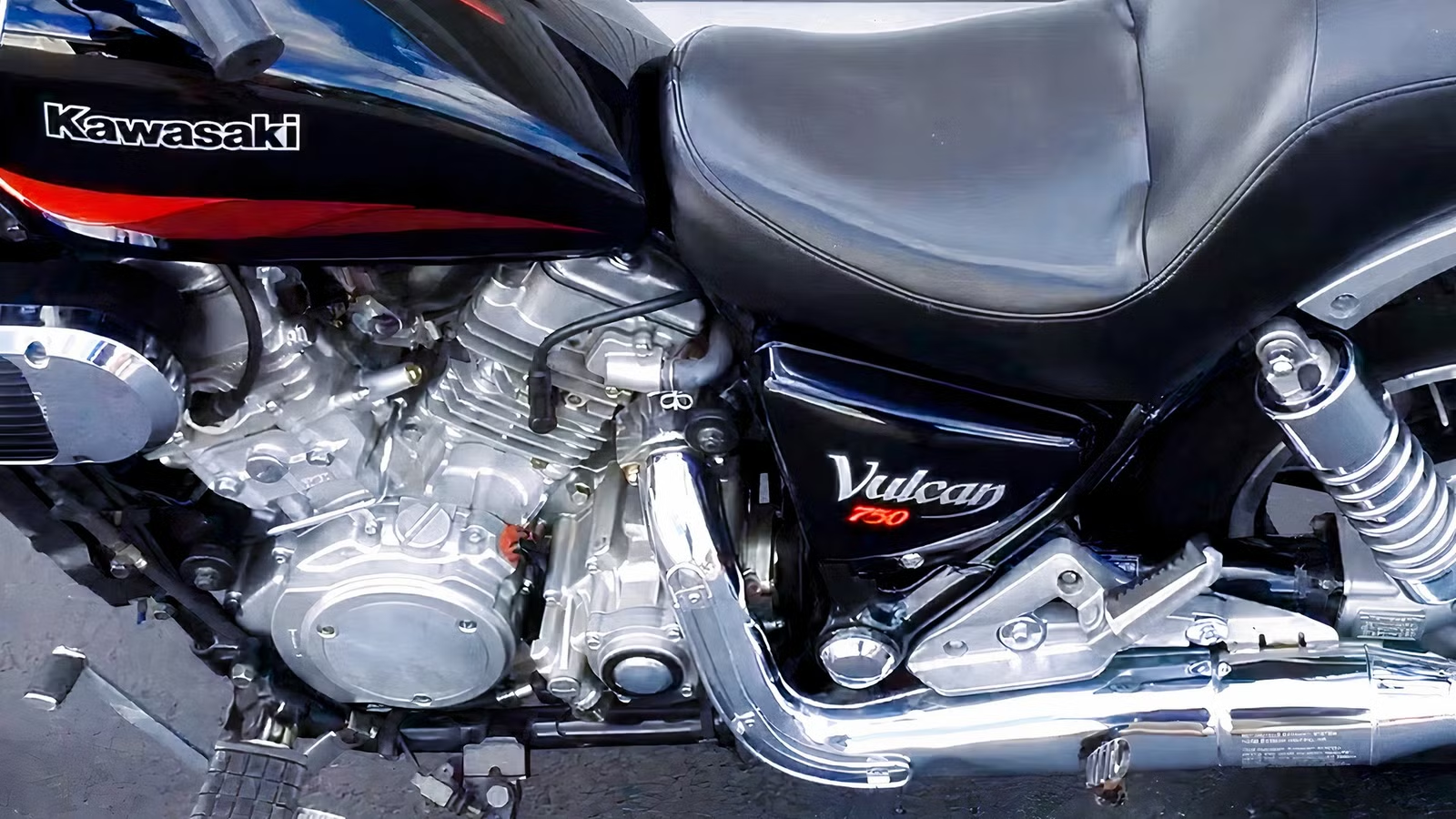
Kawasaki’s answer arrived for 1985 as the Vulcan 700. Its 699cc engine kept the American model below the tariff boundary while giving the company its first V-twin motorcycle. Kawasaki had already sold cruisers with other engine layouts, including the influential KZ900 LTD.
The Vulcan wore a stepped saddle, raised handlebars, and a long front end. Twin rear shocks and separate exhaust pipes completed the familiar cruiser outline. Kawasaki entered an established market, with Honda’s Shadow and Yamaha’s Virago already competing for American V-twin buyers.
H3 Its Displacement Kept The American Model Below The Tariff Threshold
The badge rounded the engine up to 700, but its actual displacement was 699cc. That distinction mattered at the border. The tariff applied above 700cc, leaving the smaller engine outside its displacement requirement. Kawasaki’s own historical account identifies the original American engine as a response to the tariff. Buyers still received a middleweight V-twin cruiser with a five-speed transmission. Its unusual capacity reflected the conditions under which Kawasaki had to sell it.
H2 The Vulcan’s Engine Was More Sophisticated Than Its Cruiser Styling Suggested

Inside the 55-degree V-twin were double overhead camshafts, four valves per cylinder, and two spark plugs per cylinder. A gear-driven counterbalancer controlled vibration. Rubber engine mounts provided further isolation between the engine and chassis.
Cycle World’s original test described useful pulling power from low engine speeds and unusually smooth highway running. The engine also had an 8,500-rpm redline, leaving considerably more room to rev than its appearance suggested. Kawasaki had given the bike enough flexibility for riders to spend much of an ordinary journey in top gear.
H3 Liquid Cooling, Shaft Drive, And Hydraulic Valve Adjusters Reduced Routine Upkeep

Hydraulic valve adjusters removed periodic valve-clearance adjustment from the owner’s maintenance schedule. Shaft final drive eliminated chain lubrication and tension checks. Both were useful features for a motorcycle intended for regular road use.
Liquid cooling added a radiator and coolant circuit to the V-twin. Owners still had fluids to replace and cooling components to inspect. The Vulcan traded some mechanical simplicity for fewer recurring adjustments, particularly in its valve gear and final drive.
H2 The Vulcan Grew To 749cc For The 1986 Model Year

For 1986, the American motorcycle became the Vulcan 750, with displacement increasing to 749cc. Kawasaki’s parts catalog identifies that model as the VN750-A2. The larger engine continued the original bike’s liquid-cooled, shaft-driven layout. The timing needs care, however. The federal tariff program did not end in 1986; Reagan terminated the remaining relief in October 1987. The appearance of a 750cc Vulcan therefore cannot be explained simply by saying the tariff had expired.
H3 Kawasaki’s American Manufacturing Operation Adds Another Part Of The Story

Kawasaki already had an American manufacturing operation when the tariff arrived. Its Lincoln, Nebraska, facility opened in 1974, and the first locally assembled KZ400 rolled out in January 1975. That investment predated the motorcycle trade dispute by several years.
Domestic assembly mattered because the tariff treatment differed from that of completed imported motorcycles. Contemporary reporting stated that imported powertrains for American assembly were exempt. This provided Kawasaki with another option, although that general exemption alone does not establish the precise production arrangements behind the 1986 Vulcan’s larger engine.
H2 A Tariff-Sized Cruiser Started A Vulcan Family That Lasted Decades

The 699cc American model was a brief opening chapter. The 750 continued through the 2006 model year, with service-manual coverage spanning the original 700 and its larger successor. Its maintenance features remained relevant long after the trade measure that shaped its introduction had disappeared.
The Vulcan name subsequently spread across Kawasaki’s cruiser range, from smaller machines to large touring motorcycles. Its first American V-twin had entered the market with an engine sized around a customs rule. That restriction lasted only part of the decade; the name outlasted it by generations of motorcycles.
Sources: Ronald Reagan Presidential Library, Kawasaki, Cycle World, Haynes, GovInfo

Related posts



Latest Post


No Comments