
The Japanese Sports Bike That Sets The Standard For Reliability
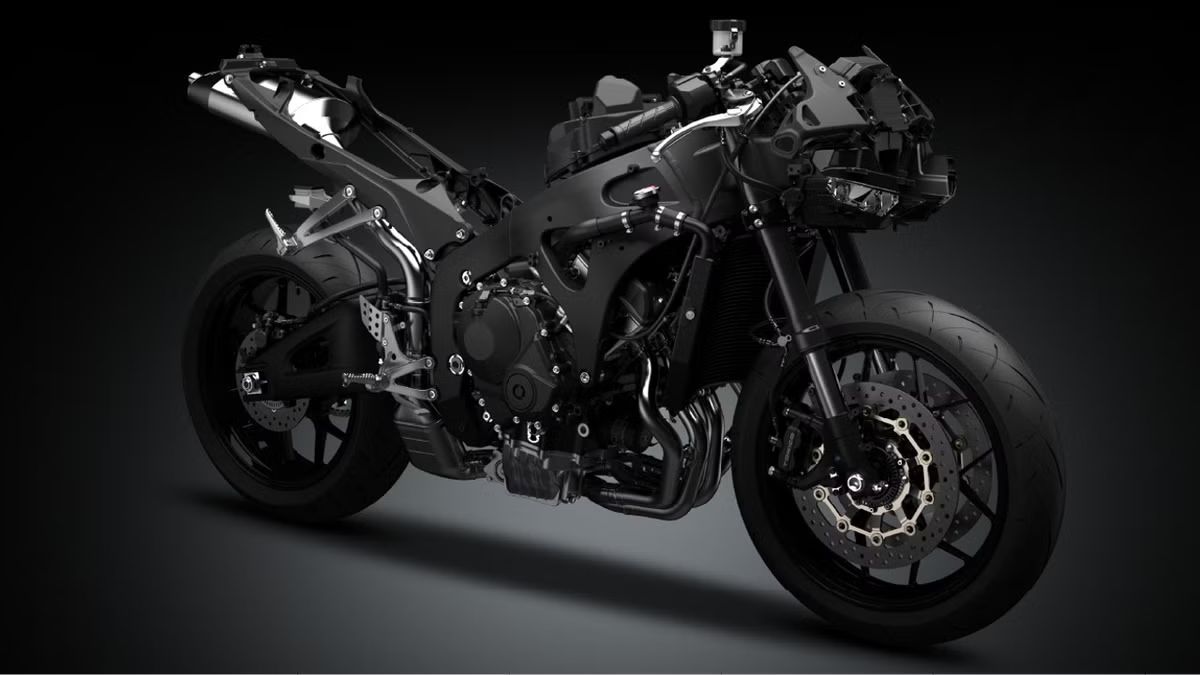
Trust is everything when you throw a leg over a sports bike. Unlike a laptop that freezes or a watch that loses time, a motorcycle that lets you down at speed can put you in the gravel with consequences far worse than a missed deadline. That calculus gets even sharper on a supersport — a machine built to chase lap times and flirt with its own mechanical limits. If you want a sports bike you can genuinely count on, the answer, perhaps unsurprisingly, comes from Japan.
Why Japanese Sports Bikes Are More Reliable Than Their European Counterparts

Japan has long had a reputation for building motorcycles that simply refuse to break. Remarkably, the country’s major manufacturers have managed to carry that trait into their high-strung sports bike engines as well. The secret is largely disciplined simplicity: Japanese brands rarely chase headline-grabbing engine technology, preferring instead to perfect the fundamentals and execute them flawlessly.
Even today’s Japanese flagship (the CBR1000RR-R SP) uses a relatively straightforward inline-four without variable valve timing, and it doesn’t chase displacement beyond 1,000cc the way European rivals like Ducati and Aprilia do. The sports bike that sets the standard for reliability today follows that same philosophy — nothing exotic, everything right.
The Honda CBR600RR Is The Japanese Sports Bike That Sets The Standard For Reliability


With so many dependable sports bikes to choose from, singling out one name is no easy task. But the Honda CBR600RR makes the strongest case. The reasons are compelling. For starters, this is one of the longest-running platforms in the segment without significant internal overhauls — the core four-cylinder architecture has remained largely unchanged for the better part of 25 years.
The version sold in the US has been essentially unchanged since 2013, which means any issue that could conceivably surface is already well-documented and understood by the community. And Honda hasn’t abandoned the platform: OEM parts remain available, warranty coverage is in place, and the company continues to issue recalls when potential problems arise.

Beyond the paper record, owner forums and Reddit threads are filled with riders calling this motorcycle effectively unbreakable. With routine maintenance, the inline-four can reportedly surpass 80,000 miles without major mechanical expense — a remarkable figure for a high-compression, track-ready engine. On the competition side, the CBR600RR’s engine powered the Moto2 class for years, enduring full racing abuse with very few failures. That’s about as real-world a durability test as you can get.
There Are Other Reliable Japanese Sports Bikes On Offer

Looking for alternatives? Breaking it down by segment: the Yamaha YZF-R3 stands out at the entry level, its 321cc engine well-proven and capable of absorbing considerable abuse without complaint. The Ninja 500 is another option in this space, though its 451cc mill is comparatively new and still building a long-term track record.
In the middleweight class, the Kawasaki Ninja 650, Honda CBR650R, and Honda CBR500R all earn honorable mentions. At the top of the food chain, the Honda CBR1000RR (standard, not the Fireblade SP) and the Suzuki GSX-R1000 are the liter-bike names to consider. Of the two, the CBR edges ahead on reliability grounds thanks to its lower output and absence of variable valve timing.
Powered By A Screaming 599cc, Inline-Four Engine

Any discussion of the CBR600RR’s details has to begin with the engine. It’s one of the last true screaming inline-fours available today, spinning freely past 15,000 RPM at a compression ratio of 12.2:1. Those figures translate to just over 115 horsepower and 47 lb-ft of torque — peak power arriving at 13,500 RPM and peak torque at 11,500 RPM. A six-speed gearbox handles power delivery, and with enough road ahead, the CBR will push past 160 mph.
Honda CBR600RR Key Engine Highlights
- PGM-DSFI (Programmed Dual Sequential Fuel Injection System) optimizes power and torque
- Two injectors per cylinder (up to a certain level of RPM, only the lower injector operates, but when the throttle is more than 25 percent open and the engine is operating at more than 4,800 RPM, the upper injector comes into play)
- DAIS (Direct Air Induction System) smoothly channels a large volume of air
- Large polypropylene and fiberglass intake port extension saves weight
- IACV (Intake Air Control Valve) tuned to cover all RPM ranges
Track-Focused Underpinnings With Fully Adjustable Suspension

The CBR600RR is one of the few remaining true-blooded supersports, and its chassis hardware reflects that mission without compromise. A twin-spar aluminum frame forms the backbone, paired with an aluminum swingarm. Up front, 41 mm Showa USD forks handle damping duties; out back, Honda’s Unit Pro-Link rear suspension takes over — both ends are fully adjustable. The Unit Pro-Link design forgoes a conventional top mount on the frame, instead anchoring to the upper swingarm to, in Honda’s words, “deliver superb traction and turning ability.” Braking hardware is straightforward: 310 mm front discs clamped by Tokico calipers, and a 220 mm rear disc with a Nissin caliper.
The CBR Has Compact Dimensions

The track-first philosophy carries through to the numbers. The CBR600RR rides on a 53.9-inch wheelbase, tips the scales at 419 pounds wet, and holds a 23.9-degree rake angle. The 32.4-inch seat height is relatively accessible for a full supersport. Opting for dual-channel ABS adds 15 pounds, bringing the total to 434 pounds. Seventeen-inch cast aluminum wheels with a 12-spoke design round out the rolling package.
The CBR600RR Is As Raw As Supersport Bikes Come

Given how long this CBR has been in production, its feature list shouldn’t raise any eyebrows. Equipment runs to a semi-digital instrument cluster, fuel injection, a slipper clutch, and an electronic steering damper. There is no traction control, no riding modes, and no quickshifter — and the quickshifter isn’t available as an accessory, either. For riders who prefer their supersports raw and unfiltered, that’s part of the appeal; for everyone else, it’s a genuine trade-off worth knowing before you buy.
Sources: Honda Powersports

Related posts


Latest Post


No Comments