
The Japanese Motorcycle That Quietly Does Everything Better
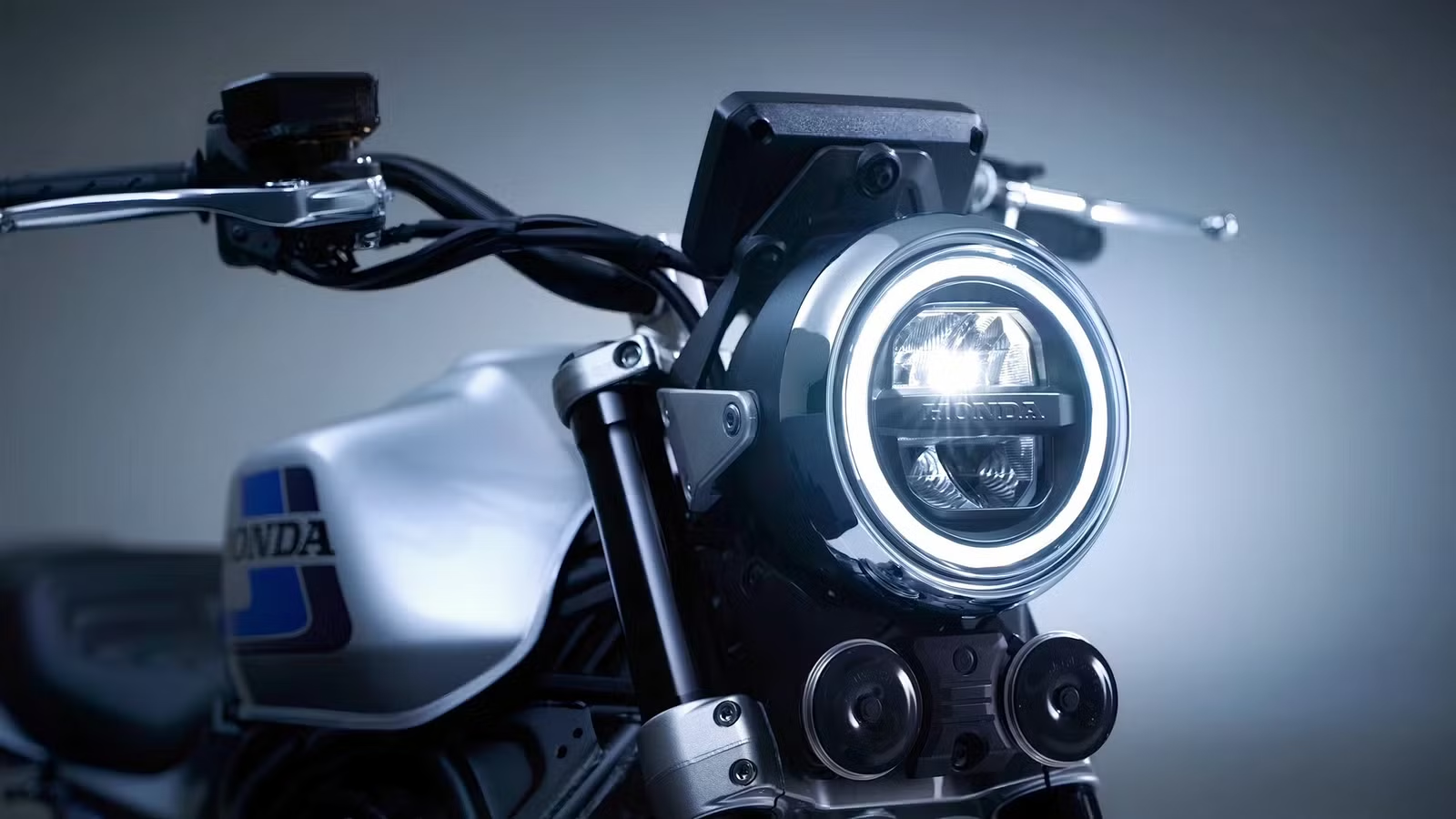
There was a time when big power used to be the mainstay of a Japanese roadster. The Honda CB750 set the stage for the Universal Japanese Motorcycle (UJM) back in the 70s, and it became the template to follow. And then the performance motorcycling world evolved into much more powerful and electronically-sophisticated machinery. The humble roadster, meanwhile, took a back seat as modern liter-class naked bikes evolved as well, and many of them drifted toward superbike-levels of commitment. Eventually, this resulted in bloated price tags and a drastic compromise in their everyday use. To bring back the lost charm of a proper roadster, Honda steps up yet again, and delivers the modern benchmark with another evolution of the CB naked bike.
The Best Roadsters Have Stopped Chasing Outright Performance

With the kind of performance-focused progression that naked bikes as a whole have seen, the harder trick today is to make them easy to live with without sanding away the character. A good everyday street bike needs to be quick without demanding commitment, comfortable without becoming soft, and modern without turning every ride into a menu-setting exercise.
Retro styling is in, but nostalgia only carries a motorcycle so far. The strongest neo-retro roadsters in this space are then the ones that use old-school cues as packaging around contemporary engineering. And while peak horsepower is easy to market because it fits neatly in a headline, it is less useful when a motorcycle spends most of its life accelerating in second and third gears, filtering through traffic, or settling into a highway cruise. That is why some of the most convincing modern standards are moving away from the idea that every flagship naked bike needs to feel like a superbike with its fairing removed.

The same shift is happening with chassis setups. Ultra-short wheelbases, stiff suspension, and aggressive rider triangles make sense when outright pace is the priority. On public roads, a little more suspension travel, a natural handlebar position, and predictable steering can make a regular commuter motorcycle faster in the hands of more riders simply because it asks less of them. Electronics matter too, but only when they solve real problems, sitting quietly in the background.

That leaves a surprisingly difficult target of building a liter-class four-cylinder roadster with enough performance to be exciting, enough comfort to ride all day, useful electronic support, and styling that does not look dated after one design cycle. Honda has gone back to one of its oldest CB formulas to get there, complete with nostalgia that harks back to the bike that ‘Fast Freddie’ Spencer put on the AMA Superbike Championship podiums.
The Honda CB1000F Brings The Super Four Idea Back

The 2026 Honda CB1000F is a modern interpretation of the CB750F and CB900F, but its job is broader than recreating old bodywork. It sits alongside the CB1000 Hornet SP as Honda’s more traditional roadster, using the same 1,000cc inline-four design while changing the tune, gearing, ergonomics, and visual character. It starts at $10,599, which also puts it below the $10,999 Hornet SP and makes it among the cheapest inline-four bikes you can buy today. At the very first glance, the CB1000F looks like a motorcycle that is substantial without being unwieldy.
Its Inline-Four Has Been Tuned For The Road

The CB1000F develops 122 horsepower at 9,000 rpm and 76 pound-feet at 8,000 rpm. Those figures are modest besides today’s 150-plus-horsepower hyper-nakeds, yet they are hardly modest in normal use. More importantly, Honda says the engine is specifically tuned for stronger midrange performance. The transmission reinforces this as the first and second gears are shorter than the Hornet’s, while third through fifth are taller. That gives the CB1000F stronger response at real-world revs to offer better roll-on acceleration, then settles the engine down once speeds rise. A four-into-one exhaust with a three-chamber muffler is also tuned to support low to midrange torque.
The Chassis Is Sporty Without Becoming Demanding

The CB1000F uses a 41mm Showa Separate Function Fork-Big Piston fork with 5.1 inches of travel and a Pro-Link rear shock with 5.5 inches. The fork is adjustable for preload, compression, and rebound damping, giving riders control over the front-end’s behavior. A 57.2-inch wheelbase, 25-degree rake, and 3.9 inches of trail keep the geometry firmly in stable yet agile roadster territory. Braking hardware is courtesy of radial-mount calipers gripping twin 310mm floating front discs, backed by cornering ABS. Add the upright riding position and the CB1000F looks less like a softened sport bike and more like a balanced modern classic.
Modern Electronics Do Not Overwhelm The Motorcycle

The most convincing part of the CB1000F may be how much modern control Honda fits behind an old-school silhouette. Throttle-by-wire supports Standard, Sport, Rain, and two programmable User modes. These settings alter power delivery, Honda Selectable Torque Control, and engine braking, while a six-axis IMU enables lean-sensitive functions. Wheelie control is also part of the package. A five-inch TFT display handles the interface, and Honda RoadSync adds smartphone connectivity for functions such as navigation, calls, messaging, music, and weather.
Comfort Is Part Of The Performance Equation

Honda’s open rider triangle is not a minor detail either. A 31.3-inch seat and upright handlebar position make the CB1000F easier to manage at low speeds and less tiring when the road straightens out. Its taller third, fourth, and fifth gears should also reduce the busy feel that can make short-geared performance nakeds less pleasant on sustained highway runs.
The 4.2-gallon tank gives it enough capacity to function as an everyday motorcycle as well, while the assist-and-slipper clutch reduces lever effort and helps control rear-wheel hop during aggressive downshifts. Honda lists 18 accessories covering comfort, storage, styling, and sport use, which doesn’t make it a tourer, but the basic package leaves room for a variety of uses as a practical modern classic without the bike feeling fundamentally miscast.
The CB1000F Makes Its Rivals Look Expensive Or Specialized

The pricier $12,899 Kawasaki Z900RS is still quite the rival to beat as it has been around for longer. For 2026, it gains a much stronger electronics package, including IMU-based rider aids, cruise control, traction control, and a bidirectional quickshifter. It is also a convincing retro four in its own right, but its base MSRP is a good $2,300 higher than the Honda’s.
Yamaha’s 2026 XSR900 costs exactly the same, and brings a lighter, sharper personality around its 890cc CP3 triple. It is arguably the more overtly sporting choice. The CB1000F, on the other hand, has the smoother character and familiarity of a liter-class inline-four, with a more approachable 31.3-inch seat. It does not dominate every category for sure, but the CB1000F improves the balance between speed, comfort, technology, character, and price instead of sacrificing all four of them to win one.
Source: Honda

Related posts


Latest Post


No Comments