
The German V8 That Turned Out To Be More Reliable Than Anyone Expected
The 1990s marked a turning point for the automotive industry. For decades, Europe’s flagship luxury sedans had been defined by over-engineered, silky-smooth engines built without compromise. But a controversial transatlantic merger shifted priorities toward cost-cutting and modular manufacturing, putting one beloved dual-overhead-cam V8 on the chopping block.

Enthusiasts were outraged when its replacement was revealed. On paper, the new cast-aluminum V8 looked like a cheaper, profit-driven compromise. Yet despite the criticism, it proved to be a surprisingly capable engine that went on to build an impressive legacy of its own.
The Over-Engineered Trap of Late-1990s Powertrains

To understand the sentiment of the automotive world, we need only look at the late90s. The luxury sector was engaged in a ruthless arms race, dictated by hyper-complexity. Manufacturers crammed as much technology under the hood as humanly possible. This was the case due to tightening global emissions standards and the simultaneous race to increase horsepower. The engines were like complex pieces of a mechanical watch.
The predecessor of the power unit that emerged from the merger between two global elites was a masterclass in high-cost, high-tech philosophy. It was a heavy, dual-overhead-cam (DOHC), 32-valve beast of an engine that used premium, specialized alloy cylinder blocks and complex variable valve timing. It had won the 24 Hours of Le Mans in legendary endurance racing cars while also powering hand-assembled sports sedans. The result? Massive performance with massive costs. It was expensive to make, incredibly heavy, and had a massive footprint.
The Corporate Merger That Broke Enthusiasts’ Hearts

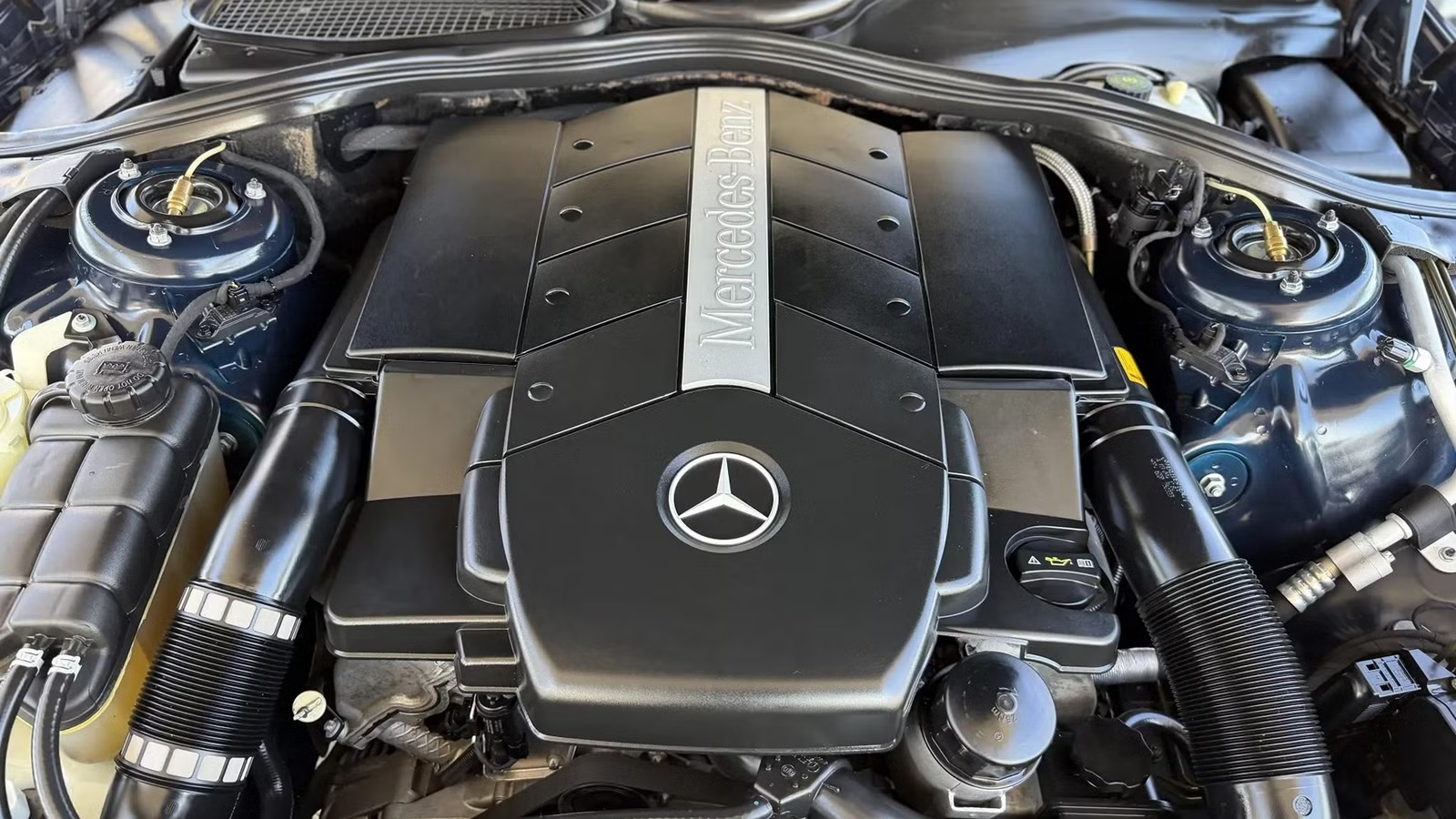
When Mercedes-Benz unveiled its new V8 for the 1998 model year, enthusiasts were stunned. Developed during the DaimlerChrysler cost-cutting era, it replaced the brand’s legendary DOHC design with a modular SOHC architecture shared with a V6, featuring just three valves per cylinder and cheaper Silitec cylinder liners.
On paper, it looked like a major step backward—a cost-driven engine that seemed better suited to a truck than a flagship luxury sedan. Purists feared Mercedes-Benz had sacrificed engineering excellence for efficiency, leaving many to question whether the new V8 could live up to its predecessor.
Why the Mercedes M113 V8 Lasts 100,000 Miles

The engine that proved every naysayer wrong was the Mercedes-Benz M113 produced from 1997 to 2011. This 90-degree die-cast aluminum V8 proved that power did not require over-complication. By choosing a single cam and a three-valve-per-cylinder design, Mercedes not only cut costs but also inadvertently eliminated numerous failure points.
The three-valve layout left ample space for use inside the combustion chamber. The engineers used this space to implement a highly sophisticated twin-spark ignition system with two spark plugs per cylinder. A sophisticated engine management system governed this sequencing, firing the plugs sequentially rather than simultaneously. That created an incredibly rapid, uniform, and complete burn of the air-fuel mixture.
Because the combustion was so efficient, the engine did not need an aggressive compression ratio or high rpm to make power. Instead, the M113 produced a broad, flat wave of low-end torque that arrived early and stayed late in the power band. The standard 5.0-liter variant, the M113 E50, easily produced 302 horsepower and 339 lb-ft of torque in a relaxed manner, like the kind that would suit a luxuryAutobahncruiser.
Furthermore, Mercedes used a proven heavy-duty duplex roller timing chain. That meant the M113’s timing assembly was practically indestructible. Combine that with an open-deck aluminum block that offered cooling across the cylinder walls, and the internal components were well protected from thermal stress. The M113 did not face the bore-scoring or rod-bearing failures that plagued its German rivals. Instead, it simply required regular maintenance, as the mechanical core was so sound that it ran for 100,000 miles without any trouble.
From Bare-Bones Commuter to the Supercharged M113K Hammer

The true strength of the M113 architecture lay in its modular versatility. The thing that it was heavily criticized for became the M113’s biggest weapon. In its entry-level forms, like the 4.3-liter found in the C43 and the E430, and the high-performance 5.0-liter variant found in the SL500, the S500, and the indestructible G-wagon, it proved to be a strong performer. The M113 was a quiet, silky-smooth luxury; it could idle for hours in the desert heat without overheating and haul heavy SUVs up steep inclines with no effort.
But the platform’s true potential was unlocked when the engineers at AMG in Affalterbach got their hands on it. They did not abandon the single-cam, three-valve design that made it so durable; they went a step ahead and reinforced it. AMG increased the displacement to 5.4 liters, added a forged-steel crankshaft and reinforced connecting rods, and bolted on a massive 2.1-liter Roots-style supercharger with an air-to-water intercooler; what resulted is still the stuff of legend.
The defining variant was the M113K; the K stood for Kompressor, denoting forced induction. When that engine debuted in the 2003E55 AMG, it produced 469 hp and a monumental 516 lb-ft of torque, numbers unheard of at the time in a luxury sedan. It was a sledgehammer of an engine, transforming the sedan into a tire-shredding machine that could run with supercars all day long. The M113K became an automotive icon for the extraordinary power it handled, with aftermarket tuning boosting boost pressure on stock internals without issue, and for its absolute durability.
Why Modern German V8s Can’t Match The M113’s Legacy

Looking back, the M113 arrived during a transitional period for Mercedes-Benz, burdened by corporate cost-cutting and low expectations. Yet through sheer engineering discipline and intentional simplification, the M113 outlasted almost every other complex engine of the era.
When Mercedes eventually replaced the M113 with the more complex M273 engine, history repeated itself, and the more advanced engine was immediately plagued by issues such as premature timing chain idler wear and intake manifold flap failures. At the same time, the old M113 continued to accumulate miles across the globe without any drama.
The M113 remains an enthusiast’s secret: a German luxury V8 that endures with routine maintenance and the predictability of an old-school tractor. By choosing simplicity over fragile excess, Mercedes-Benz created what is arguably the most reliable, durable luxury German V8. The M113 proved to the automotive world that numbers and figures on the spec sheet are not the entire picture, and that an engine’s true measure is its longevity.
Source:Mercedes,Bring a Trailer

Related posts





Latest Post


No Comments