
The Forgotten Mopar Coupe Built On The Same Line As The Eclipse And Talon
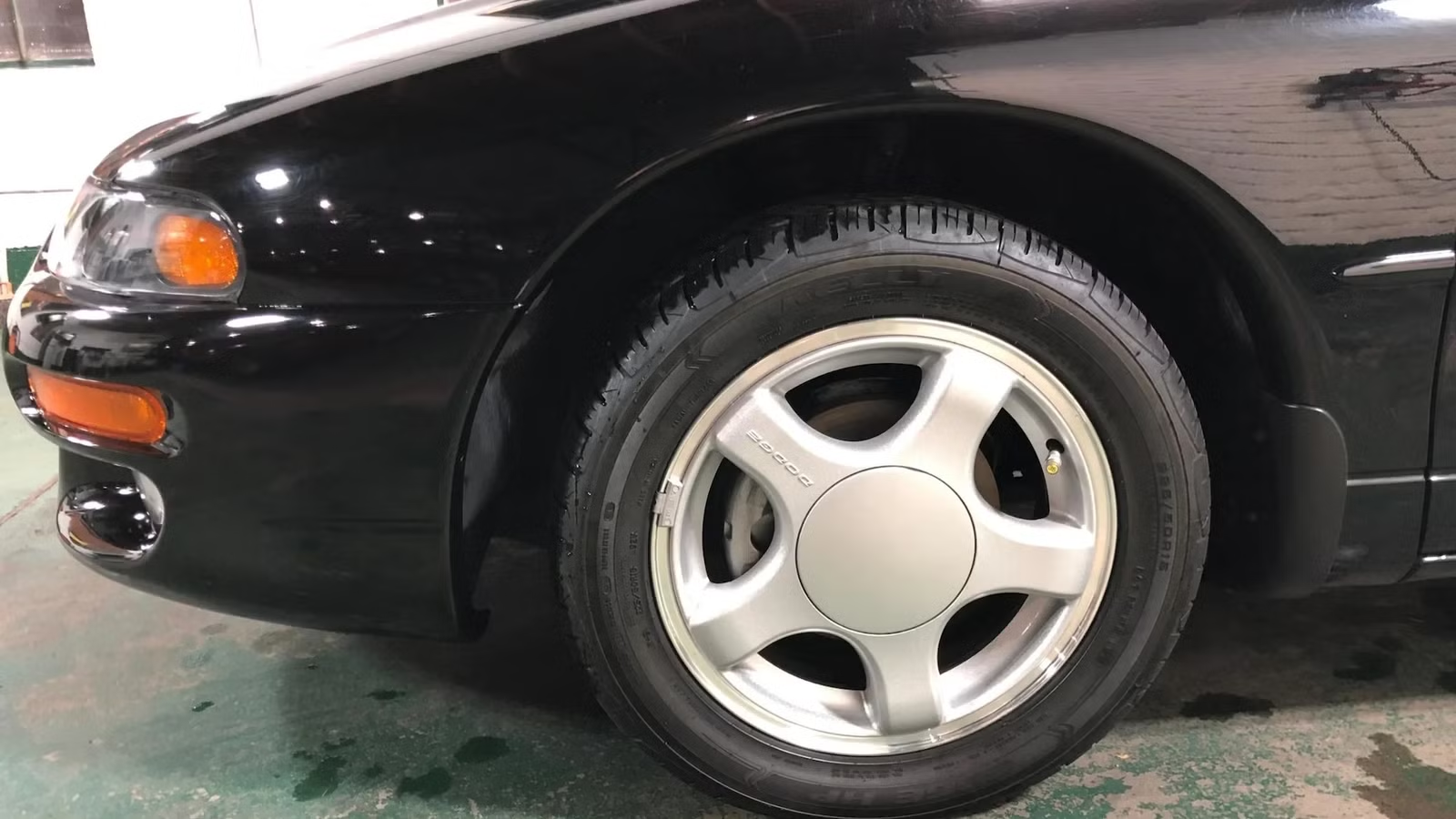
Stop overlooking this rare Mopar coupe. It may not be stealing shows right now, but it has true historic value and performance potential that doesn’t deserve to be forgotten. Best of all, being a lesser-known makes it a steal on today’s market and provides a backdoor entry to Diamond-Star Motors ownership.

Even though it has its own unique style and personality, it shares much of its DNA with beloved icons like the Mitsubishi Eclipse and Eagle Talon. Sure, that does mean it can at least serve as a parts bin for other projects. But don’t overlook its value as a budget-friendly alternative to those popular platforms that can stand proud on its own.
The Chrysler-Mitsubishi Partnership Wanted To Replace The Dodge Daytona
Chrysler and Mitsubishi became partners in 1971 when Chrysler bought a 15% stake in Mitsubishi Motors. In 1985, they formed Diamond-Star Motors and shared a plant in Normal, Illinois. This is where the Mitsubishi Eclipse, Eagle Talon, and Plymouth Laser were built. Later, in the 1990s, the two automakers worked together to replace the Dodge Daytona.

The Dodge Daytona was struggling for several reasons. It was riding on the old, outdated front-wheel-drive K-platform and an equally dated chassis. Plus, it struggled to compete with modern sports cars hitting showrooms with sharper styling. During its final year, it sold under 11,000 models.
Chrysler decided that it would be too expensive to invest in revamping the Daytona because it would need a new platform. So, the automaker designed a replacement that was manufactured with the help of Diamond-Star Motors. This car was supposed to revive sales by offering more space and a more comfortable ride than the outdated Dodge Daytona.
The Overbuilt American Car That Defied Logic
This beast had a V10 engine and no-frills design that helped kickstart America’s performance car renaissance in the ’90s.
The Dodge Avenger Was Born With Mitsubishi DNA

From 1995 until 2000, the Dodge Avenger was built in Normal, Illinois, alongside the Mitsubishi Eclipse and Eagle Talon. It rides on a stretched Mitsubishi Galant platform. The longer wheelbase is credited with providing the Avenger with a more stable ride and enhanced handling compared to the discontinued Daytona.
The Dodge Avenger features a standard Chrysler-built 420A 16-valve four-cylinder engine with 140 horsepower and 130 lb-ft of torque. Buyers could also upgrade to the Mitsubishi 6G73 SOHC 16-valve 2.5-liter V6 engine with 155 hp and 161 lb-ft of torque. It wasn’t powerful enough to make history, but it could accelerate from 0 to 60 mph in about 8.7 seconds and cover the quarter-mile in roughly 16.6 seconds with a top speed of 125 mph.
|
Car |
Engine |
HP |
Torque |
|
Dodge Avenger |
2.0-liter four-cylinder |
140 |
130 LB-FT |
|
Dodge Avenger |
2.5-liter V6 |
155 |
161 LB-FT |
The Dodge Avenger, Mitsubishi Eclipse, and Eagle Talon also share the four-speed Chrysler Ultradrive automatic transmission and the five-speed manual transmission. Plus, these cars have the same alternators, certain motor mounts, CV axles, suspension systems, brake system components, trims, seats, and dashboard components.
While being mechanically identical, the Dodge Avenger does have a few unique features to set it apart from the Eclipse. The Avenger has a longer wheelbase, making it 10 inches longer and 200 pounds heavier. It’s also more of a traditional two-door sedan with a larger trunk and more interior space to accommodate adults in the rear.
Here’s Why The Dodge Avenger Was Abandoned

Unfortunately, the Dodge Avenger had a short run and was discontinued in 2000. It was caught in a difficult period as the partnership with Mitsubishi came to an end and the DaimlerChrysler merger began. This led to a massive corporate integration and sweeping changes. Chrysler was exiting the coupe segment as it previously relied on its partnership with Mitsubishi to build an affordable option.
But Chrysler was making these changes in response to declining sales. Interest in two-door coupes was falling and people were gravitating toward four-door sedans and SUVs instead, favoring more practical options. Additionally, the lackluster engine compounded the problem. Drivers found the Avenger to be underpowered.

The Avenger couldn’t compete against rivals like the Ford Mustang and Chevrolet Camaro with potent V8 power. It was stuck in an awkward position between an affordable compact car and an exciting sports car. Sales dropped to about 5,000 models in 2000. Meanwhile, the Avenger was being outsold by the smaller and more affordable Dodge Neon.
On that note, the Dodge Neon was in production from 1994 until 2005. The 2.0-liter inline-four engine provided 132 hp and 130 lb-ft of torque. The double overhead cam variant delivered 150 hp and 133 lb-ft of torque. In 2003, it got an available turbocharged 2.4-liter four-cylinder engine with 215 hp and 245 lb-ft of torque. Its power was later increased to 230 hp and 250 lb-ft of torque.
America’s First Turbocharged AWD Car Nobody Remembers Anymore
Long before the WRX and Evo hit American streets, there was already a turbocharged AWD car — but chances are, you’ve completely forgotten about it.
The Dodge Avenger Sedan Buries The Coupe

The Dodge Avenger Coupe is often overlooked because the 2008-214 Dodge Avenger sedan creates confusion. It stands out as a miniature Dodge Charger and was designed as a sportier alternative to standard family cars.
The standard 2.4-liter four-cylinder engine delivers 173 hp and 166 lb-ft of torque. Buyers could upgrade to the 2.7-liter V6 engine for 189 hp and 191 lb-ft of torque. Also, the available 3.5-liter V6 engine delivers 235 hp and 232 lb-ft of torque. It could accelerate from 0 to 60 mph in about 6.2 seconds and complete a quarter-mile in about 15.5 seconds with a top speed of 120 mph.
It stands apart from the earlier Avenger by being faster. It is also a larger four-door sedan that offers more practicality. But history repeated itself, as the modern Avenger was caught up in another merger when Chrysler became Stellantis and sales plummeted. It failed to compete with other sedans like the Honda Accord and Toyota Camry, ultimately being canned during this period.
The Lost American Sports Car That Beat The Corvette By Four Years
This race-bred roadster set a Bonneville record in 1949, then vanished into obscurity despite beating the Corvette to market by four years.
The Dodge Avenger Coupe Has Secret Value

Being forgotten about helps the 1995–2000 Dodge Avenger stand out as a hidden gem with potential. It’s more affordable than its nearly identical siblings, the Mitsubishi Eclipse and Eagle Talon. It offers a blend of American heritage and Japanese tuning, and can be easily modified.
The Avenger has value as a project build or a parts bin, as it is a unique Diamond-Star Motors model with an attractive style inspired by the Dodge Viper. Sharing parts with the Eclipse and Talon help reduce maintenance costs while giving it access to the same upgrades that make those cars popular in the enthusiast segment.

The problem with the Avenger is that only a few thousand models are believed to still survive today. Many were heavily used as commuter cars or scooped up for projects. Avenger models that are in rough shape typically sell for between $300 to $1,200. Models that are cleaner or in driveable condition fetch between $1,500 and $2,400. Those in pristine condition sell for between $2,500 and over $3,500.
If you’re interested in an Avenger model, make sure to take a look at its timing belt. The Mitsubishi V6 is an interference engine, and the belt should be changed every 60,000 to 90,000 miles to avoid snapping. Plus, the head gaskets are prone to failing and overheating. In short, proper maintenance by the former owner is key to making sure a deal is worth considering. If it is, you can wind up with a hidden gem before the crowd got wise to it.
Source: Zero To 60 Times, Bring A Trailer

Related posts

Latest Post


No Comments