
The Ducati That Finally Balances Passion and Practicality
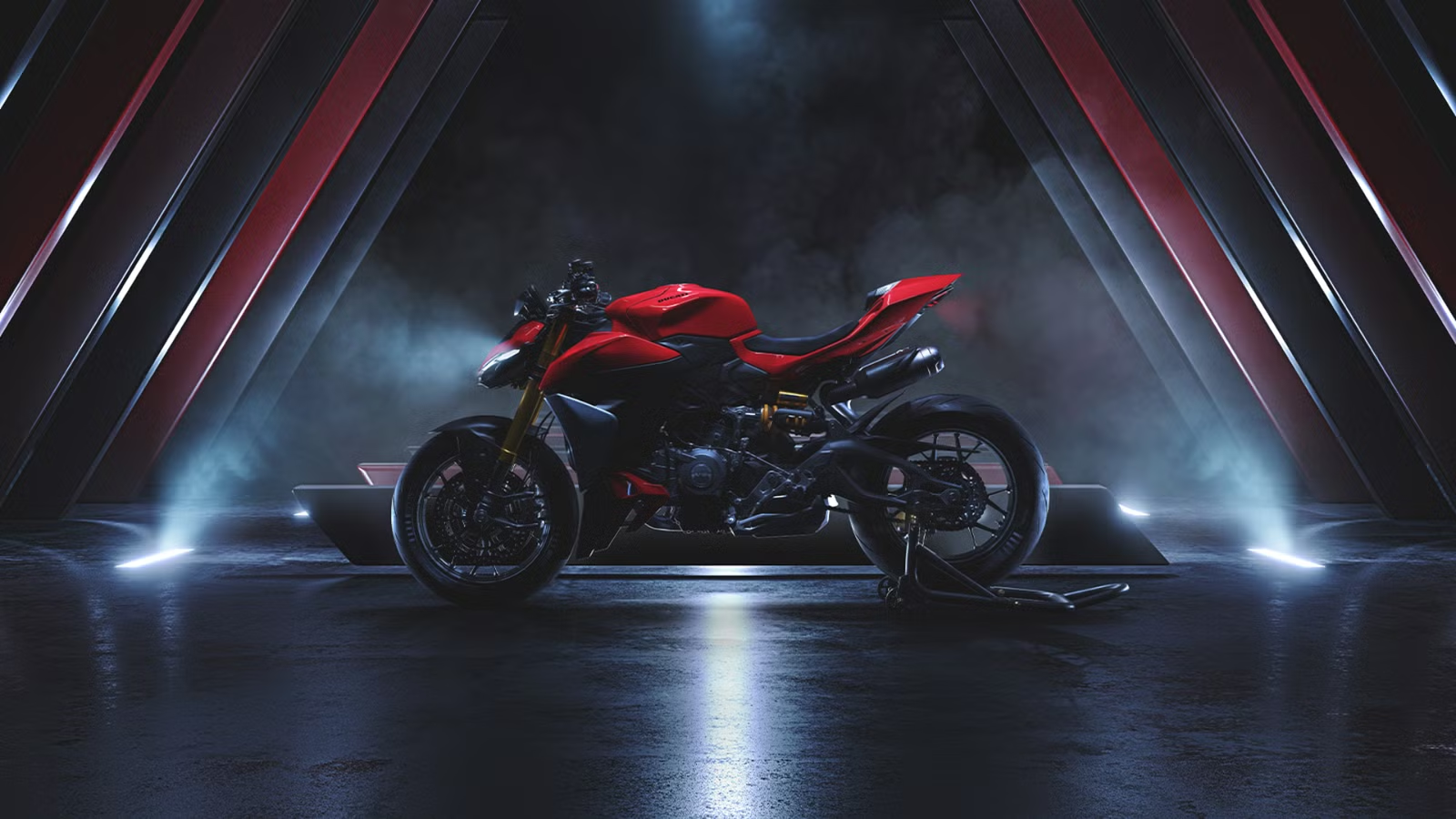
Say the word “Ducati” to anyone who rides, and you’ll get the same reaction: envy. The Italian marque has spent a century building motorcycles that look like moving sculpture, sound like an argument you can’t win, and go faster than most riders will ever need. However, owning one has always meant signing up for the fine print — engines that roast your inner thighs in traffic, riding positions built for a racetrack, throttle response that punishes hesitation, and service intervals that make your wallet nervous. For decades, passion and practicality lived on opposite ends of the showroom floor. One new Ducati is finally trying to close that gap.
The Historic Price Of Italian Passion

There has always been a certain logic to buying a Ducati. The numbers are spectacular, the engineering is exotic, and the bikes can deliver a level of performance that few motorcycles can match. However, the gap between what a motorcycle can do and what American roads allow you to do with it keeps getting wider.

Take the modern superbike. Once a motorcycle is making well over 200 horsepower, its biggest advantage is often found on a track rather than during the daily commute. On potholed city streets, crowded interstates, and heavily monitored highways, that much performance is difficult to exploit. You are spending more money on abilities that can be both unnecessary and demanding. That does not make those motorcycles bad. It just makes them specialized.

Ducati ADVs solve that to an extent. They are more practical, usable, and versatile than specialized tools, with the new-age examples truly being reliable, too. But somewhere in the middle, the passion takes a back seat. These bikes can feel too refined. Or too non-Ducati-like. So what blends Ducati passion and practicality then? Well, it bears the Streetfighter name.

The Ducati Streetfighter V2 Has Italian Passion And Road-Riding Practicality
Base Price: $15,995

We’re talking about the new Ducati Streetfighter V2. In its current spec, the Panigale-derived bits are ever-so-prevalent. The engine, aluminum monocoque chassis, wheels, and Brembo M50 front brakes are all from the sports bike to check the passion side of things. But at the same time, the ergonomics are neutral to boost practicality.
As for prices, the SF V2 starts at $15,995, before a $995 destination charge, in Ducati Red. The more expensive Streetfighter V2 S starts at $18,995 in Ducati Red and $19,495 in Ducati Yellow. The big differences involve suspension, battery, seating configuration, and a few track-focused functions.
A New 890cc V2 Engine Built For Torque You Can Actually Use

Diving deeper, there’s a new V2 engine at heart that produces a claimed 120 hp at 10,750 rpm and 69 lb-ft of torque at 8,250 rpm. These figures look modest next to the outgoing Superquadro on a spec sheet. But what those numbers don’t show is how the power actually arrives. Thanks to an intake variable timing (IVT) system, the engine delivers roughly 70 percent of its peak torque as low as 3,000 rpm, well within the range most riders actually use on public roads. Ducati also managed to make the engine itself remarkably light: at 120 lb, it’s the lightest twin-cylinder engine the company has ever built in Borgo Panigale.
Why Less Peak Power Is The Point

It’s fair to ask why anyone would celebrate a Ducati with 33 fewer horsepower than the bike it replaced. The answer has less to do with bragging rights and more to do with how people actually ride. Peak horsepower matters on a racetrack, where a rider can hold a bike wide open in fifth gear for half a mile. On a public road, that number is almost irrelevant — what matters is how the engine behaves between 2,000 and 6,000 rpm, which is where nearly all street riding actually happens. By trading a marginal top end for a fatter, more usable mid-range, Ducati built an engine that rewards a normal commute instead of punishing it. It’s a more honest kind of performance.
Panigale Pedigree Without The Pain

The Streetfighter V2 shares the same aluminum monocoque frame from the Panigale V2, and without the bodywork, the Streetfighter V2 actually comes in lighter than its faired sibling (386 lb wet without fuel for the S model, 392 lb for the standard version). The bigger change is in the ergos. In place of the Panigale’s low clip-ons, a wide, aluminum handlebar takes over, along with a reworked ergonomic triangle that pulls the rider more upright. Ducati says this significantly reduces the load on a rider’s wrists compared to the sports riding position.
33-Inch Seat Height And The Comfort Trade-Off

Not every part of the practicality story is a clean win, though. At 33 inches, the Streetfighter V2’s seat height is tall by naked-bike standards, and shorter riders will want to sit on one before assuming it fits them the way a Monster or a Hypermotard might. It’s a byproduct of the Panigale-derived chassis and the ground clearance Ducati’s engineers weren’t willing to sacrifice — and it’s worth knowing about before falling for everything else this bike does right.
Suspension And Brakes That Don’t Cut Corners

Where Ducati didn’t compromise was stopping power and suspension quality, even on the base variant. The standard Streetfighter V2 rides on a fully-adjustable 43mm Marzocchi fork up front and a fully-adjustable Kayaba mono-shock out back. Step up to the V2 S and Ducati swaps in a 43mm Öhlins NIX30 fork with TiN coating, paired with a matching Öhlins shock, both aimed at riders chasing fine-tuned compression and rebound for track days.
As for brakes, both the standard and S versions come with radially mounted Brembo M50 Monobloc calipers biting down on twin 320mm discs, backed by Bosch Cornering ABS. That’s the same braking hardware found on considerably pricier Ducatis, meaning the base-model buyer isn’t left with a “budget” brake package.
Race-Bred Electronics That Quietly Do Daily-Rider Work

Underneath the Streetfighter V2’s bodywork sits a six-axis inertial measurement unit, the same electronic backbone found on the Panigale V4. It feeds real-time lean angle and acceleration data into a full suite of rider aids: Cornering ABS, Ducati Traction Control, Ducati Wheelie Control, and Engine Brake Control, all tunable through four riding modes. Ducati’s quickshifter technology, also known as Quick Shift 2.0, comes standard too, letting riders clutch-free their way up and down the gearbox — genuinely useful in heavy traffic, not just on a canyon road.

All of that is managed through a 5-inch TFT display with three selectable layouts, built to keep the most relevant information legible at a glance. However, the feature that best captures this bike’s split personality is Ducati’s “Ready For” accessory program that includes cruise control, a tire pressure monitoring system, a USB port, turn-by-turn navigation through the Ducati Multimedia System, and heated grips, all designed to bolt onto the Streetfighter V2.
Where The S Model’s Premium Actually Goes
The roughly $3,000 gap between the standard Streetfighter V2 and the S isn’t just about Öhlins suspension. The S also gets a lighter lithium-ion battery, Ducati Power Launch for controlled starts, a pit lane speed limiter, and a single-seat configuration as standard, with the passenger seat sold separately as an accessory. Taken together, those upgrades read like a track-day wish list rather than commuter equipment. So this one is less about practicality and more about squeezing extra performance.
None of this makes the Streetfighter V2 a boring bike — it still looks like it wants to bite something, and 120 hp in a 392 lb package is never going to feel slow. What it does is remove the tax that’s followed Ducati ownership for decades: the heat, the ergonomics, the fragile relationship between throttle and traction on a damp morning commute. For the first time in a long time, buying into that Ducati feeling doesn’t mean signing up for all the ways it used to make daily life harder.
Source: Ducati

Related posts

Latest Post


No Comments