
The Cruiser With Honda Reliability And Harley-Level Road Presence
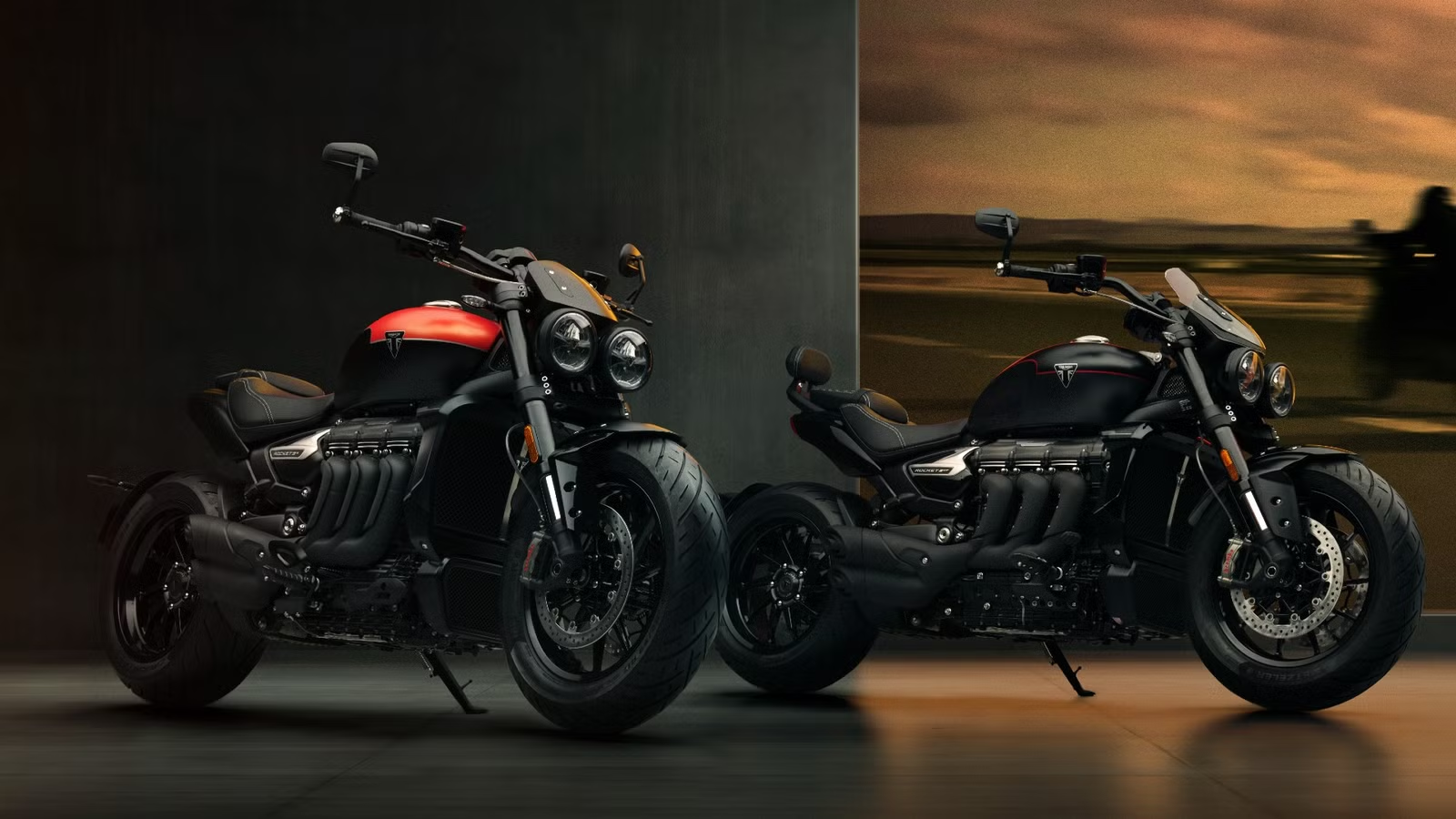
Finding a cruiser that genuinely delivers on two fronts — soul-stirring style and long-term dependability — has always been the holy grail for riders who refuse to compromise. Harley-Davidson owns the road-presence conversation, and Honda sets the gold standard for reliability, but rarely do those two qualities live under the same tank. So what happens when a British manufacturer decides to build the biggest, most torque-rich production engine on the planet and wrap it in a cruiser that turns heads like a custom show bike? You get something worth talking about.

That something is the Triumph Rocket 3 GT — a power cruiser that sidesteps the usual trade-off entirely. It has been on the market long enough to build a genuine reliability record, and it carries enough visual muscle to stand toe-to-toe with anything Milwaukee has to offer. Here’s why it deserves your attention.
The Balance Between Style And Reliability Matters More Than You Think
Every motorcycle segment has a different focus. Superbikes focus on track-ready performance while tourers focus on long-distance comfort. Cruisers, on the other hand, focus on how the motorcycle makes you feel. V-twin character, laid-back ergonomics, and straight-line stability are all part of it, and so is styling. A good-looking cruiser is one you always turn back to admire after parking, and one that makes you feel good riding it around town.

This style usually doesn’t come with Honda-level reliability. That’s not to say Harley-Davidson doesn’t make reliable cruisers; the Motor Company has come a long way, and its modern Milwaukee-Eight V-twin engines are proving to be quite reliable. Still, they trail the industry benchmark set by Honda, which also tends to mean lower ownership costs over the long haul. And unlike Harley-Davidson, Honda cruisers trade away their style in pursuit of dependability — which is why many riders see them as little more than Harley imitations.

For modern cruiser enthusiasts, choosing one over the other becomes tricky, which is why the balance is important. Considering how expensive motorcycles have gotten, if you’re going to spend a significant sum on a cruiser, it had better be both good-looking and reliable. Not many cruisers strike this balance, but there is one British power cruiser that does just that. It’s the Triumph Rocket 3 GT.
The Triumph Rocket 3 GT Is The Cruiser With Honda Reliability And Harley-Level Road Presence

The Rocket 3 has been around for a long time now without any major changes to the chassis or driveline. That’s mostly because it doesn’t need any. It carries the biggest production motorcycle engine on the planet, after all. This might seem like stagnation, but what it really means is that the Rocket 3 is tried and tested to the point where reliability concerns are largely off the table. And when you have a motorcycle with car-like displacement, its sheer size draws eyeballs wherever it goes. It helps that the Rocket 3 looks good in a brutish sort of way, making it a match for any Harley.
The Triumph Rocket 3 GT Starts At $27,145

The Rocket 3 isn’t cheap. In fact, its price gives Italian exotica a run for its money. However, we keep coming back to the same question — how much are bragging rights worth to you? This is an engine that generates more power than most liter-class nakeds, with stump-pulling torque to match. If you want the biggest, most powerful cruiser on the market, you need to be prepared to pay for it. There is some consolation: it isn’t the most expensive cruiser out there, though it is significantly pricier than any Honda or Harley cruiser currently on sale.
The Triumph Rocket 3’s Engine Is Bigger Than Anything Else

The Rocket 3 has held the title of largest-displacement engine in a production motorcycle since the first generation launched in the early 2000s. Harley-Davidson has crept closer in recent years, but the Rocket 3 remains the displacement king. It uses a longitudinally mounted inline-three displacing 2,458 cc, producing 180 horsepower at 7,000 rpm and a massive 166 pound-feet of torque at a low 4,000 rpm. Drive goes through a six-speed manual gearbox — the only transmission option offered.
The clutch is hydraulically assisted, which is a necessity given that torque output. Power reaches the rear wheel via a driveshaft rather than a chain or belt. As befits a premium machine, the Rocket 3 features a ride-by-wire throttle and a six-axis IMU, enabling multiple ride modes, cornering traction control, and cruise control as standard. Triumph claims fuel efficiency of 42.8 miles per gallon.
Quality Underpinnings And Expensive Materials Come Standard Here

The second-generation Rocket 3 was engineered with weight reduction as a priority, so the frame is constructed entirely from aluminum, as are the swingarm and wheels. The suspension consists of Showa inverted cartridge forks with adjustment for both compression and rebound damping. At the rear, the monoshock features a piggyback reservoir with a remote hydraulic preload adjuster.
Wheel travel stands at 4.7 inches front and 4.2 inches rear. The brakes are more than capable of reining in this behemoth: twin 320 mm discs up front are clamped by radial Brembo Stylema four-piston monobloc fixed calipers. The rear uses the same caliper family on a single 300 mm disc. Cornering ABS is standard.
Triumph Rocket 3 GT Dimensions

Triumph doesn’t publish an overall length figure for the Rocket 3, but the motorcycle needs to be substantial to house its longitudinally mounted inline engine and gearbox — and the 66-inch wheelbase gives you a sense of just how long it really is. The seat height of 30.4 inches is a touch tall for a cruiser, though it remains low by the standards of any other motorcycle category. Wet weight comes in at 705 pounds, which is still an impressive 88-pound reduction compared to the first-generation Rocket.
No Dearth Of Features

The Rocket 3 uses a TFT display for instrumentation with a distinctive layout that still stands out today. It provides access to all menus, and a Bluetooth module is available as an optional extra. This isn’t a cruiser with an overwhelming accessories catalog, but there are some genuinely useful touches. The footpegs of the R and GT variants are interchangeable, so you can easily switch between a relaxed, feet-forward position and the more aggressive mid-mounted placement. The electronics package also includes wheelie control and hill hold assist as standard.
It’s Kind Of In A Niche Of Its Own

There is no real direct competition for the Rocket 3 GT. The biggest Indian cruiser available is the Chief Dark Horse, but its air-cooled Thunderstroke 116 engine falls woefully short in the horsepower department. You could also consider the Ducati XDiavel V4, which is not only more expensive but positions itself squarely as a power cruiser, just as the Rocket 3 does.
The XDiavel V4 is one of the fastest-accelerating bikes on sale today, and its brilliant V4 engine features a counterrotating crankshaft and rear cylinder bank deactivation. Ducati has deliberately tuned it for a better torque curve via a twin-pulse firing order rather than chasing peak power figures. The electronics are top-notch and a generation newer than the Triumph’s, and the chain drive suits its sportier character.
Triumph Rocket 3 GT Vs Harley-Davidson Fat Boy
|
Models |
Triumph Rocket 3 GT |
Harley-Davidson Fat Boy |
|
Price |
$27,145 |
$22,599 |
|
Engine |
Longitudinal I3 |
45° V-twin |
|
Cooling |
Liquid cooled |
Air cooled |
|
Displacement |
2,458 cc |
1,917 cc |
|
Power |
179.5 HP @ 7,000 RPM |
104 HP @ 4,800 RPM |
|
Torque |
166 LB-FT @ 4,000 RPM |
126 LB-FT @ 3,000 RPM |
|
Curb Weight |
641.5 LBs (dry) |
694 LBs (wet) |

However, we’re here to compare the Rocket 3 to either a Honda or a Harley. Honda doesn’t really have a premium cruiser. The closest it offers to the Rocket is the Gold Wing, but that is a bagger and lacks the horsepower to compete. Neither does the Harley-Davidson Fat Boy, but it is the Harley that matches up to the Rocket 3 most closely from the cruiser range. It is also instantly recognizable and an icon of American culture. And if you’re value-conscious, you’ll spend considerably less on a Fat Boy than you would on the Rocket 3.
Source: Triumph

Related posts


Latest Post



No Comments