
The Cruiser That Balances Comfort And Character Better Than Most
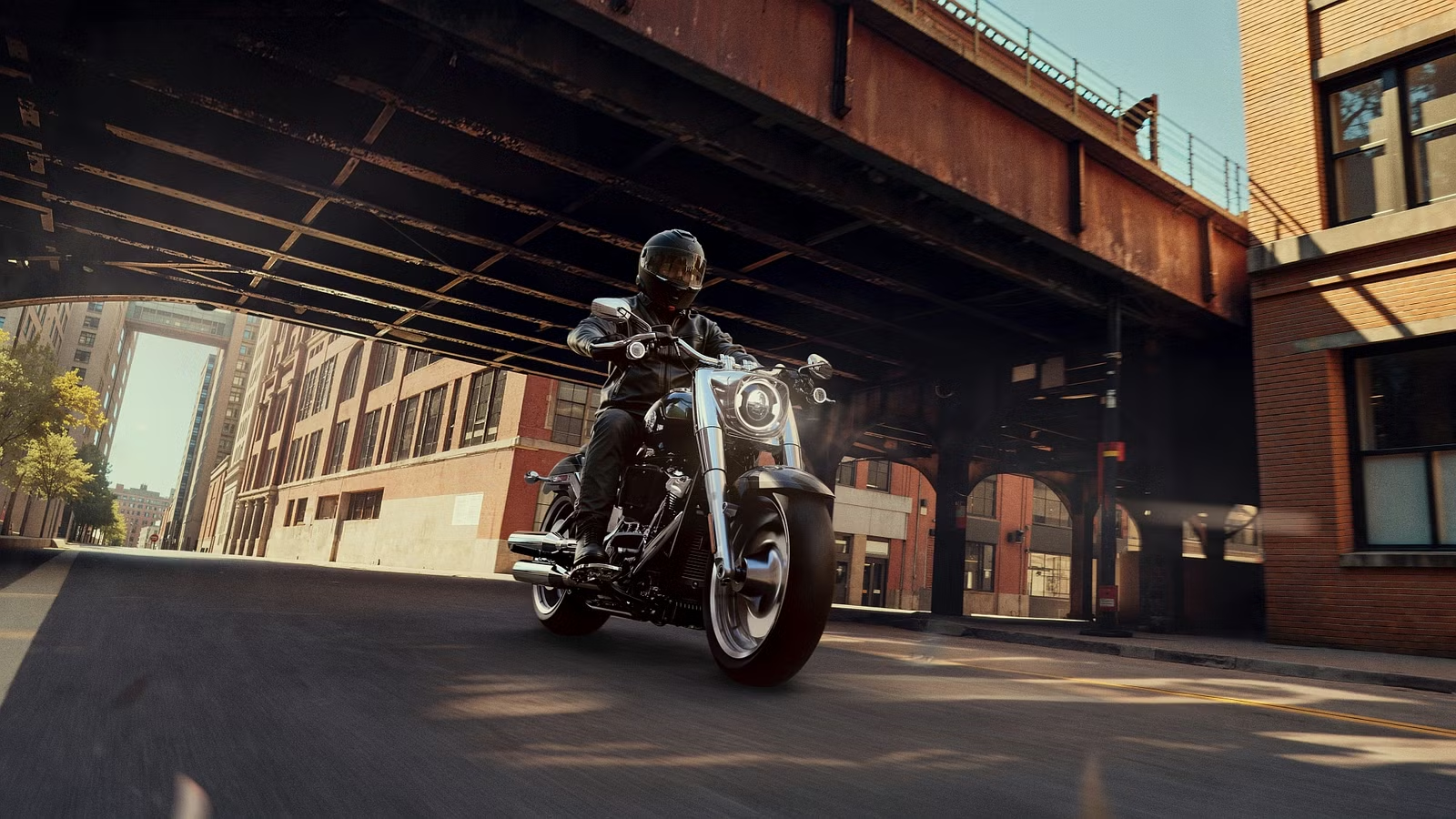
If you like long-distance cruising, then you will find many options for a cruiser motorcycle that will fulfill the need. This is a large market that is also profitable, so manufacturers have worked hard on putting out products that have all the features you’d want from a modern motorcycle—features that solve problems that you might encounter on your long ride. The problem with all these solutions is that they can make the bike feel over-engineered and without character. In addition, the complexity can hurt reliability, so maybe this isn’t an ideal solution.
What Full-Size Premium Cruisers Need To Change

The premium cruiser market is dominated by American brands, although you have other brands trying to compete by going completely in the opposite direction. They are styled beautifully like retro motorcycles, but unfortunately, the ride and handling also feel like retro motorcycles — that is, unrefined and slow.
That slammed stance might look great, but it does no favors for suspension travel or your spine on anything but a billiard-smooth road—these cruisers can be very uncomfortable. What needs to change is the attitude toward prioritizing looks over comfort. If you design a long-distance cruiser, it needs to be comfortable for long distances, and this is not a negotiable trait.
The Best Cruisers Start With Sound Engineering, Not Styling

Neither of those two extremes described above is ideal, but there is an area in the middle that allows for some great balance. It needs to start with a great engineering base; any chassis and engine that is mechanically sound can be tweaked to serve the purpose well. Then you won’t have to rely on great looks or complex electronics to smoothen out the rough edges.

It needs to have stability, fatigue-free highway running, and enough road feel to keep you connected, but not so much that the rider experiences discomfort in the contact points with the seat. Harley-Davidson would know about this better than anyone.
Harley-Davidson Has The Most Experience With This Type Of Cruiser

Other brands might come and go off sale or enter and exit the segment, but Harley-Davidson has been in the heavyweight cruiser segment for well over a century. It has always been the benchmark for these types of motorcycles, and so it is with the current crop of Softail cruisers. There are a variety of styles to choose from, even in the Softail range, but one stands out even among them. It performs its duty so well that it’s almost a default choice for anyone who wants a full-size American cruiser.
Why The Fat Boy Feels Like More Than The Sum Of Its Parts

The Fat Boy is an American icon, and not just in terms of motorcycles or automobiles. This might make you feel like it’s all style and no substance, but in reality, the opposite is true.
The way it makes you feel as a rider—with its broad-shouldered stance, great performance off the line, capability out on the highway, and head-turning looks—all adds up to something that is greater than the sum of its parts, which is saying something, since it looks as fantastic as it does. That style is backed up by some serious engineering, and it is small wonder that it is the flagship cruiser for the most famous cruiser brand in the world.
The Premium Price Is Justified Because It Delivers On It

The Fat Boy is priced at $22,599 for the base model, which makes it one of the most expensive cruisers not just in the Harley-Davidson lineup, but in any brand’s cruiser lineup. It is still a luxury cruiser that is worth every mile.
You’ll want to add a few things to the base model, which comes in flat gray; dual-tone paint can run up to $1,100, and if you’re talking about comfort, you will definitely want to spec it with the optional Öhlins rear suspension. In all, you’re probably looking at a $25,000 cruiser, but justifying that price starts with what’s under the tank — and the Milwaukee-Eight 117 is where the Fat Boy’s case truly begins.
Excellent Performance Is Provided By The Milwaukee-Eight 117 Engine

The Milwaukee-Eight series of engines powers everything in Harley’s lineup except for the two Sportster models and the Pan America. In the Softail lineup, Harley has chosen to fit various models with different versions of the Milwaukee-Eight 117 engine. The Fat Boy gets one that uses oil cooling for the heads; it uses its own radiator to keep things cool and reliable. In choosing this version of the M8 117, Harley-Davidson has made the Fat Boy the perfect middle ground between muscle and mellow.
The displacement of this 45-degree V-twin stands at 1,917 cc and has a compression ratio of 10.3:1. Coupled with a long-stroke design, these characteristics explain why power and torque are produced relatively low in the rev range.That’s 104 horsepower at 4,800 RPM and 126 pound-feet at 3,000 RPM. A six-speed gearbox and belt drive send power to the rear wheel.
How The Softail Frame Hides Its Sophistication Under A Retro Shell


As with the entire Softail lineup, this uses a steel tube cradle frame. The front suspension consists of 49 mm Showa Dual Bending Valve forks with 5.1 inches of travel. At the rear, there is a Showa monoshock hidden under the seat with 3.4 inches of travel. Even the stock rear shock features hydraulically adjustable, tool-free preload.
The brakes consist of a 300 mm single disc at the front with a four-piston fixed caliper, and a 292 mm rear disc with a two-piston floating caliper. It uses 18-inch wheels at both ends, which is not typical for a cruiser, and because it is such a broad motorcycle, it also uses radial tubeless tires. Even in stock form this is a very capable chassis, and it quietly gets better with every mile.
694 Pounds And 40 Inches Wide — Here’s Why That Works In Your Favor
This is a long motorcycle because it is a full-size cruiser, and the reason it is named the Fat Boy is because it is extremely wide. It measures 93.1 inches long and 40 inches wide, with a 65-inch wheelbase. The seat height is 25.9 inches high when laden, with an unladen ground clearance of 4.9 inches. The fuel tank can hold five gallons of fuel, and this is a fairly heavy cruiser at 694 pounds wet, but it is built to last.
The Fat Boy’s Old-School Look Conceals A Full Modern Safety Suite

The Fat Boy uses a tank-mounted version of the analog-digital circular instrument cluster that we see on many other Harleys. It has the same layout and analog speedometer around the circumference, with the reverse LCD panel at the bottom.
The digital display shows information such as fuel level, odometer, and tripmeter readings, while the warning lamps are housed in the middle of the dial. It isn’t without modern features, though: the front brake lever is adjustable, there is a USB-C charging port, and tire pressure monitoring is standard.

The electronics are top-flight. It has a by-wire throttle and a six-axis IMU, which means that you get all the safety possible on this premium product. The safety features include three ride modes, cornering ABS, traction control, engine drag-torque slip control, and cruise control. The options list is almost endless, with everything from looks to comfort to performance upgrades available. It might look retro, but it ages better than anything else on the road today.
The Competition Is Stiff, But Cannot Dethrone The Fat Boy

This is one of the few times that we have to offer all the competition their due respect, because they are all iconic in their own right. The Indian Chief Vintage is the product that goes head-to-head with the Fat Boy and is so good, it makes Harley owners look twice.
Just like the Fat Boy, it leans into its brand’s heritage with valanced fenders, a single seat, and a hardtail look that make it two-wheeled art rather than a motorcycle. At the same time, Indian has given it a circular TFT screen with connected features, a by-wire throttle, and rear cylinder deactivation.

If you look across the pond, the Triumph Rocket 3 GT boasts the world’s largest-ever engine in a production motorcycle—a 2.5-liter inline three-cylinder that generates a face-melting 180 horsepower. It manages to conduct itself remarkably well given its size and weight, coming across as the most balanced power cruiser on the market. Your pillion’s going to need that backrest, though.

Ducati solves the problem of the pillion by installing a pillion seat on the XDiavel V4 that no sane pillion is going to be confident about. To give the manufacturer its due, there is a pillion backrest and a better pillion seat in the delivery crate. However, the XDiavel is best enjoyed alone, with its appetite for revs, corners, and with Ducati’s whole electronics suite backing it up. At the same time, it is fast, balanced, and surprisingly comfortable for the rider.
Source: Harley-Davidson USA

Related posts



Latest Post


No Comments