
The BMW Motorcycle Built For Riders Who Hate Compromise
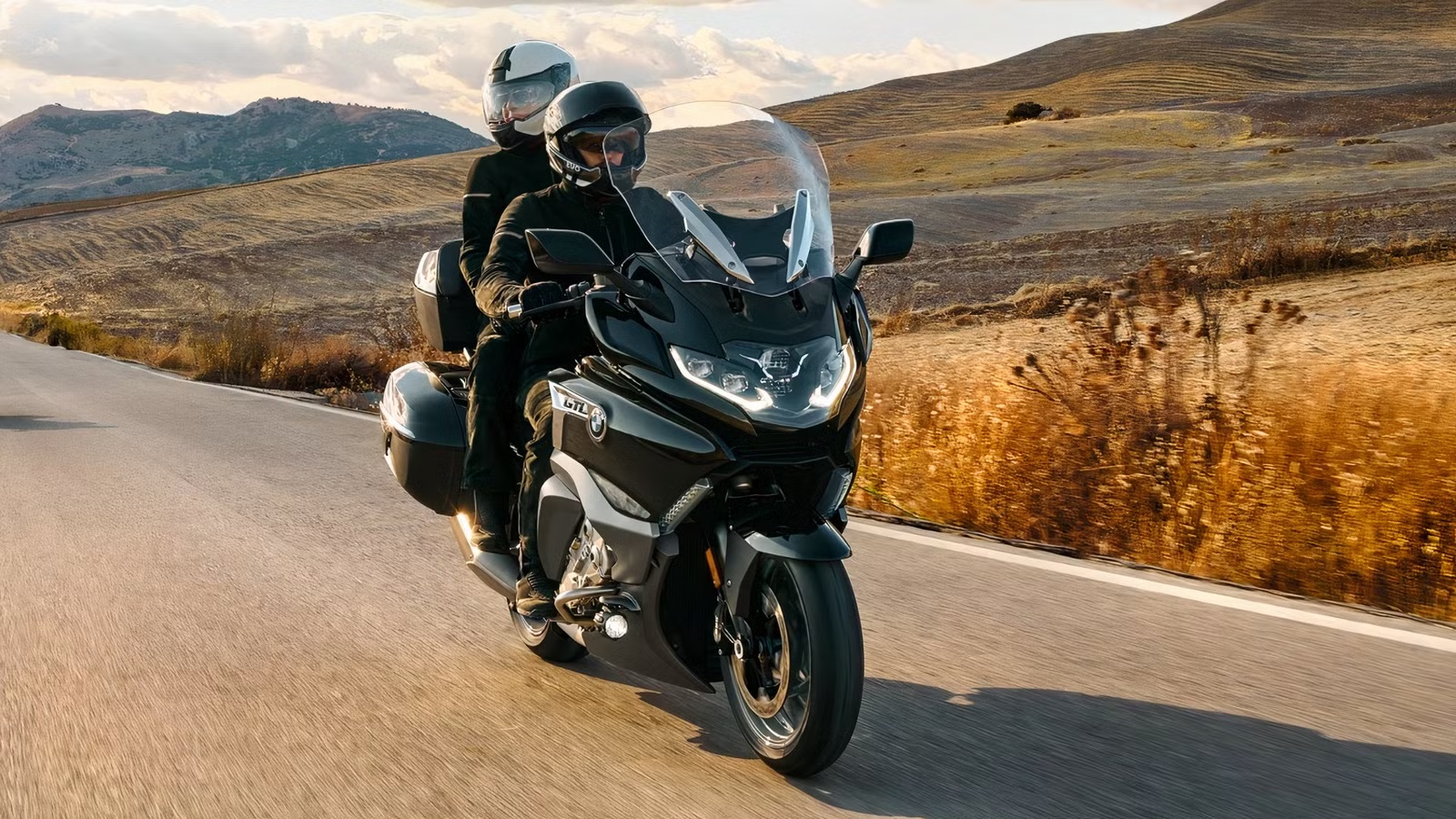
Luxury touring motorcycles have a particularly difficult job because the people buying them aren’t exactly shopping with modest expectations. Spend north of $30,000 on a flagship, and you’ll probably want something comfortable enough to devour an interstate, spacious enough for a passenger and luggage, and loaded with technology. But when the highway finally starts twisting, you’d also rather not discover that all that luxury has turned your motorcycle into a two-wheeled living room.
Luxury Touring Can Come With A Catch

That’s traditionally been the trade-off at this end of the market. Big full-dress tourers excel at wind protection, luggage capacity, passenger comfort, and making huge distances remarkably painless, but those qualities usually come with a lot of motorcycle attached. Once you’re threading through a parking lot or hustling down a winding road, several hundred pounds of luxury suddenly become much harder to ignore.
Going the sport-touring route fixes some of that, but it usually moves the compromise somewhere else. You gain agility and a more involved riding experience, yet passenger accommodations, storage capacity, weather protection, and outright opulence can take a step backward. There’s nothing inherently wrong with either approach. The problem starts when you’re spending flagship money and don’t particularly want to choose between them.
BMW Motorrad Has Been In The Touring Game For Decades


BMW Motorrad has had plenty of time to figure that equation out. The R 100 RT arrived in 1978 with a full fairing developed around improved rider protection and an available luggage system, cementing the RT formula that would become a recurring part of BMW’s lineup. The company later expanded its touring ambitions through the K-series, bringing four-cylinder power and increasingly sophisticated chassis technology into the equation.
By 1998, BMW had introduced the K 1200 LT, a motorcycle developed specifically around luxury, comfort, and extensive standard equipment. It replaced the K 1100 LT and pushed BMW further into heavyweight touring territory, while still placing unusual emphasis on agility for such a substantial machine. That combination of touring luxury and mechanical sophistication would eventually provide the blueprint for something far more ambitious.

The next major step came with BMW’s six-cylinder touring platform. The original K 1600 generation emerged around 2010, with the GT and more luxurious GTL reaching customers for the 2011/2012 model cycle. Rather than merely adding more amenities, BMW built the platform around an inline-six and positioned it as high-performance luxury touring. More than a decade later, that basic philosophy is still very much alive.
The BMW K 1600 GTL Is A Purpose-Built Long-Distance Tourer

That brings us to the BMW K 1600 GTL, which starts at $30,095 before BMW’s $1,195 destination and handling charge. The GTL sits at the luxurious end of BMW’s six-cylinder family, combining relaxed two-up ergonomics, integrated side cases, a standard top case, and serious wind protection with something almost nobody else in modern motorcycling can offer: a naturally aspirated 1,649cc inline-six.
This isn’t simply a giant touring motorcycle with a powerful engine bolted into it. BMW describes the GTL in terms of “performance touring,” and that distinction matters. It’s intended to cover long distances with a passenger and everything that comes with them, but without making the interesting sections between fuel stops irrelevant. There’s even 29.9 gallons of total storage space, so bringing enough stuff for a proper trip doesn’t require turning yourself into a minimalist.
Six Cylinders Completely Change The Character

The centerpiece is an oil-and-water-cooled 1,649cc inline-six with four valves per cylinder, producing 160 horsepower at 6,750 rpm and 132.7 pound-feet of torque at 5,250 rpm. BMW says it’ll exceed 120 miles per hour, but the numbers only explain part of the attraction. Six cylinders allow the engine to deliver its performance with a smoothness and mechanical character that’s distinctly different from the twins and fours dominating much of today’s touring market.
Power reaches the rear wheel through a six-speed transmission and shaft final drive. The latter makes particular sense here because long-distance touring is exactly where not having to clean, lubricate, and periodically adjust a chain becomes useful. Throttle-by-wire engine management, three riding modes consisting of Rain, Road, and Dynamic, plus engine drag torque control help modernize the experience without taking attention away from that wonderfully excessive engine.
BMW Uses Technology To Make 789 Pounds Actually Manageable
There’s no getting around the GTL’s size. BMW lists it at 789 pounds road-ready and fully fueled, stretched across a 63.7-inch wheelbase with a seven-gallon fuel tank. That’s a lot of mass, but the chassis underneath it is far more sophisticated than the typical heavyweight touring recipe. A cast-aluminum bridge frame works with BMW’s Duolever front suspension and Paralever single-sided rear setup, with 4.5 inches and 5.3 inches of suspension travel, respectively.
Dynamic ESA electronically controls the suspension and automatically compensates for changing loads, something especially useful when the difference between today’s setup and tomorrow’s is a passenger plus stuffed luggage. Integral ABS Pro works with dual 320-millimeter front discs and four-piston calipers, while the rear gets another 320-millimeter disc. Dynamic Traction Control also comes standard, giving the electronics plenty to do when all 132.7 pound-feet meet imperfect pavement.
The 29.5-inch seat height is surprisingly approachable for something this substantial, although nobody is going to confuse the GTL for a middleweight at a stop. That’s why Reverse Assist and Hill Start Control Pro make so much sense. The bike rolls on 17-inch cast-aluminum wheels wearing a 120/70 front and chunky 190/55 rear tire, while its maximum permitted payload is 445 pounds with standard equipment.
It Has Nearly Everything You’d Expect From A Luxury Car

Then there’s the equipment list. A 10.25-inch TFT brings connectivity and map navigation through BMW’s Connected App, while a ventilated, splash-resistant USB-C phone compartment keeps your device charged. The GTL also comes standard with an adaptive full-LED headlight, four programmable favorite buttons, tire-pressure monitoring, heated grips, heated seats, Keyless Ride, Intelligent Emergency Call, and BMW’s Audio System 2.0 with satellite radio capability.
The passenger hasn’t been forgotten either. The GTL’s rear accommodations are built for genuine two-up travel, with the standard top case doubling as a substantial backrest and the side cases providing the bulk of its luggage capacity. Passenger armrests are available as accessories, along with case liners and a tank bag. Buyers wanting even more equipment can add central locking, Shift Assist Pro, an alarm, auxiliary LED lighting, and engine protection through the available Comfort Package.
The Real Luxury Is Not Having To Pick Just One Kind Of Ride

None of this makes the GTL universally sensible. At more than $30,000 and nearly 800 pounds, it’s the wrong motorcycle for anyone whose priorities begin with affordability, minimalism, or light weight. There are lighter sport-tourers for attacking corners, simpler motorcycles for everyday use, and plenty of big tourers built primarily around making highway miles disappear. The interesting part is how little the GTL seems interested in committing exclusively to any one of those roles.
And that’s where its version of luxury goes beyond heated seats, giant screens, speakers, or enough luggage capacity to make packing discipline optional. The real extravagance is breadth. You can carry a passenger and their belongings across states, settle into hundreds of highway miles, and still have 160 horsepower and one of the industry’s increasingly rare inline-six engines waiting when the road finally gets interesting.
Compromise hasn’t disappeared. A machine this large will always remind you of its mass eventually, and its price ensures exclusivity whether BMW intended that or not. But the K 1600 GTL approaches those compromises differently. Rather than becoming exceptional at one kind of riding and merely acceptable everywhere else, it tries to give its owner fewer reasons to wish they’d brought a different motorcycle. For a luxury tourer, that might be the most extravagant feature of all.
Source: BMW Motorrad

Related posts
Latest Post


No Comments