
The Bike That Can Make 50,000 Miles Feel Like The Beginning
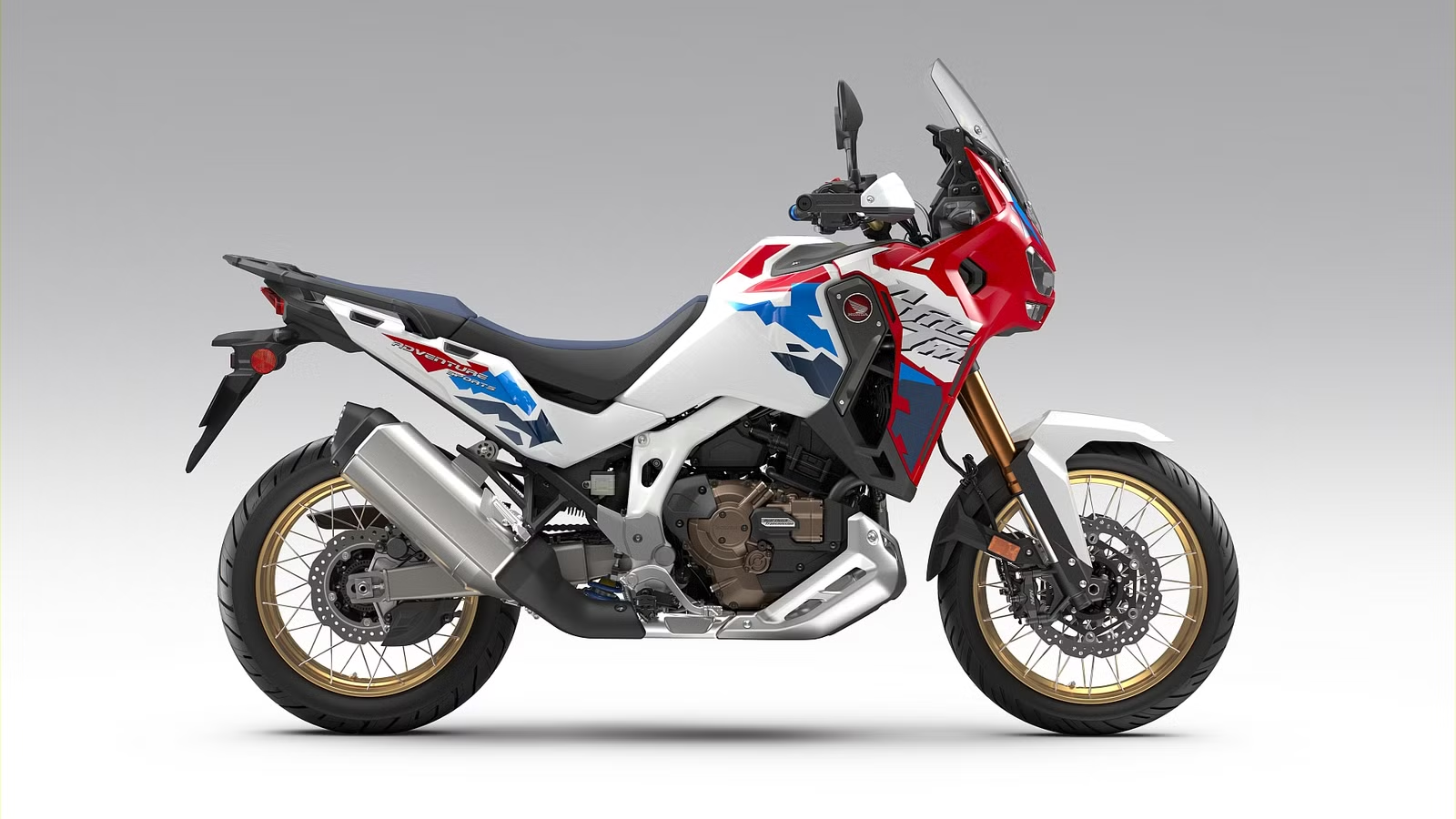
When you hear that a motorcycle has covered 50,000 miles, it is easy to imagine something like Doc Hudson from Cars. Once a star at the top of his game, now sitting around with his best years seemingly behind him. For a motorcycle, 50,000 miles can carry much the same implication. Surely, after that much time on the road, the adventures are starting to wind down. But that is not necessarily the case with certain motorcycles built to keep going.

Such a motorcycle needs to be capable of handling much more than one kind of ride. It should be able to settle into a long stretch of road without complaint, take the trails when the pavement runs out, and still be practical enough to handle the everyday runs in between. Because when the odometer starts climbing north of 50,000 miles, versatility can be just as important as durability. We’re talking about a prime example of that here.
Japan Has A Track Record Of Building Bikes For The Long Haul
There is a reason Japanese motorcycles have earned such a strong reputation for reliability. Consumer Reports found that Yamaha, Suzuki, Honda, and Kawasaki were the four most reliable motorcycle brands in its survey, with predicted failure rates for four-year-old motorcycles ranging from just 11 percent to 15 percent. The survey covered more than 12,300 motorcycles, making it one of the more substantial attempts to quantify what riders have long believed about Japanese bikes.
Honda Usually Shines The Brightest In This Regard


Out of the four, Honda shines the brightest with one of the largest two-wheeler lineups in the US. Its reputation for building motorcycles that just keep going is not something that appeared overnight, either. The company has spent decades putting durability and quality at the center of its motorcycles, and that philosophy can be traced back to its founder, Soichiro Honda. In 1953, Honda published what became known as its “120 percent product quality” philosophy.

The idea? An aim beyond perfect quality rather than accepting that even a small percentage of defective products was inevitable. That idea has remained part of Honda’s approach to quality ever since. The results are easier to see in Honda’s motorcycles themselves. The Super Cub is perhaps the clearest example. First introduced in 1958, the little commuter motorcycle has gone on to become one of the most successful motorcycles ever made, with the series surpassing 100 million units of global production in 2017. This approach eventually birthed an adventure bike based on the same idea, which is capable enough to make 50,000 miles feel like the beginning.
The Africa Twin Has An Already Proven Long-Distance Durability Record

The Africa Twin’s long-distance durability is not based entirely on stories from individual owners. Ride Adventures, a North American adventure touring and rental company, has put more than 30 Africa Twins through six years of near-constant use across its tours and riding classes. The company says its fleet accumulated nearly one million miles during that period, giving it a particularly good idea of how the Africa Twin platform holds up under much heavier use than the average privately owned motorcycle.
Honda’s maintenance schedule also treats high mileage as part of normal ownership rather than a finish line. Scheduled maintenance repeats at established intervals as the odometer climbs, with some items checked every 4,000 miles and others every 8,000 miles. Valve clearance is checked at 16,000-mile intervals, while the drive chain needs inspection and lubrication every 600 miles. If you follow these, the Africa Twin can easily last you over 500,000 miles, as evidenced by certain owners. So 50,000 miles will truly be the beginning.
The 1,084cc Engine Isn’t Chasing Huge Numbers

The Africa Twin takes a different approach to performance than its rivals. Its 1,084cc parallel-twin engine isn’t trying to turn the Adventure Sports ES into a horsepower monster. Instead, it delivers the kind of usable performance that makes sense when the same motorcycle might spend one day crossing state lines and the next finding its way down a rough trail.
1,084cc Of Usable Performance

Diving deeper, the ADV makes 101 horsepower and 82.6 pound-feet from its parallel-twin engine. As is evident, Honda has focused more on delivering its performance across the rev range than chasing a headline-grabbing peak figure. The engine uses a 270-degree crank and Honda’s Unicam valve train to spread power across the revs, while its dry-sump lubrication system allows Honda to keep the engine’s sump compact and preserve the ground clearance needed for off-road riding.
The DCT Gives You More Ways To Ride

Honda offers the Africa Twin with a six-speed manual transmission as standard, but you can opt for the company’s six-speed Dual-Clutch Transmission for some extra moolah. The DCT makes even more sense when you consider what this motorcycle is built to do. If you’re keeping an Africa Twin for years and putting tens of thousands of miles on it, there will be plenty of days when constantly working through gears is the last thing you want to think about. The DCT can handle shifting automatically, but it doesn’t take you completely out of the equation. Paddle shifters let you take control whenever you want, while G mode changes the DCT’s behavior for better control when riding off-road.
It Has The Versatility To Keep The Miles Coming

A motorcycle can be perfectly reliable and still become boring or impractical long before it reaches 50,000 miles. The Africa Twin Adventure Sports ES avoids that problem by giving riders enough versatility to keep finding reasons to ride it, whether the next trip involves a long stretch of highway, a rough trail, or simply another day of everyday riding. Much of that is down to its Showa EERA suspension.
Electronic Suspension For Different Riding Conditions

Honda fits the Adventure Sports ES with Showa’s EERA system, which offers five damping settings: Soft, Mid, Hard, Off-Road, and User. The first four are fairly self-explanatory, while User lets you create a custom suspension setup. Preload can also be adjusted electronically through four settings using the handlebar controls. The system also uses the bike’s six-axis IMU to continuously adjust damping based on terrain and rider inputs. Joining hands with this is a 19-inch front wheel, giving the Adventure Sports ES a more road-focused character than the standard Africa Twin’s 21-inch front wheel.
All The Necessary Features You’ll Need Over The Years

Sure, you can be the kind of rider who only cares about the motorcycle itself. But when you intend to keep one for years and travel thousands of miles on it, everything around the engine starts to matter too. That brings us to the premium feature list. The Adventure Sports ES gets a 6.5-inch TFT touchscreen with three display layouts, Apple CarPlay and Android Auto, letting navigation, calls, messages, and music come along for the ride. Then there is the electronics package behind it. A six-axis IMU manages features such as Honda Selectable Torque Control, three-mode ABS, and wheelie control, while six riding modes—Tour, Urban, Gravel, Off-Road, User 1, and User 2—let the rider tailor the bike to different conditions.
Features That Make High-Mileage Riding More Comfortable

All that side, Honda gives the ES a reshaped seat with improved foam density specifically for greater comfort on long highway rides, while its rally-style fairing and revised side deflectors are designed to reduce high-speed buffeting. Cruise control comes standard, and the 6.6-gallon fuel tank means fewer stops when you’re covering serious distances. The engine also uses a biaxial counterbalancer to reduce vibration, while the standard tubeless tires make flat repairs easier when you’re far from home.
50,000 Miles Doesn’t Change What Makes The Africa Twin Special

The Adventure Sports ES is Honda’s flagship, so it isn’t cheap. Honda lists the 2026 model at $17,799 before the $775 destination charge, putting it firmly in premium adventure-bike territory. That makes its long-term durability and versatility even more important; a motorcycle at this price needs to be capable of justifying the investment long after the novelty wears off.
All in all, a motorcycle with 50,000 miles on the odometer has every right to show some signs of its age. But mileage alone does not change what made the Africa Twin Adventure Sports ES appealing in the first place. It still has the engine, suspension, technology, and long-distance comfort to take on whatever the next stretch of road brings. For an Africa Twin, the odometer reaching that number does not have to mark the end of its adventure. It can simply mean there are another 50,000 miles waiting to be added.
Sources: Honda

Related posts



Latest Post


No Comments