
The American Power Cruiser With Japanese Reliability
Ask any seasoned rider to name the most reliable motorcycles on the planet, and Japanese brands will dominate the list — often without debate. Their machines are legendary for low maintenance costs, tolerance for neglect, and an almost stubborn refusal to break down. American motorcycles, by contrast, have traditionally traded on character over dependability: thunderous V-twins, imposing road presence, and the kind of mechanical personality that leaves an oil spot as a calling card. That reputation, however, is changing faster than most riders realize — and one Harley-Davidson in particular makes a compelling case that you no longer have to choose between American muscle and Japanese-grade peace of mind.

Things are rapidly evolving as manufacturers learn from each other. You can now find Japanese cruisers packing large V-twins with genuine road presence, and American cruisers that promise Japan-like reliability and performance, thanks to proven, mature engines. If the latter is what interests you, read on.
The American Power Cruiser Space Has Grown In Recent Years
Whether they come from Indian or Harley-Davidson, American cruisers have always prioritized torque over horsepower. That still remains the case, but the emphasis on peak power has grown considerably in recent years. Much of that pressure comes from Europe and Japan raising the bar with machines like the Ducati Diavel V4 and Triumph Rocket 3. Inevitably, the American giants had to respond.
Indian Has Some Torque-Loaded Options


Indian’s cruiser lineup is quite broad, blending fully liquid-cooled and air-cooled options. The Scout range leads the former, while the Chief takes the traditional route. Among them, the power-cruiser crown belongs to the 101 Scout, which clears the 100-hp mark while offering genuinely sporty underpinnings. The standard Scout range tops out below 90 ponies, and Indian doesn’t publish an official horsepower figure for the Thunderstroke lineup. A Powerplus 112 in a cruiser chassis would be exciting, but that remains a distant prospect for now.
But Harley-Davidson Is The Flagbearer

Harley-Davidson is the flagbearer in this regard. It has built out a new Sportster range armed with liquid-cooled Revolution Max engines, delivering 91 hp from the 975cc unit and 121 hp from the 1,252cc version — the latter being the highest output available in a Harley cruiser today. The Softail lineup is also more powerful than ever, with the Milwaukee-Eight 117 now serving as the standard engine in place of the Milwaukee-Eight 114, pushing average Softail output closer to triple digits than at any point in the model’s history.
This Harley Breaks The American Reliability Stereotype

Beyond chasing more power, Harley has put real effort into improving reliability. Notable internal changes over recent model years include a revised cooling system, updated ECU calibrations, and reworked intake and exhaust systems. You still can’t expect the same abuse tolerance as a Japanese machine, but the gap has narrowed meaningfully since the days when Harleys were known for marking their territory.
The Harley-Davidson Low Rider S Is Powerful And Reliable

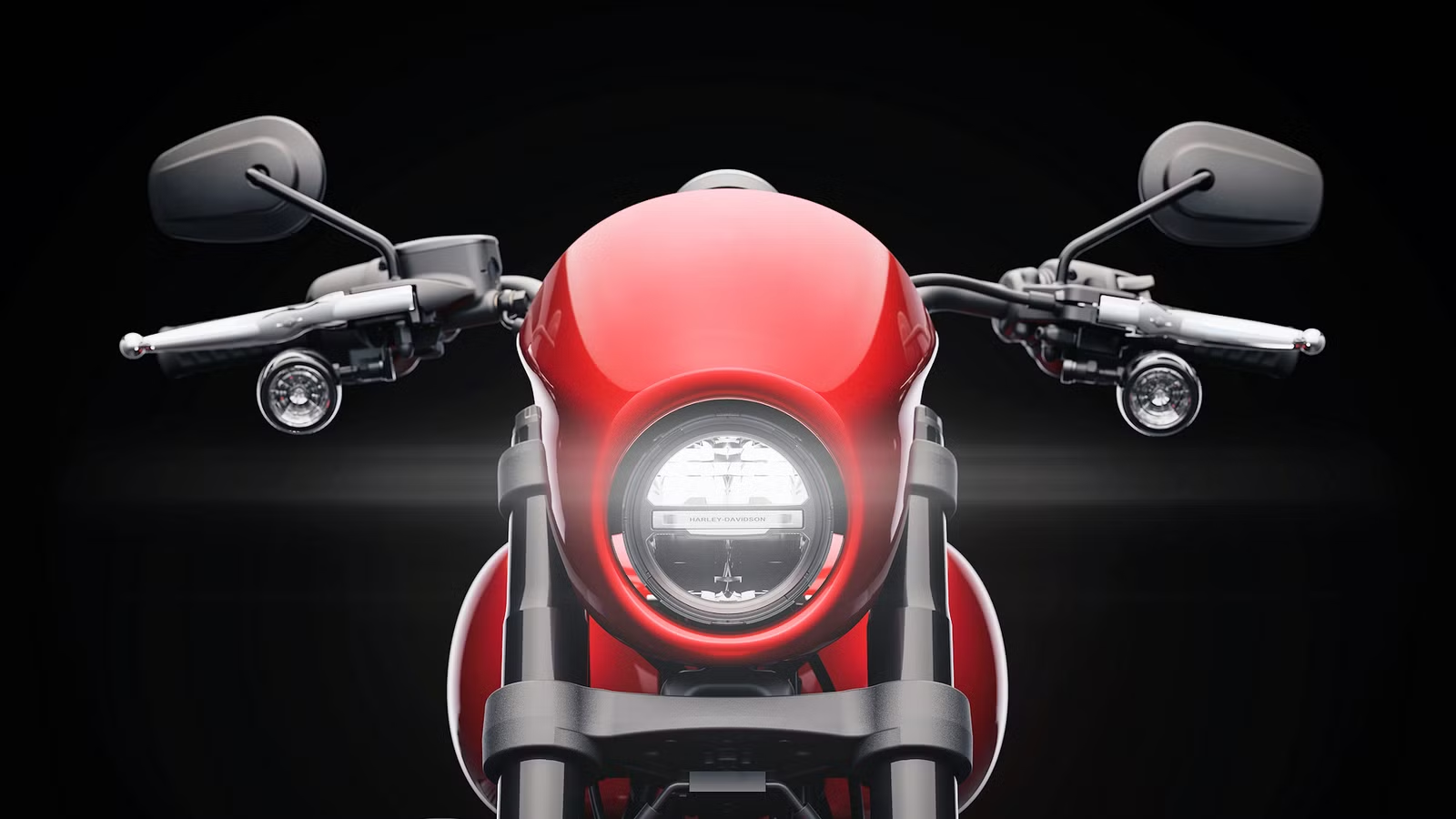
Considering all of this, the Low Rider S is arguably the best cruiser to justify that title. In its current form, the S carries the most powerful version of the Milwaukee-Eight 117 — and also the most refined, which translates to better long-term reliability than any previous iteration. Browse the owner forums and you’ll find plenty of riders who have accumulated serious mileage on this engine with nothing beyond routine servicing.
More Reliable Than Before

It also helps that the Milwaukee-Eight 117 has been in Harley’s portfolio long enough for the early teething troubles — oil seepage, weak lifters, and overheating — to be systematically addressed. Harley’s supply chain situation has improved as well, so if something does go wrong, parts availability and warranty support are in better shape than they once were. That said, keep expectations realistic: the Low Rider S is more dependable than ever, but the inherent failure risk still sits above what you’d find with a comparable Japanese bike.
The Low Rider S Promises A Premium Experience

In 2026, the Low Rider S is more impressive than ever. Successive updates to its design, features, and powertrain have compounded over the years, and a more aggressive pricing strategy under new leadership means you’re effectively getting a better motorcycle for less money than before.
Produces Over 110 HP And 125 LB-FT

At its heart, the Low Rider S runs the Milwaukee-Eight 117 High Output engine. The “High Output” designation brings a forward-facing Heavy Breather intake, a performance-tuned 2-into-1 exhaust, a high-performance SE8-511 camshaft, and a raised redline. The result is 114 horsepower and 128 lb-ft of torque — the highest output figure in the 2026 Softail lineup. Power arrives at 5,000 rpm and peak torque at 4,000 rpm. Keep it pinned and the Low Rider S will reach 124 mph; back off the throttle and the V-twin settles into a fuel-sipping 47 mpg.
|
Engine |
Horsepower |
Torque |
Transmission |
Claimed mileage |
Top speed |
|
Milwaukee-Eight 117 High Output |
114 HP @ 5,000 RPM |
128 LB-FT @ 4,000 RPM |
Six-speed |
47 MPG |
~124 MPH |
Modern Showa Suspension Brings A Sporty Edge

Harley typically takes a conservative approach with its Softail cruisers — a steel double-cradle frame and conventional telescopic forks are the usual recipe. The Low Rider S departs from that norm with clear sporting intent. Up front, 43 mm Showa inverted forks handle damping duties, while the rear uses a preload-adjustable monoshock. Sporty alloy wheels in a 19/16-inch combination complete the package, with the front axle carrying dual disc brakes — a distinction that sets it apart from most Softail siblings.
Sub-700-Pound Weight And High Lean Angles

Those chassis choices pay dividends on the scales. The Low Rider S tips the scales at 670 pounds wet, making it one of the lightest Softails in the current lineup. Ground clearance of 5.7 inches enables a maximum lean angle of 31.3 degrees per side — the highest of any Softail. Other key dimensions include:
- Ground clearance: 5.7 inches
- Seat height: 27 inches
- Wheelbase: 63.6 inches
- Weight: 670 pounds (wet)
- Tire size: 110/180-section (F/R)
Superbike-Like Rider Aids Ensure Safety
This may be the most impressive aspect of the Low Rider S after the engine itself. The styling is unmistakably retro, but recent updates have layered in a thoroughly modern electronics package. A six-axis IMU underpins cornering ABS, cornering traction control, and cornering drag-torque control, all complemented by selectable ride modes that adjust throttle sensitivity and engine mapping.
The creature-comfort list is equally strong: cruise control, a tire pressure monitoring system, a USB port, and LED lighting all come standard. The one shortcoming is the instrument cluster — the semi-digital LCD display feels out of step with the rest of the package, and a crisp TFT screen would be a welcome upgrade.
The Low Rider S Boasts More Value Than Ever Before

If the spec sheet hasn’t already sold you on the Low Rider S, the price tag might. The starting MSRP currently sits at $18,999 — and to put that in perspective, Harley charged $18,199 for the 2016 Low Rider S with optional security and ABS added. You’re paying just $800 more for a 2026 machine with the full modern electronics suite and the most powerful engine ever fitted to a Low Rider.
There are caveats worth noting. The base MSRP applies only to the Billiard Gray color in the chrome trim. Opting for the blacked-out trim adds $1,000, and any color other than gray carries a premium as well — expect to pay up to $650 more for the top-tier liveries.
Source: Harley-Davidson

Related posts
Latest Post


No Comments