
The Aircraft Engineer Who Built The First Minivan 50 Years Before Chrysler
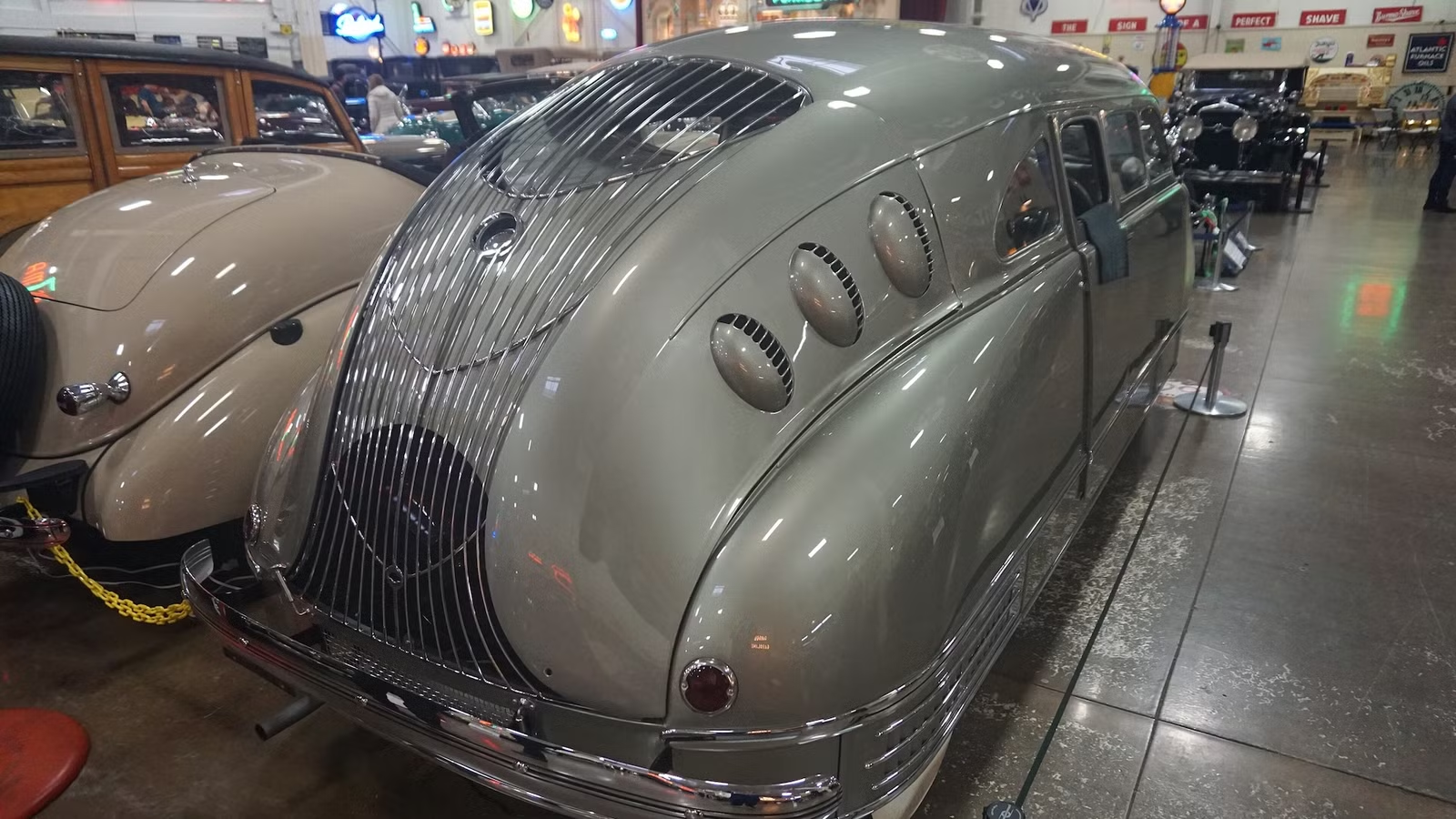
Imagine, you’re at a car show in the greater Detroit area in the late 1980s, when a truly unique 1930s vehicle rolls up. It has the flowing, Art Deco lines of a VW Beetle, but stretches as long as a small bus. The owner flings open the huge rear passenger door to reveal a flat floor. You think, Where is the drivetrain? A pair of Chrysler executives walking by laugh. “So, who’s going to tell Lee he didn’t invent the minivan?” You’re looking at a forgotten chapter of automotive history that nearly changed everything.
The 1984 Dodge Caravan Was A Pioneering Minivan

Chrysler Corporation considered a vehicle similar to the 1984 Dodge Caravan/Plymouth Voyager several times. Company brass’ criticism was always, “If a minivan is a good idea, Ford and Chevy would already be building them.” Then Ford fired Lee Iacocca, famed champion of the Mustang project, and Chrysler snapped him up as its next CEO. One of his first moves was green-lighting the “T-115” project.
The Caravan/Voyager stood at 5’4” so it fit in any residential American garage. It had a 112-inch wheelbase (the same as Chrysler’s big, RWD New Yorker Fifth Avenue sedan). It could fit three rows of passenger seating. Or with the seats removed, a piece of plywood could fit between its wheel wells (with the liftgate open).

The secret to the roomy vehicle was that it rode on Chrysler’s FWD “K-car” platform. This meant it had a transverse-mounted engine up front that drove the front wheels. The result was no driveshaft, a low floor, low roof, and maximum cargo capacity between. The van was two inches wider than the K-car class wagons but shorter overall.

The minivan brilliantly maximized the passenger and cargo capacity of a vehicle that could fit in a standard garage or parking space. Within months, Ford and General Motors were engineering competitors. You might have asked, “Why has no one thought of this before?” But someone had. In the 1930s, to be exact.
William B. Stout Was An Aviation Engineer Ahead Of His Time

William Bushnell Stout, born 1880, was an engineer, inventor, and visionary. One of his major early contributions was insisting that airplanes could and should be built out of metal. This quest led him to develop an airplane design Henry Ford would buy and turn into the Ford Trimotor. Stout would go on to pioneer regular aviation service, founding a company that he sold and which eventually turned into United Airlines.
His engineering credo—inspired by one of his own designers—was “Simplicate and add more lightness.” He would go on to pioneer automotive air suspension, seats that slid to adjust, prefabricated homes, and a hybrid car/airplane.
By the early 1930s, Stout felt current automobiles were obsolete. He reportedly wasn’t against fundraising stunts, such as sending letters to the wealthy about his airplane company that read “Give me just $1,000—no more no less—and I’ll promise that you’ll lose your shirt. But you’ll get your money’s worth in fun.”
When the inventive Stout pivoted to found a car company, the who’s who of American entrepreneurs backed him. We’re talking early interest from Willard Dow of Dow Chemical, Philip K. Wrigley of Wrigley Chewing Gum, Robert Stranahan of Champion Spark Plugs, and Harvey Firestone.
The 1935 Stout Scarab Was The World’s First Minivan

Like Lee Iacocca, 50 years later, Stout insisted on a flat floor to maximize passenger and cargo space for his 1932 concept car. He achieved this with a rear-engine, RWD design. The layout would later become synonymous with the VW Beetle (1938) and Porsche 911 (1963).
The engine in question was Ford’s new flathead V8, which made about 95 hp and drove the rear wheels through a three-speed manual transaxle. To be specific, the engine was mounted over the rear axle but reversed—its flywheel and clutch facing the front of the vehicle.
The wheels were pushed to the very corners of the vehicle. All four rode on coil springs and “oil shock absorbers.” Up front, the vehicle had independent suspension. In the back, it had trailing arm suspension with a swing axle—a setup inspired by airplane landing gear. This setup left maximum room for the vehicle’s main compartment.

The vehicle featured a space frame unit-construction body instead of traditional body-on-frame construction. The prototype was built of aluminum, while production cars had steel bodies to cut costs.
Rumor has it that Dow was visiting Stout’s office and accidentally glimpsed one of many design sketches. He was taken by the art deco look and announced he’d buy that exact car. The resulting vehicle is as curvy as a Chrysler Airflow, with an ornate, Art Deco style. Stout leaned into the beetle-like shape and named it the “Stout Scarab” after the famous Egyptian bug.
Selling A $100k Family Car During The Great Depression

By all accounts the Stout Scarab was an excellent family car. It featured a full-height passenger door for the rear. The mid seats were just set on the floor so you could configure seating. The folding table was also completely adjustable. The coil suspension created a very smooth ride for the day, though the car wasn’t exactly nimble in the corners. It also had a radio, a heater, and ventilation via large vents that could open at the front of the compartment.
Stout’s investors bought up the first batch of the innovative vehicle. So in the 1930s, Dow, Firestone, Stranahan, and Wrigley were driving around in these things. Wrigley apparently loved his Scarab so much, he kept it at his summer home until 1964. Stout logged 250,000 miles in his own Scarab.
As drivable as the Scarab was, its price was a major problem. Stout was asking $5,000. That would be over $116,000 today. For what was essentially a shiny minivan. Meanwhile, a Chrysler Imperial Airflow would set you back just $1,345. And remember, this is during the Great Depression. Stout set up shop at a factory in the greater Detroit area, ready to sell his car “by invitation.” But no one seemed interested. He built one concept car and nine production cars.
The Stout Scarab Jumped The Gun

If Iacocca’s executives had returned from the car show to tell the CEO someone had invented the minivan in the 1930s, I doubt he would have been shocked. Considering how important the Scarab is to Ford history, he probably had already seen the thing. But even if he hadn’t, there are only so many ways to reinvent the wheel. The fact that engineers were attempting a large passenger vehicle with a flat floor in 1932 makes it clear that 1930s engineers were insightful, not that 1980s ones were behind.
In 1984, calling “the current automobile” obsolete as a “horse-drawn vehicle” might have been as true as it was in 1934. But rarely has ingenuity alone hindered Detroit’s innovation. Instead, it’s often held back by what killed the Scarab: budget. Iacocca’s brilliance was simply dusting off the perennial plan for a minivan when he knew it was finally financially viable. And the rest is, as they say, history.
Source: 1936 Stout Scarab

Related posts




Latest Post


No Comments