
Porsche’s Next 911 GT3 Is Almost Certainly Going Turbo — Here’s Why That Changes Everything
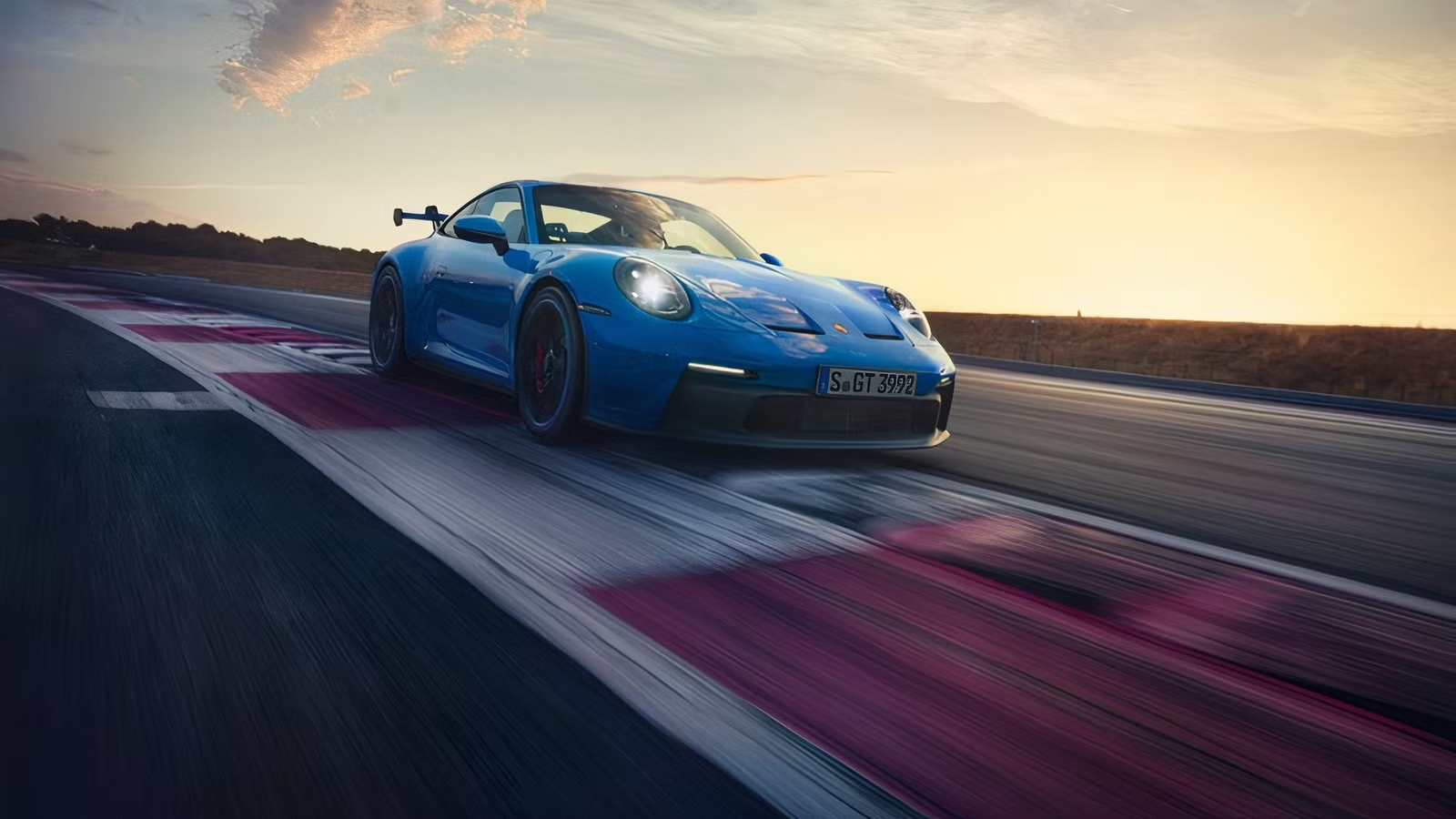
For more than two decades, the 911 GT3’s naturally aspirated flat-six has been the beating heart of Porsche’s performance philosophy — a high-revving, 9,000-rpm argument that raw engine character matters more than peak output. That era is ending. MotorTrend reported this week that the next-generation 911 GT3 is almost certainly moving to forced induction, a shift that carries implications well beyond a single model’s spec sheet.

The GT3 has always been the purist’s Porsche — the car that resisted turbos when the rest of the lineup embraced them, the one that rewarded throttle finesse over brute torque. Forced induction changes that calculus in ways that are both measurable and deeply felt. Understanding what’s gained, and what’s genuinely lost, matters for anyone who cares about where the sports car segment is heading.
What MotorTrend’s Reporting Actually Confirms
MotorTrend’s reporting frames the turbo GT3 as a near-certainty rather than a rumor, driven by the same regulatory and efficiency pressures that have reshaped Porsche’s broader lineup. The current 992.2 GT3’s 4.0-liter naturally aspirated flat-six produces 502 horsepower and revs to 9,000 rpm — numbers achieved through decades of motorsport-derived development. The next generation is expected to push past that figure meaningfully, with turbocharged architecture enabling higher output while meeting tightening global emissions standards.

Porsche has not officially confirmed specifications, but the direction is consistent with decisions already made across the VW Group. The company recently announced a restructuring plan that includes significant investment through 2035, signaling a long-term commitment to electrification and efficiency compliance. A turbocharged GT3 fits that trajectory without requiring a full hybrid system — at least for this generation.
What Turbocharging Costs the GT3 Experience

The GT3’s NA flat-six doesn’t just make power — it communicates. Throttle response is immediate and linear because there’s no turbo spool standing between your right foot and the combustion event. The engine builds revs in a way that feels directly connected to driver input, and the payoff at the top of the rev range — that final surge toward 9,000 rpm — is the emotional core of what makes GT3 ownership evangelical.
Forced induction changes that relationship. Turbocharged engines deliver torque earlier and more abundantly, which makes them faster in many real-world scenarios, but the throttle response curve becomes less predictable at low-to-mid revs, and the linear buildup that GT3 drivers memorize disappears. Engineers can tune wastegates and boost maps to minimize lag, and modern twin-scroll and electric turbo technology has narrowed the gap considerably — but it hasn’t closed it. The character of a turbocharged engine at 3,000 rpm is fundamentally different from a naturally aspirated one, and that difference is most noticeable precisely where track driving lives.
The GT3 Isn’t Alone — A Segment-Wide Reckoning

Porsche isn’t capitulating in isolation. The sports car segment has been moving this direction for several years, and the GT3’s resistance was always the exception, not the rule. Lamborghini’s Temerario replaced the Huracán’s naturally aspirated V10 with a twin-turbocharged V8 hybrid system — a decision that drew exactly the same reaction from Lamborghini purists. Ferrari has leaned on turbocharged V8s across its mid-range lineup for over a decade, with the 296 GTB’s turbocharged V6 hybrid now sitting at the heart of its sports car range. Even Chevrolet retired the naturally aspirated LS-family small-block from the Corvette lineup in favor of the flat-plane LT6, and the next-generation platform will face its own forced-induction pressures.
The pattern is consistent: emissions regulations in Europe and increasingly in Asia make high-displacement, high-revving naturally aspirated engines difficult to certify without significant efficiency penalties. Turbocharged engines produce more power per liter, generate less CO2 per unit of output, and can be tuned to meet Euro 7 and equivalent standards in ways that a naturally aspirated 4.0-liter cannot. The GT3 held out longer than almost anyone, but the regulatory math eventually catches every holdout.
What Turbocharging Gains — And Whether It’s Enough
The case for a turbocharged GT3 isn’t purely defensive. More boost means more power, and a next-gen GT3 pushing beyond 550 horsepower would be genuinely faster on track — shorter lap times, stronger straight-line exits, broader usable torque across a wider rev range. For drivers who use the GT3 as a track tool first and an emotional object second, those gains are real and meaningful.
Porsche’s engineers also have a strong track record of preserving driver engagement through chassis and exhaust tuning when the engine itself changes character. The 992 Turbo S is a turbocharged car that still communicates well through its steering and suspension. The question is whether that same engineering discipline can replicate what the GT3’s NA engine does specifically — not just the lap times, but the sensation of a flat-six spinning freely toward its redline. That’s a harder problem, and one that no amount of exhaust tuning fully solves.
The current 992.2 GT3, still naturally aspirated, may end up being the last of its kind — and used GT3 prices suggest the market already senses it. Whether the turbocharged successor can preserve what made the GT3 worth caring about, or whether it becomes a faster but fundamentally different machine, is the question Porsche’s engineers now have to answer. The numbers will be impressive. The harder job is making sure the feeling follows.

Related posts


Latest Post


No Comments