
This Factory Harley Bagger Has More Riding Modes Than Some Superbikes
Performance baggers have been gaining traction over the years as a niche category in the modified motorcycle universe. It’s an oddball subgenre that has become far more serious than the name suggests. Harley-Davidson still builds motorcycles around large V-twins, saddlebags, and long-distance comfort, but some of its most expensive models now carry hardware that would have seemed completely out of place on a touring bike not long ago. Adjustable suspension, radial brakes, lean-sensitive electronics, and track-oriented settings have all entered the picture. The latest factory example takes that idea considerably further.
Riding Modes Aren’t Just For Superbikes Anymore

Electronic rider aids initially made the most sense on motorcycles where managing power was already part of the job. Throttle maps, traction control, and adjustable ABS gave manufacturers another way to make increasingly powerful machines easier to use under different conditions. Those features eventually spread beyond sport bikes as electronic throttles and lean-sensitive systems became more common. A touring motorcycle could benefit from changing conditions just as easily as something built around outright speed.
Harley-Davidson now offers selectable modes across several parts of its lineup. Road and Rain settings are useful on a large touring bike because the same motorcycle might encounter dry mountain roads, heavy rain, and hours of highway riding in a single trip. Sport modes add another option when a rider wants a sharper response. What is less conventional is building a bagger with settings intended for a racetrack.
Harley-Davidson Has Been Pushing Its Baggers Further

Part of that change has happened in competition. Harley-Davidson races heavily modified Road Glides in MotoAmerica’s King of the Baggers series, where motorcycles that started with touring-bike architecture are subjected to the demands of road racing. The factory program has become a serious operation rather than a novelty class on the side of another race weekend. Kyle Wyman secured the 2025 King of the Baggers championship aboard a factory-prepared Road Glide.

That racing program has also given Harley a place to work on braking, suspension, chassis setup, and engine performance under conditions that street riding cannot reproduce. The company has already demonstrated how directly it is willing to connect the two sides with the limited-production CVO Road Glide RR, which Harley describes as being born from its factory racing program. Only 131 of those motorcycles were produced. The next step was bringing more of that thinking to a regular-production CVO.
The 2026 CVO Street Glide ST Has Eight Riding Modes

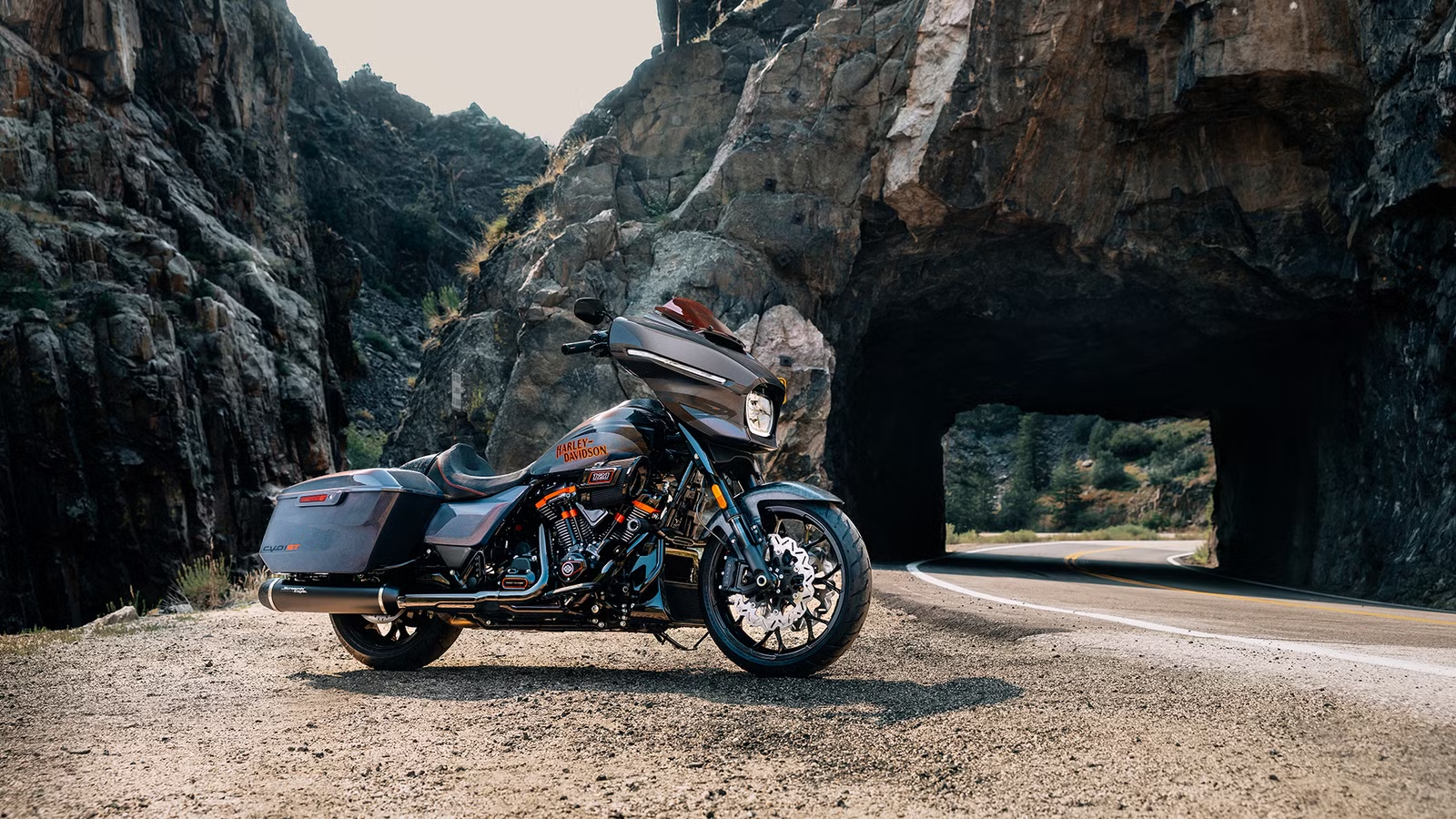
That motorcycle is the new 2026 CVO Street Glide ST. Harley-Davidson gives it eight selectable riding modes from the factory, a number that for a motorcycle that still wears a Batwing fairing and hard saddlebags might seem a bit overkill. The list consists of Road, Rain, Sport, Track, Track+, and three Custom modes.
The ST is also not a stripped racing special with lights and a license plate. It remains a CVO touring motorcycle with a 12.3-inch TFT display, Skyline OS, built-in luggage, and a 6-gallon fuel tank. Harley lists the starting MSRP at $44,999 before additional charges. This combination of touring equipment and extensive electronic adjustment makes the bike unusual.
Track And Track+ Are More Than Different Throttle Maps

Changing modes affects more than how quickly the engine responds to the throttle. The motorcycle has traction control, ABS, electronically linked braking, and drag-torque slip control, along with cornering versions of those systems. Lean angle can therefore become part of how the motorcycle manages braking and rear-wheel traction. There is considerably more happening in the background than on older touring models.
Track and Track+ sit at the aggressive end of those settings, while the three Custom modes give riders room to create their own combinations. That distinction is important because a mode selector is only as useful as the systems connected to it. Harley has surrounded the engine with enough electronic control to make different calibrations worthwhile. There is also considerably more engine for those systems to manage.
Harley Built The Hardware To Match The Electronics

The electronics would be difficult to justify if the rest of the motorcycle followed the standard touring recipe. Up front, Harley uses 1.9-inch inverted forks with adjustments for preload, compression, and rebound damping. The rear suspension also provides adjustment for all three, rather than limiting the rider to basic preload changes. Harley lists SHOWA as the suspension supplier and Brembo for the braking hardware.
Dual floating front rotors work with 4-piston radial-mounted calipers, while a single brake handles the rear. The bike also provides 31 degrees of lean angle on either side, useful context for a machine that is still unmistakably a Harley touring model. None of this turns a Street Glide into a conventional superbike. It does show that Harley developed the chassis alongside the extra power and electronics rather than treating them as isolated upgrades.
The 121ci V-Twin Makes 127 Horsepower And 145 LB-FT

Power comes from the Milwaukee-Eight 121 High Output, a 121ci V-twin with an 11.4:1 compression ratio. Harley-Davidson rates it at 127 horsepower at 4,900 rpm and 145 lb-ft of torque at 4,000 rpm. A Heavy Breather intake and Screamin’ Eagle titanium mufflers are standard equipment. Harley also uses a lower final-drive ratio to favor acceleration.
The important comparison is with Harley’s other 121ci touring engine. The Milwaukee-Eight VVT 121 in the standard 2026 CVO Street Glide produces 115 horsepower and 139 lb-ft, putting the ST up 12 horsepower and 6 lb-ft without adding displacement. Its Heavy Breather intake also flows 25% more air than the VVT 121 intake. The ST is therefore using a substantially different version of Harley’s 121ci package rather than simply adding riding modes to the regular CVO powertrain.
This Is Still An 800-Pound Harley-Davidson Bagger

Harley-Davidson CVO Street Glide ST
The specification that puts everything else into perspective is weight. Harley-Davidson lists the CVO Street Glide ST at 816 pounds in running order, with a 64-inch wheelbase and 2.42 cubic feet of luggage capacity. Forged-carbon components help trim weight in selected areas, but there is no disguising the size of the motorcycle underneath them. This remains a full-size bagger rather than a lightweight sport bike wearing Harley-Davidson bodywork.
That makes its electronics more interesting, not less. Harley has taken the basic Street Glide idea and added adjustable suspension, radial brakes, 127 horsepower, cornering-sensitive rider aids, and eight selectable riding modes without removing the equipment that makes it a touring motorcycle. Track and Track+ are the clearest signs of how far the performance-bagger concept has moved. The modern factory bagger has become a much more complicated machine than its saddlebags suggest.
Source: Harley-Davidson

Related posts


Latest Post


No Comments