
New Renault E-Space concept hints at future MPV revival
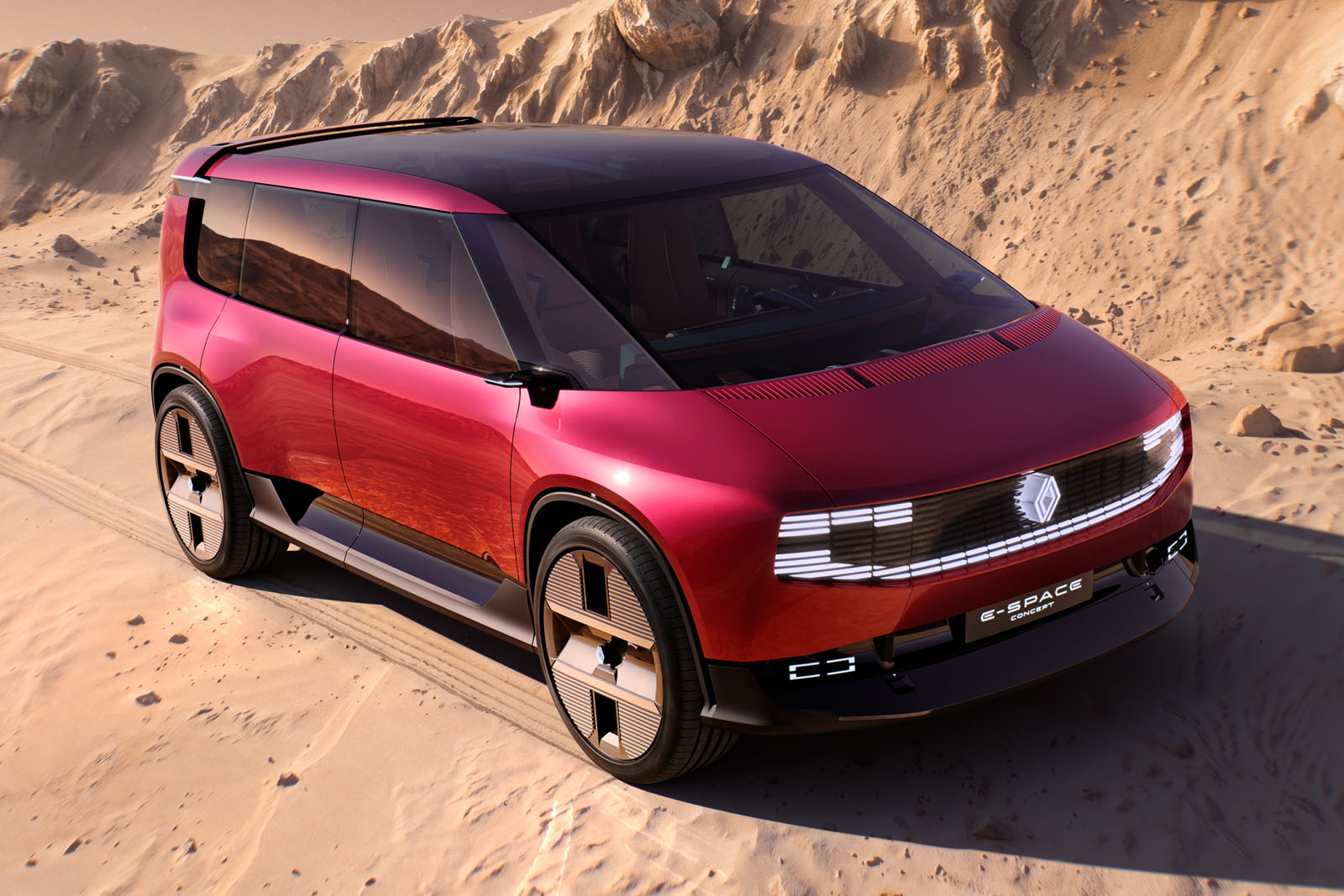
The new Renault E-Space concept previews a future electric MPV designed to disrupt the dominance of family SUVs.
The original Espace, launched in 1984, was a key player in popularising the people carrier. It stuck with that format until 2023, when it became a stretched version of the Austral SUV. But amid a wave of retro revivals spearheaded by the 5 supermini, Renault is considering a return to tradition – as shown by its Paris motor show reveal.

“We have captured the iconic character of Espace,” said Alexandre Malval, Renault’s vice-president for design. “At the same time, we have taken it into the future with cutting-edge technology and style.”
Chief among the throwback design cues is the heavily raked windscreen reminiscent of France’s TGV trains. Meanwhile, the rear spoiler recalls the roof bars that were prominent on the Mk3 and Mk4 Espace.
Renault said the E-Space was designed from the inside out and the size of its glasshouse has been maximised to ensure the cabin feels light and airy. It took inspiration from Bauhaus designer Ludwig Mies van der Rohe’s Farnsworth House, a monolithic building clad almost entirely in windows.

To that end, Renault said it attempted to obscure the meeting points between the large-windowed box section and conventional bodywork. The effect is particularly pronounced at the D-pillar, where the spoiler ‘floats’ above the glass, with back-lighting for emphasis.
The E-Space can house six people across three rows of seats. Passengers in the second row have access to folding tables mounted on the backs of the first-row chairs, or they can spin around to face the third row, giving an arrangement similar to a train’s. The second-row seats can also be folded flat to form a table for those in the third row.
Up front is the new ‘OpenR Panorama’ screen, which spans the entire width of the dashboard. Renault said this feature will enter production on the next-generation Scenic and Rafale, due around 2030. The move reflects a wider industry trend towards placing instrumentation in the driver’s eyeline.
A smaller infotainment touchscreen – suspended from the dashboard to place it closer to the driver – provides control over functions such as music and sat-nav.
Notably, the E-Space has a yoke in place of a traditional steering wheel. It uses a steer-by-wire system, meaning it has no mechanical link with the front wheels, and the lack of a traditional steering column frees up extra space in the footwell. Placed on the yoke are touch-sensitive controls used to interact with the OpenR screen.
Renault has said it will “explore possible futures” for the E-Space but has yet to comment on whether it is intended for production.
The firm is currently developing a new RGEV Medium 2.0 architecture for future vehicles, which any production Espace would likely be based on. The flexibile skateboard chassis can accomodate both electric and range extender powertrains, with an 800V system allowing for fast-charging. Renault claims that EVs on the platform could offer up to 466 miles of range, with range extenders reaching 870 miles.

Related posts


Latest Post


No Comments