
Mustang GTD: Inside Ford’s 800-HP Le Mans-Bred Hypercar
Making a production sports car isn’t easy. You have to satisfy fans and tug their emotions, but at the same time, you’re also juggling with fragmented and strict vehicle regulations and production constraints. This is exactly why futuristic concept cars are usually significantly toned down when they hit the production line.

Race cars, however, are subject to a different set of rules—one that is less about emissions and production constraints, but more about leveling the playing field. If a production car is based on a race car, that’s what you call a homologation special, and these are often the most special high-performance machines you’ll ever see. That’s how the first iteration of the Porsche 911 GT3 started, and how we ended up today with the Toyota GR Yaris.
And then there are sports cars that were developed from their racecar counterparts, not necessarily for homologation, but because it’s a passion project. Enter the 2026 Ford Mustang GTD. Remember, the Mustang GT3 is based on the production Mustang, but the Mustang GTD is based on the Mustang GT3. This engineering pathway has produced a wealth of interesting engineering decisions that have led us to one of the ultimate supercars America has ever produced.
Why The GTD Matters More Than You Think

I always love it when an automaker takes on a passion project with not necessarily the goal of being able to profit from it. This is why we have such passionately engineered cars like the Lexus LFA and more recently, the Toyota GR GT. The Mustang GTD takes a similar path, but with the goal of delivering shock and awe to the established Europeans.
What Makes It A GTD

The Ford Mustang GTD was born in 2023 as a road car based on the Mustang GT3. The Mustang GT3 has been used at FIA Group GT3 races such as the LMGT3 class of the 24 Hours of Le Mans, 24 Hours of Nurburgring, and the IMSA SportsCar Championship’s Grand Touring Daytona class (which is what GTD means). Current GT3 racecars are based on production cars, so there was no regulatory incentive for Ford to produce the Mustang GTD. Rather, this was purely a passion project for the Blue Oval brand to see what’s possible for the Mustang nameplate if it became a supercar competing with Europe’s best.
Think of cars like the Porsche 911 GT3 and Mercedes-AMG GT. The former was created for homologation purposes, but producing the Mustang GTD was not a requirement for Ford to enter FIA Group GT3 racing. But we’re not complaining one bit, because this is perhaps the first time that Ford officially created a Mustang for GT3-class racing. The previous effort was based on the fifth-generation (S197) Mustang that was developed solely by Multimatic. For the Mustang GTD, however, Ford directly partnered with Multimatic—owing to Multimatic’s experience in making a GT3-class Mustang—to explore what the ultimate road-legal Mustang racecar could be.
Clearly Not A GT500 Successor

At this point, you are probably wondering whether the 2026 Ford Mustang GTD is a successor to the Shelby GT500—one of the pinnacles of the Mustang hierarchy. Well, that is absolutely not the case, as the two models take a completely different path. The Mustang Shelby GT500 is a higher-performance version of the standard Mustang. It’s still a muscle car through and through. The Mustang GTD, meanwhile, was developed with the Mustang GT3, which is a racecar. The Mustang GTD will run rings around the Mustang Shelby GT500, particularly in the handling department. This is no longer the Mustang as a muscle car, aiming to be a sports car. Instead, the Mustang GTD is here to out-handle and out-muscle Europe’s finest-handling and most capable supercars.

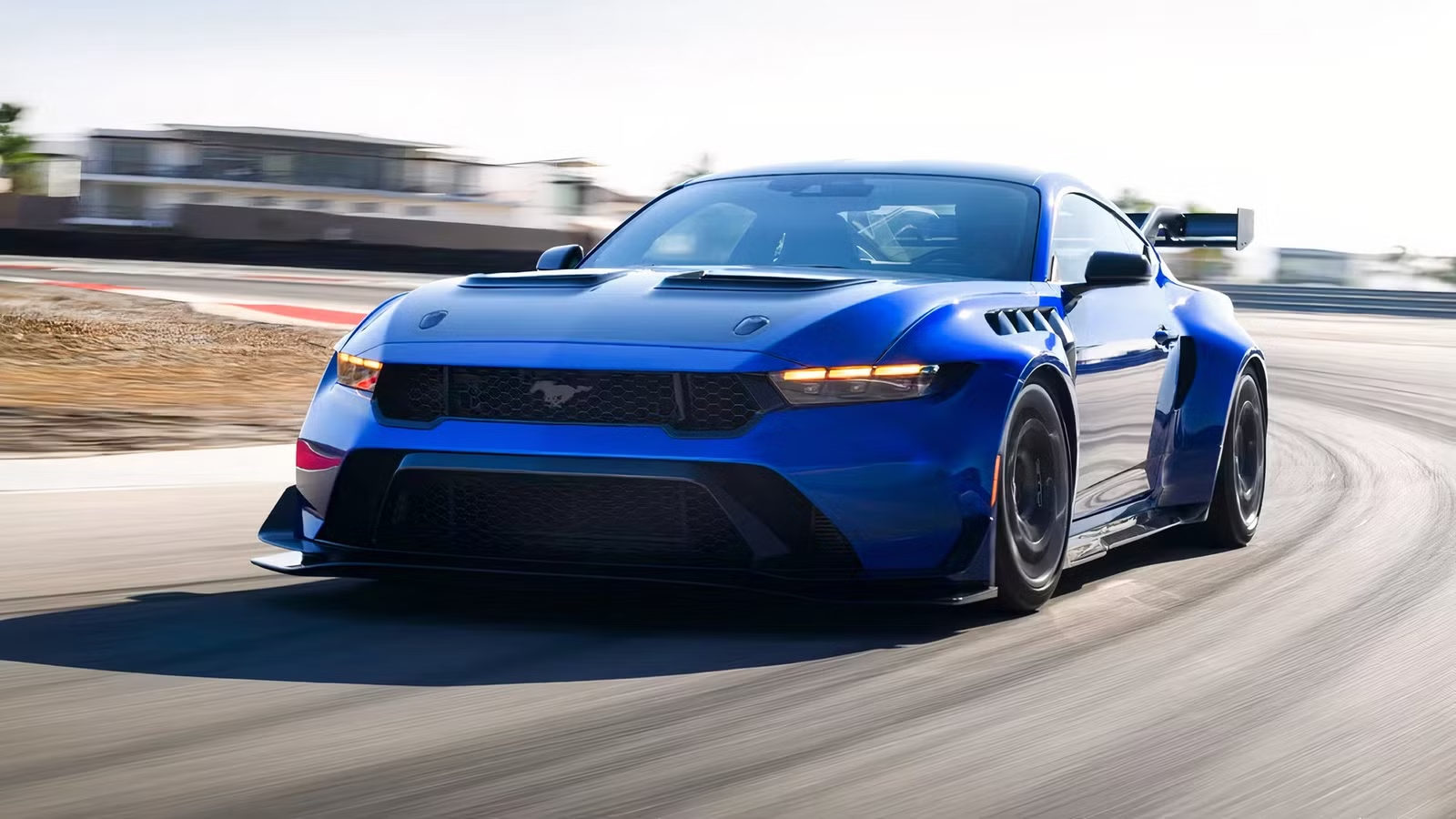
The Mustang GTD measures more than 80 inches wide, and though it doesn’t need extra amber lights since it’s not a commercial vehicle, it still has extra amber turn signals at the grille because, at a hard angle, the standard turn signals aren’t visible. This extra width, not to mention the supercar-worthy price, is just the tip of the iceberg on how different an animal the GTD is compared to any Mustang variation before it. Though the Mustang has been getting more sports-car-like in terms of handling with every successive generation, the Mustang GTD fully realizes this ambition to turn it into a true supercar.
A True Racecar For The Road

The 2026 Ford Mustang GTD’s story is very special in its own right, and even more interesting are the engineering decisions the Blue Oval brand made to create its fastest car to ever lap the Nürburgring.
Racecar Suspension With Ride Compliance

The Mustang GTD’s craziness begins with its suspension. Up front, it uses a short-long arm suspension, which improves lateral stiffness and grip during high-G cornering compared with the standard model’s MacPherson strut. The rear suspension is even more interesting, because the rear dampers are mounted inboard and are seen from a glass housing at the rear for the world to see. Yes, that’s pushrod suspension you’re seeing, similar to what the Lamborghini Aventador has. Since pushrod suspension is mounted horizontally, in this case, to a motorsports-inspired tubular steel subframe rather than the usual vertical mounting, you no longer have space for rear seats. On the upside, this creates space to accommodate its ultra-wide 345 mm rear tires.
Pushrod suspension is extremely flexible, allowing the wheels to have the maximum contact path at every dip and bank of the road. The GTD’s entire suspension configuration features a semi-active setup through Multimatic’s Adaptive Spool Valve (ASV). GT3 cars aren’t allowed to have active suspension, so the ASV is itself a sign that the Mustang GTD is actually more advanced than the Mustang GT3. The ASV dampers can adjust from softest to firmest in just 15 milliseconds, which is ten times faster than the 150 milliseconds it takes for an eye to involuntarily blink.

The Mustang GTD, however, is still a road car, and this is where the dual-spring system comes in for ride compliance. Each damper has a primary stiff spring and a secondary softer spring placed in series. In Street Mode, the two springs are put together, which in turn ends up softer than each individual spring. In Track Mode, the high-pressure hydraulic pump pushes against the softer spring, compressing it out of its path. The ride height lowers as a result by 1.6 inches and only the primary stiff spring becomes active.
Because of this broad range of capability, even benchmarked against the 911 GT3 RS, Chris Harris said he’d much rather drive the Mustang GTD every day than even a Porsche in the same class. It’s more comfortable and more spacious, but it’s hard to believe this came from a standard S650 Mustang.
Designed To Roar And Cheat Aerodynamics

Likewise, GT3 racecars aren’t allowed to have active aerodynamics, yet the Mustang GTD has. See its ultra-aggressive wide body? Everything was sculpted by science. In fact, Ford says that the Mustang GTD’s aerodynamic enhancements are the most advanced they’ve ever incorporated into their vehicles. Carbon fiber is used on the bodywork, plus there’s the front fascia with its aggressive splitter, the fender vents, and the C-pillar-mounted rear wing. The Performance Package, however, adds dive planes on the front bumper, active underbody flaps, and a drag reduction system (DRS) for the rear wing. The latter two elements are the Mustang GTD’s active aerodynamics, which, according to Ford, can generate nearly two tons of downforce at peak performance.

At the heart of the Mustang GTD is a roaring 5.2-liter supercharged V-8 that produces 815 horsepower and 664 pound-feet of torque. The supercharger is a 2.65-liter Eaton TVS R2650 unit, while the engine employs dry-sump oiling to limit oil starvation during high-G cornering.

Though the numbers are strong, the way this engine delivers power is even more interesting. According to Late Model Restoration’s dyno testing, the GTD makes more than 500 pound-feet of torque from as low as approximately 2,700 rpm all the way to around 7,400 rpm. Even compared to the Mustang Shelby GT500, the GTD’s power band is far broader, but with 345 mm rear tires, this car puts its power down onto the road far better than any Mustang before it. Additionally, when accounting for drivetrain loss, the GTD makes 75 horsepower and 43 pound-feet more than the previous Shelby GT500.
Power is sent through a Tremec 8-speed dual-clutch automatic transmission mounted as a transaxle at the rear wheels. The goal is for the Mustang GTD to achieve a near 50-50 weight distribution, hence the decision for a transaxle configuration. Larry Holt, the founder of Multimatic, told Road & Track that the Mustang has never been anywhere near this level of weight distribution.
“The race car has a transaxle instead of a [traditonal] gearbox. All the Aston Martin front-engine cars have transaxles in the back. All the Ferrari front engine cars have transaxles in the back. So we packaged a transaxle into Project Gold [the GTD]. We gave ourselves a target of a 50/50 weight distribution. We’re at 51/49 at the moment. And we may be able to squeeze out 50/50, which is a big deal. The Mustang has never been anywhere near that before. So that was a big one.”
|
Engine |
5.2-liter supercharged V-8 |
|
Horsepower |
815 hp @ 7,400 rpm |
|
Torque |
664 lb-ft @ 4,800 rpm |
|
Transmission |
8-speed DCT (transaxle) |
|
Drivetrain |
RWD |
|
Front Suspension |
Short-long arm (SLA) with Adaptive Spool Valve (ASV) dampers |
|
Rear Suspension |
Inboard multilink push-rod with rocker-actuated Adaptive Spool Valve ASV dampers |
|
Top Speed |
202 mph (325 km/h) |
A Once-In-A-Lifetime Mustang Achievement

The 2026 Ford Mustang GTD is an engineering marvel that’s worth its own coffee table book, but did Ford and Multimatic successfully achieve its goals? Absolutely, and here is what the Mustang GTD has achieved ever since it first took to the Nürburgring.
The Fight For Nurburgring Supremacy

Jim Farley told Road & Track that their goal with the Mustang GTD was to take what the company is really good at (the Mustang), and then do the unthinkable. In this case, taking on the Europeans at what they’ve been doing for decades. He says:
“Our idea behind this car was, let’s take a race car and not change anything for the street. In fact, let’s add some stuff that’s outlawed in racing, for the street. So it’s like a different kind of project. It’s for AMG Black, it’s for Aston Martin, it’s for the GT3 RS. And we want to beat [that competition]. We take what we’re really good at, like a Mustang, and we do the unthinkable. Like, take on the Europeans—punch for punch—at what they have been doing for decades. As an underdog.”

And everyone always loves an underdog story, right? In May 2025, at its second Nurburgring Nordschleife run, the Mustang GTD posted a lap time of 6:52.072. But with Chevrolet having the Corvette ZR1X in its arsenal, Chevrolet was confident it could beat the Mustang GTD. So on July 2025, the ZR1X posted a lap time of 6:49.275, which is just a few milliseconds off the current 992.1 generation of the Porsche 911 GT3 RS. Ford CEO Jim Farley congratulated the Corvette development team but also declared “game on,” and so the fight for American supremacy at the Nürburgring continues.

In April 2026, Ford showcased the Mustang GTD Competition, which is even more extreme than the GTD we already know and love. The vehicle is in pre-production stages, and though Ford has not yet revealed its full details, we do know that it has a power increase, more aerodynamic features, magnesium wheels, and other modifications. With a lap time of 6:40.835, Ford has beaten the Germans at their own game. The pushrod rear suspension and short-long arm suspension, not to mention its ultra-wide body, allow it to sustain high cornering loads of as much as 1.5 Gs. The decision to use dry-sump oiling is to prevent the vehicle from oil starvation during such cornering speeds.
The Ultimate Mustang At An Ultimate Price

Unsurprisingly, the price for the ultimate Mustang doesn’t come cheap. In fact, with a base price of $325,000 before options, and heck, even before the Performance Package, it costs even more than the $241,300 that a Porsche 911 GT3 RS commands when it wasn’t yet discontinued. The GT3 RS is ultimately its key rival, given the stripped-out nature and sheer amount of active aero that the Mustang GTD has. The question now is, would you splurge for what is still essentially a Mustang, or is the 911 GT3 RS (or just the 911 GT3) still your cup of tea?
That ultimately depends on what you’re looking for. The 911 GT3 RS and its high-revving 4.0-liter flat-six is an engineering marvel of its own. Its raspy flat-six noise along with its timeless 911 shape will always be alluring and graceful to almost any car enthusiast. The Mustang GTD, meanwhile, is wide, aggressive, and designed to make an entrance wherever you go, especially with its roaring V-8. It’s no longer the muscle car we’ve grown up with, since Ford and Multimatic have essentially turned the Mustang into a world-class supercar competing with Europe’s best.
Whatever you prefer, the Mustang GTD is undeniably the ultimate Mustang. It’s not like a Shelby GT500, which simply added more power and made modest tweaks to the chassis. The GTD, on the other hand, builds on top of the Mustang GT3, and then enhances it even more, since it isn’t constrained by FIA rules that disallow active aero and suspension. But you have to act fast if you’ve got the cash, because only 1,700 units will be made through 2029. There are plans, however, to extend the allocation to 2,000 units if demand continues.

Related posts




Latest Post


No Comments