
Mitsubishi’s Ultra-Rare Aussie Falcon Rival is the Anti-Evo
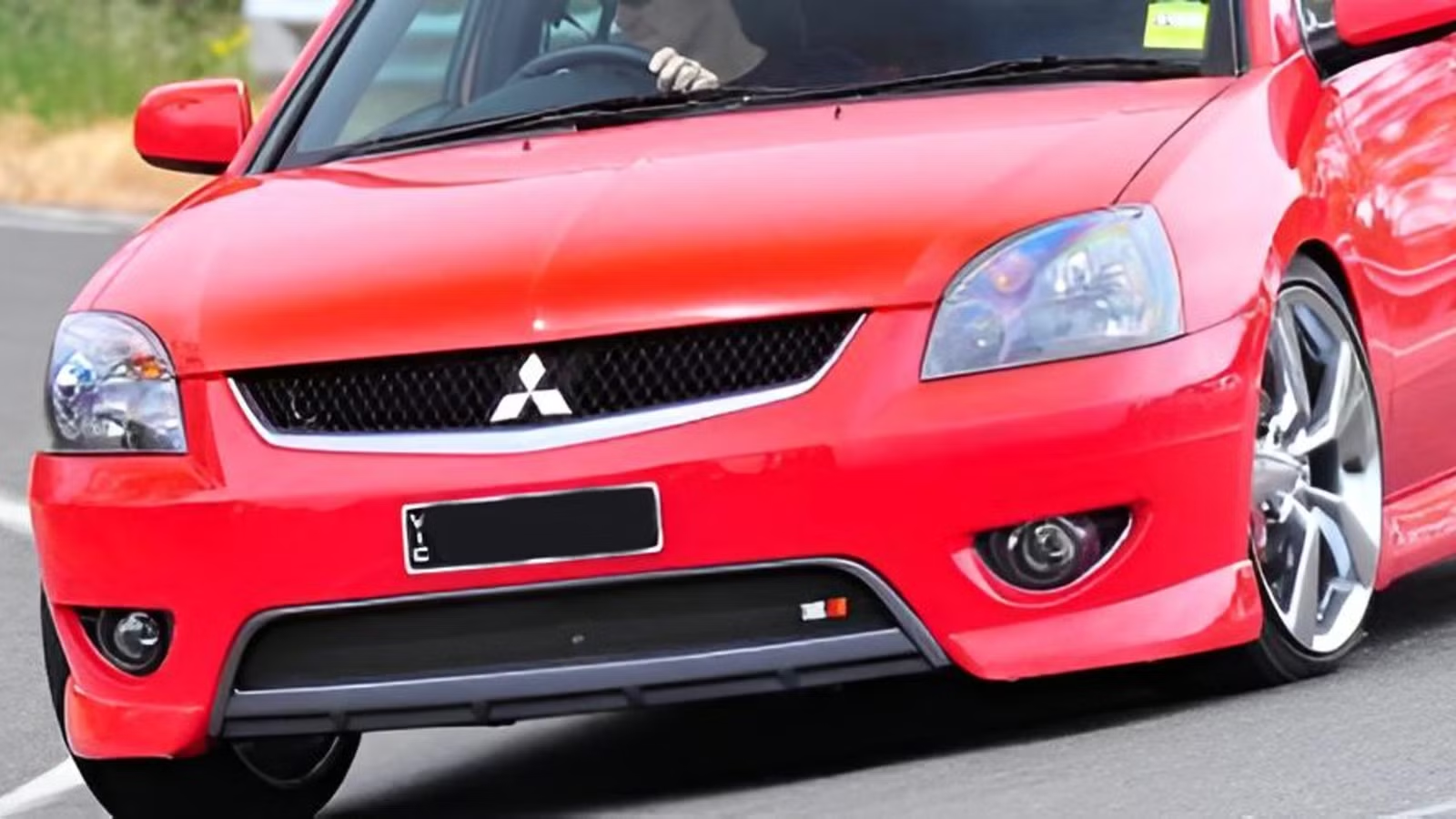
They don’t mass produce cars in Australia anymore, and it’s a story so sad there’s even been songs written about it. If you ask us, it’s a shame for quite a different reason as well. Why? Well, right alongside the straight-six Fords and V8 Holdens, none other than Mitsubishi was planning to get in on the fun right before everything fell apart. The only problem is, so few examples exist that there’s almost no proof it ever happened.
The End of Mass Production in Australia

By the mid-2000s, the writing was already on the wall for domestic Australian car manufacturing, even as the local muscle-sedan wars were raging at full volume. For decades, local buyers defined loyalty through rear-wheel-drive homegrown titans like the Holden Commodore and Ford Falcon. The pair fought it out at the dealership, on the streets, and at the race track for the better part of half a century.
All the while, their American bosses were plotting as import tariffs dropped and domestic manufacturing became increasingly unprofitable. After building cars in Australia since 1948, the last Holden, a VF II Holden Commodore SS-V Redline, left an Australian production line in 2017. On the Ford side of things, who’d made cars in the country since the mid-1920s, the last Falcon XR6 left the factory in 2016.
It was a tearjerking watershed moment for Australian car production, a sign that the era of Australian muscle cars had officially ended forever. With that said, Ford and Holden weren’t the only names in Australian domestic manufacturing, as OEMs in Japan had also established factories Down Under. Whether they realized native Australian manufacturers were prepping to wind down or not in the years prior is anyone’s guess, but based on what they had planned, they certainly didn’t act like it.

Mitsubishi in Australia: Japanese Cars for the Aussie Palate

As Toyota built Camrys and Aurions in Melbourne while importing HiLux trucks from Japan, Mitsubishi Motors Australia Limited was fighting to keep its Tonsley Park, Adelaide, assembly line alive. The plant had been producing market-exclusive Magnas and Veradas since the 1980s, and in 2005, Mitsubishi rolled the dice on a reworked, wider, and stiffer large sedan derived from the North American-spec ninth-generation Galant, calling it the 380.
Under the hood sat a 3.8-liter 6G75 V6 making 235 hp. As a competitor to straight-six Ford Falcons and V8 Holden Commodores, Mitsubishi’s offering was at least marginally more fuel-efficient while offering that same big sedan feel that Aussie motorists were intimately familiar with. Because the crossover SUV craze was slower to hit shores there than in places like North America, the form factor still ruled Australian driveways well into the late 2000s, making a roomy, torque-rich large sedan essential to survival.
Still, a front-wheel-drive family cruiser had zero credibility next to rear-drive V8 Holdens and turbocharged straight-six Fords. If Mitsubishi wanted to prove it had what it took to compete in the Australian performance sector, Team Mitsubishi Ralliart Australia had to throw the Lancer Evolution rally playbook out the window. Led by touring-car legend Alan Heaphy, the crew bolted a twin-screw Sprintex supercharger onto the 3.8-liter V6, upping power output to 308 hp and 326 lb-ft of torque. Meanwhile, chassis upgrades including Koni dampers, Eibach springs, 19-inch ROH wheels, and massive six-piston PBR front brakes added up to something approximating a Japanese Ford Falcon, and the results were remarkable.
The Mitsubishi TMR 380: Like No Mitsu Built Before or Since

Quite the opposite of a four-cylinder turbo Evo, the Mitsubishi TMR 380 was the kind of car that would’ve only worked in Australia. We know this because every time an Australian-American automaker tried to import something from Australia to the US, even V8 performance cars, the result was something almost nobody wanted to buy.
Built to compete with the Toyota Aurion TRD just as much as top-tier Commodores and Falcons, the production TMR 380 arrived in 2008 with a $56,990 AUD sticker price, or about $52,000 USD at 2008 exchange rates. That placed it in direct competition with performance-grade Falcons and Commodores. To keep that price tag from spiraling even higher and appeal to more people, Mitsubishi dropped the 2006 show concept’s Recaro bucket seats and manual transmission in favor of the standard VRX interior and a five-speed automatic.

From that perspective, the TMR 380 wasn’t perfect, but as a direct response to Australian domestic manufacturing, it did at least have the right idea. On a long enough timeline, it’d be easy to envision Mitsu gradually adding the manual gearbox and Recaro seats back to the platform as a special edition. The only problem was that Mitsubishi’s unfortunately bad timing meant it wouldn’t have a long enough timeline to make it happen.
Only 20 Were Made, and That’s a Shame

Just as Team Mitsubishi Ralliart Australia began assembling customer cars in early 2008, Mitsubishi Motors Australia announced the permanent closure of its Tonsley Park assembly plant in Adelaide. With the entire 380 model line suddenly canceled after less than three years on the market, the TMR 380’s production run was cut off almost before it began, capping total output at just 20 numbered examples.
Eighteen went to Australian dealerships, Build #001 stayed with Alan Heaphy, and one went straight to Mitsubishi Australia CEO Rob McEniry. Today, surviving TMR 380s are exceptionally rare even in their native Australia, surfacing only rarely at specialist collector auctions like Shannons and Burns & Co, where, despite their rarity, one sold for just $40,000 AUD in 2022. That’s $30,045 in US dollars, a remarkably low price considering the history. By any measure, that price was an extraordinary bargain given the car’s rarity and history.
Source: Burns & Co

Related posts
Latest Post


No Comments