
Lexus GS 350 F Sport: Reliability Meets BMW Handling
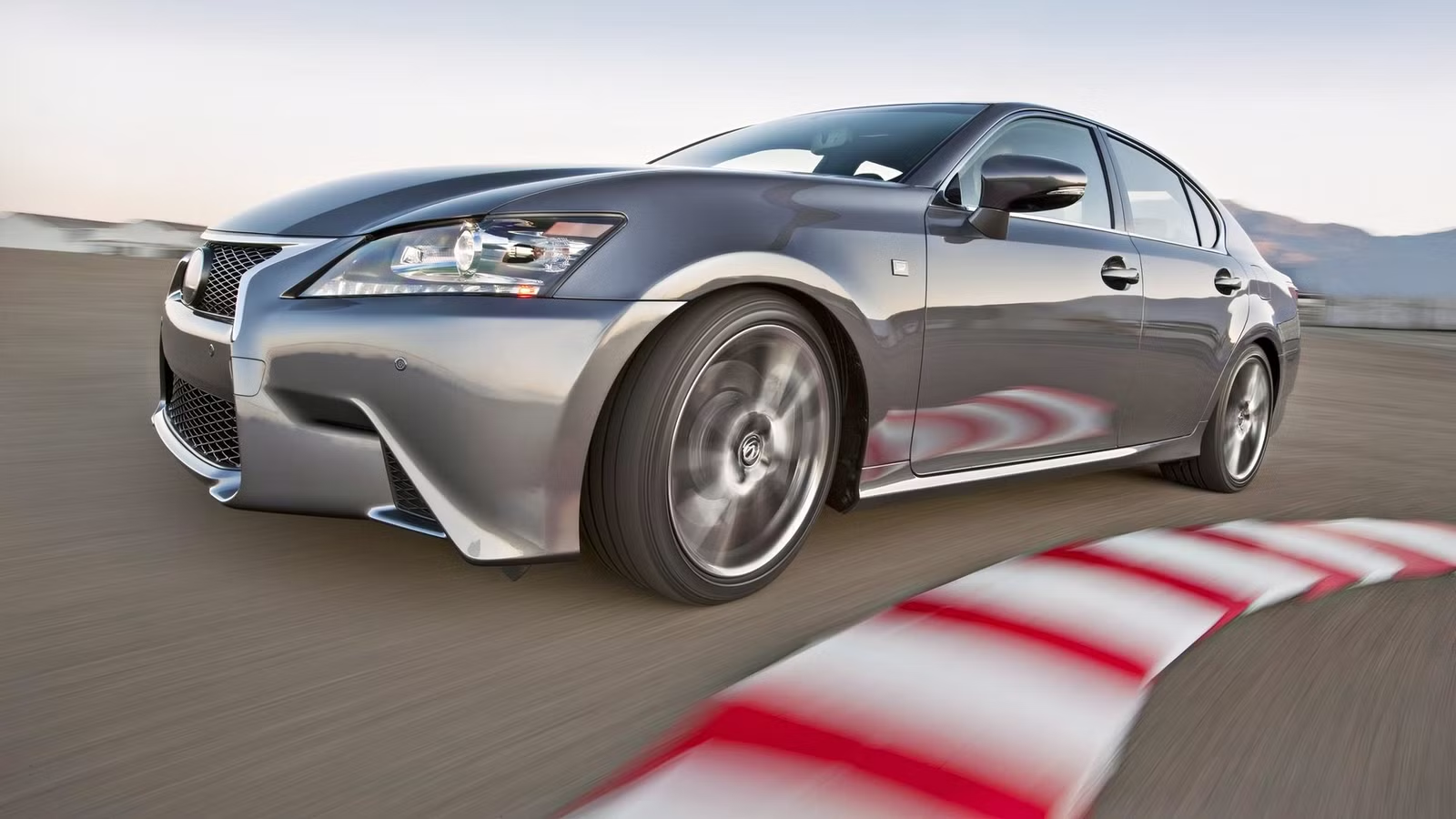
For years, the luxury sedan shorthand was easy. Buy German if you wanted steering feel and a chassis that seemed to enjoy an empty on-ramp as much as you did. Buy Japanese if you wanted something quieter, calmer, and less likely to make you send your service adviser a Facebook friend request.

One sedan made that division much less tidy. It had a naturally aspirated V6, rear-wheel drive, adaptive dampers, 19-inch performance tires, larger brakes, quick steering, and even available rear-wheel steering. Contemporary testing showed the hardware wasn’t there just to fill a brochure.
Why This Luxury Sedan Could Seriously Challenge BMW
The F Sport’s case was made underneath the body. Lexus fitted firmer springs, thicker anti-roll bars, revised bushings, adaptive dampers, and quicker variable-ratio steering. Rear-drive cars also got staggered 19-inch performance tires, which gave the GS considerably more cornering intent than the typical Japanese executive sedan of the period.

The available rear-steering system added another layer. Lexus said the system could turn the rear wheels opposite the fronts at lower speeds and, in certain conditions above 50 mph, in the same direction to improve agility and stability. On the road, the idea was simple: make a fairly large sedan feel less reluctant to turn and more settled once the speed came up.
Car and Driver found out just how much of that hardware translated to the pavement. The rear-drive performance model reached 60 mph in 5.5 seconds, pulled 0.89 g on the skidpad, and stopped from 70 mph in 160 feet, while running within a tenth of a second of a contemporary BMW 535i to 60 mph. Those results came from Car and Driver’s instrumented test of the fourth-generation car.
Period Test Results
|
0-60 mph |
5.5 seconds |
|
Skidpad |
0.89 g |
|
70-0 mph |
160 feet |
|
Engine |
Naturally aspirated V6 |
|
Layout tested |
Rear-wheel drive |
The steering wasn’t perfect. And “BMW handling” certainly doesn’t mean the GS beat BMW at its own game. Car and Driver still described the steering feel as synthetic even while praising the car’s grip, brakes, and high handling limits. BMW was simply a credible benchmark for this sedan, which was already a pretty surprising place for this particular Japanese luxury brand to find itself.
The Car Is The Fourth-Generation Lexus GS 350 F Sport

The mystery sedan is the fourth-generation Lexus GS 350 F Sport, launched for the 2013 model year. And no, this wasn’t an IS F with a quieter exhaust or a regular GS wearing an angry body kit. It was Lexus’s midsize luxury sedan with enough real chassis work to truly deserve the F Sport badge.
At launch, the GS 350 used a 3.5-liter naturally aspirated V6 producing 306 horsepower and 277 lb-ft of torque. Rear-wheel drive and all-wheel drive were both available, while the 2013 rear-drive version used a six-speed automatic with paddle shifters, quicker shifts, and throttle blips on downshifts.
2013 Lexus GS 350 F Sport Specs
|
Engine |
3.5-liter naturally aspirated V6 |
|
Power |
306 hp |
|
Torque |
277 lb-ft |
|
Transmission |
6-speed automatic |
|
Drivetrain |
RWD or AWD |
|
F Sport wheels |
19 inches |
The F Sport badge went considerably deeper than wheels and trim. It brought F Sport-tuned Adaptive Variable Suspension, firmer springs, thicker anti-roll bars, revised bushings, 19-inch wheels, and larger front brakes on rear-drive cars, while Sport S+ sharpened the adaptive suspension, steering, and powertrain settings.
Edmunds found that the changes worked, praising quick turn-in, rapid transitions, good balance, and plenty of adjustability during its track testing. Yet it still had to be a GS. Testers found the F Sport comfortable enough to work as a proper executive sedan despite the sharper chassis. Edmunds’ track test and Car and Driver’s review both landed on roughly the same point: the car got much sharper without turning every expansion joint into a personal attack.
Lexus Reliability Makes The Performance More Appealing

A used sports sedan can be cheap to buy and spectacularly expensive to keep. The Lexus badge suddenly becomes much more relevant once the car is a decade old. Strong handling numbers don’t mean much if the car spends every other weekend sitting on top of a car lift. The GS 350 F Sport’s appeal is that its reputation doesn’t begin and end with what it can do on the track.
J.D. Power gives the 2013 Lexus GS 350 an 89/100 Quality & Reliability score and lists the model as a Dependability Award winner. Consumer Reports also rates some later fourth-generation GS models well for reliability. It says the 2014 GS is more reliable than most cars from that year, while the 2015 GS is much more reliable than its peers. Put together, those ratings give the GS’s reliability reputation more than just a Lexus badge to lean on.
The 2013 car complicates the story a little. Consumer Reports currently rates it about average for reliability compared with other cars from the same model year, so calling every fourth-generation GS “bulletproof” would be doing the car no favors. Its 2013 GS reliability page is a good reminder that Lexus reliability doesn’t repeal the laws of aging, maintenance, or previous-owner creativity.
None of these cars are young anymore, and F Sport versions have more chassis hardware to inspect than a basic luxury sedan. A pre-purchase inspection should cover the service history, suspension and steering, adaptive damping, electronics, infotainment, wheels and tires, and any evidence of leaks or neglected maintenance. A GS 350 F Sport can still break, especially after more than a decade on the road. What makes it appealing is that its reliability record makes the usual old-luxury-car gamble look a little less frightening.
`;
}
itemsHtml += `

`;
itemsHtml += `
${price}
${isGreat ? ‘Great price‘ : ”}
${below ? `
${below}
` : ”}
View full listing
${src.title || ”}${src.type !== ‘car_bid’ ? ‘ ‘ + (props.trim || ”) : ”}
`;
if (src.dealername || address) {
itemsHtml += `
${src.dealername ? `${src.dealername}${props.address ? ‘,’ : ”} ` : ”}
${address}
` : ”}
${distance ? `
${distance}
` : ”}
`;
}
itemsHtml += `
`;
}
if (!itemsHtml) return;
section.innerHTML = “;
initCarousel(section);
})
.catch(function () {});
function initCarousel(section) {
var track = section.querySelector(‘.listing-marketplace-carousel__track’);
var container = section.querySelector(‘.listing-marketplace-carousel__items’);
var cards = section.querySelectorAll(‘.listing-marketplace-carousel__item’);
var leftBtn = section.querySelector(‘#carousel-left’);
var rightBtn = section.querySelector(‘#carousel-right’);
var index = 0;
function cardStep() {
var gap = parseFloat(getComputedStyle(container).gap || 0) || 0;
return cards[0].getBoundingClientRect().width + gap;
}
function maxIndex() {
var visible = Math.max(1, Math.floor(track.clientWidth / cards[0].getBoundingClientRect().width));
return Math.max(0, cards.length – visible);
}
function go() {
index = Math.max(0, Math.min(index, maxIndex()));
track.scrollTo({ left: index * cardStep(), top: 0, behavior: ‘smooth’ });
}
var sendCarouselNav = function () {
if (!window._carouselNavFired && window.websiteSentinel && typeof window.websiteSentinel.sendEvent === ‘function’) {
window._carouselNavFired = true;
window.websiteSentinel.sendEvent(‘Car Marketplace’, ‘listingscarousel_nav’, window.location.href);
}
};
rightBtn.addEventListener(‘click’, function () { index++; go(); sendCarouselNav(); });
leftBtn.addEventListener(‘click’, function () { index–; go(); sendCarouselNav(); });
var scrollNavFired = false;
var scrollNavTimeout;
track.addEventListener(‘scroll’, function () {
if (!scrollNavFired) { scrollNavFired = true; sendCarouselNav(); }
clearTimeout(scrollNavTimeout);
scrollNavTimeout = setTimeout(function () { scrollNavFired = false; }, 1000);
});
window.addEventListener(‘resize’, go);
}
}
if (document.readyState === ‘complete’) {
setTimeout(init, 200);
} else {
window.addEventListener(‘load’, function () { setTimeout(init, 200); });
}
}());
The GS 350 F Sport feels more unusual now than it did in 2013. Back then, a naturally aspirated V6, rear-wheel drive, a conventional automatic, and adaptive suspension weren’t especially exotic ingredients in a luxury sedan. Today, that combination is getting hard to find.
The GS competed with cars such as the BMW 5 Series, Mercedes-Benz E-Class, Audi A6, Cadillac CTS, Infiniti M/Q70, and Acura RL/RLX. Some of those nameplates have disappeared, others have changed direction, and the segment itself has been squeezed by crossovers, electrification, downsized turbo engines, and increasingly software-heavy luxury cars. Against today’s luxury market, the old GS suddenly has more character than its 2013 spec sheet suggested.
Depreciation strengthens the case, although current asking prices should always be checked close to publication because mileage, condition, drivetrain, and model year move the numbers around substantially. A comparable BMW may still give a purist more steering feel or a broader engine menu, while a standard Lexus might suit someone who has never once wondered what a skidpad number means. The GS 350 F Sport sits between those two ideas, which is exactly why it works.
Lexus eventually ended GS production in 2020 after four generations, leaving this particular combination without a direct successor. That makes the fourth-generation F Sport feel more significant now than when it was simply another new luxury sedan competing for showroom space. Does it handle exactly like a BMW 5 Series? No. The better question is how many used luxury sedans can still give you this much grip, comfort, naturally aspirated power, and Lexus durability in the same car.

Related posts





Latest Post


No Comments