
How A Chicago Chevy Dealer Beat GM’s Own COPO Program By Three Years
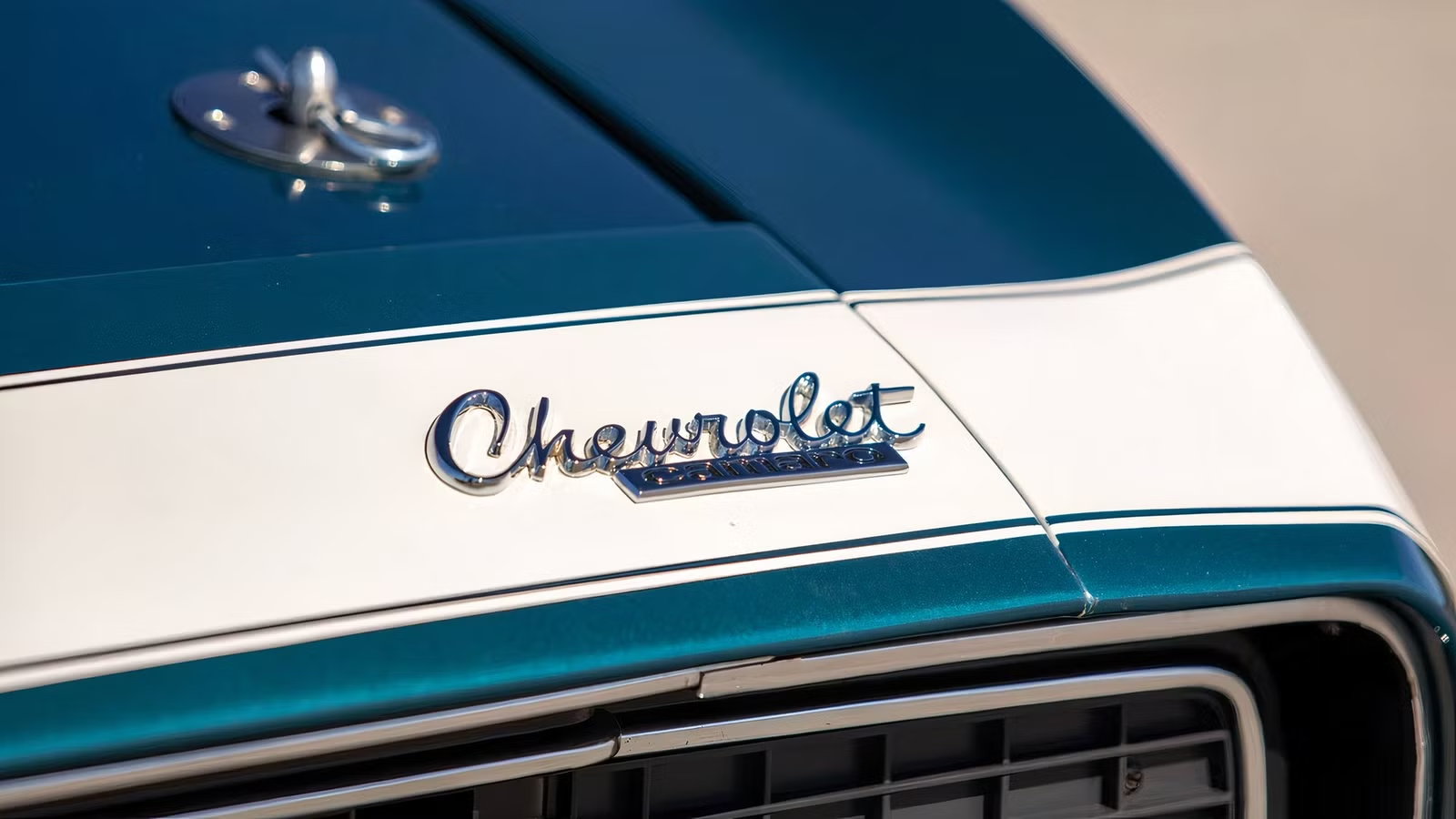
If you’re familiar with the process, a factory order form is supposed to be the clean way into a serious muscle car. You pick the engine, add the transmission that makes your left leg feel useful, choose the rear end, and wait for the transporter to bring your bad decision in dealer-prep plastic. In 1967, though, the hottest version of Chevrolet‘s new pony car didn’t come through the regular factory pipeline.

Instead, it sort of came in a round about sort of way. The paperwork said one thing, the engine bay said another, and anyone who understood the trick knew Chevy’s corporate rulebook had just been fed into a shredder.
GM’s 400-Cubic-Inch Rule Left The Camaro One Engine Short
The first-year Camaro arrived with all the right appeal. It was compact, handsome, easy to option, and aimed straight at buyers who wanted something smaller than a Chevrolet Chevelle but sharper than basic transportation. Chevy gave it plenty of hardware, including small-blocks and big-block power, but the serious Corvette-grade artillery stayed out of reach.

That was because General Motors had a corporate policy in place for 1967 that kept factory-installed engines larger than 400 cubic inches out of smaller cars such as the Camaro and Chevelle. The Corvette and full-size cars could play with the big stuff, though. The smaller cars had to stay inside the line (at least on paper).
What we’re hinting at is that the L72 427 was the kind of engine the Camaro body was begging for. Rated at 425 hp in factory form and tied to the Chevrolet Corvette’s performance image, it had credibility that didn’t need a salesman to explain it. Put that engine in a lightweight Camaro, and the math got way too hard to ignore.
The Fastest Camaro Had To Be Built After The Sale

As it turns out, there was loophole waiting that was incredibly elegant. If GM wouldn’t build a 427 Camaro on the assembly line, a dealer could sell a new Camaro and convert it before the customer took delivery. That changed the whole game, because the car no longer needed to be a factory-authorized 427 F-body. It became a dealer-built supercar, and that distinction was enough to work around the rule.
This is where the muscle car era gets properly fun, because as we all know, the best stuff didn’t always come from official channels. Dealer performance departments knew their stuff, and as a direct consequence, their customers. They knew who wanted a street car that could cruise on Friday night, run hard on Sunday, and make the guy in the next lane wonder why his expensive factory special suddenly looked underfed.
The conversion wasn’t cheap, mind. Basic 427/425 Camaros started at $3,711 in one early form, while a more developed prototype-demo car listed at about $4,300. Fully built cars could climb toward nearly $6,000, which was serious money when a basic Camaro hardtop cost far less.
Nickey Chevrolet Built The 427 Camaro Before COPO Made It Official

|
Engine |
Power |
Transmission |
1/4 Mile |
|
427ci L72 V8 |
Up to 450 hp |
Muncie 4-speed |
12.3 seconds |
The dealer at the center of this was Nickey Chevrolet of Chicago, a store that understood performance long before Muscle Cars became auction-house royalty. Nickey worked with Bill Thomas Race Cars in Anaheim, California, with Thomas handling development and West Coast construction while drag racer Dick Harrell, known as ‘Mr. Chevrolet’, helped run the Chicago side.
Lest you get the wrong idea, this was far from some loose back-alley wrenching operation with a big block hanging from a tree branch. Nickey’s 427 Camaro program had structure, advertising, packages, and a solid network. Cars could be built in different specs for different customers, and the operation was polished enough that people could even be offered delivery routes through Chicago or Anaheim.
Anticipating Demand

The key name was the Nickey Chevrolet 427 Camaro. In 1967, it beat the factory COPO 427 Camaro formula to the punch by years, showing Chevy there was real demand for an L72-powered Camaro before the company’s official special-order route made that idea famous. Nickey didn’t wait for permission. It built the car serious street racers were already asking for.
Nickey offered three stages of preparation. Stage I focused on mild tuning and appearance upgrades, including items such as headers, an 8,000-rpm tach, a steering wheel, stripes, wheels, and chrome touches. Stage II pushed further with a hotter camshaft, Hurst shifter, and heavy-duty clutch. Stage III was the version that made the local drag strip talent looking up the racing driver excuses book.
Stage III Was A Sleeper With A Drag-Strip Receipt
Stage III was where it was at, as you might have guessed. The L72 was a cast-iron, solid-lifter Mark IV big-block with Corvette DNA, and in Nickey/Thomas form, output could sit at 425 hp or rise to a rated 450 hp depending on the tune. With the right gearing, traction help, and exhaust, the car was built to leave hard.
No Messing About

The performance numbers speak for themselves. A 427 Camaro in this world was capable of roughly 5-second 0-to-60 mph runs, and quarter-mile performance has been cited at 12.3 seconds at 113.21 mph. One early Bill Thomas-built example was said to be even nastier with serious gearing, although that kind of setup was better suited to a strip than a freeway.
The sleeper angle made the whole thing better. Some Nickey Camaros wore stripes and obvious add-ons, while others kept more discreet trim. One early 427 Camaro retained its original 350 emblems, which is hilarious in the way only old-school street racing can be. Imagine pulling up next to what looks like a warmed-over small-block Camaro and finding out too late that there’s a Corvette big-block under the hood. Talk about getting schooled.
Proving A Real Nickey Is Harder Than Proving A Factory COPO

The same thing that makes these cars brilliant’s also what makes them difficult today. A factory COPO Camaro has a clearer paper trail because the hardware was tied to a factory ordering process. A Nickey 427 Camaro lives in a murkier, more reclusive world. It was dealer-built, customer-specified, and often altered around the buyer’s intended use. That means normal VIN decoding won’t tell you the whole story.
Real Nickey Camaro authentication leans heavily on documentation. The important proof can include Nickey Registry certification, NICB delivery records, original owner affidavits, builder verification, photographs, and paperwork showing the car’s conversion history. In some cases, names like Don Swiatek are important because original-builder confirmation can carry serious weight. A car can look and sound right, and still need a stack of evidence before anyone starts writing fat checks with confidence.
The Righteous Gap

That’s why auction results are so sensitive to provenance. A documented and certified 1967 Nickey/Bill Thomas 427 Stage III Camaro sold for almost $400,000, while another 1967 Nickey Camaro SS sold for $385,000 in 2012. Those numbers are paying for proof, history, rarity, and the fact that this was one of the earliest serious answers to the gap GM wouldn’t officially fill yet. Nickey found that gap, and it just so happened to be 427 cubic inches wide.
Sources: CarGuyChronicles, SS396, Supercars.net, RM Sotheby’s, Mecum.

Related posts

Latest Post


No Comments