
Harley-Davidson’s Rarest Superbike Was Built To Fight Ducati
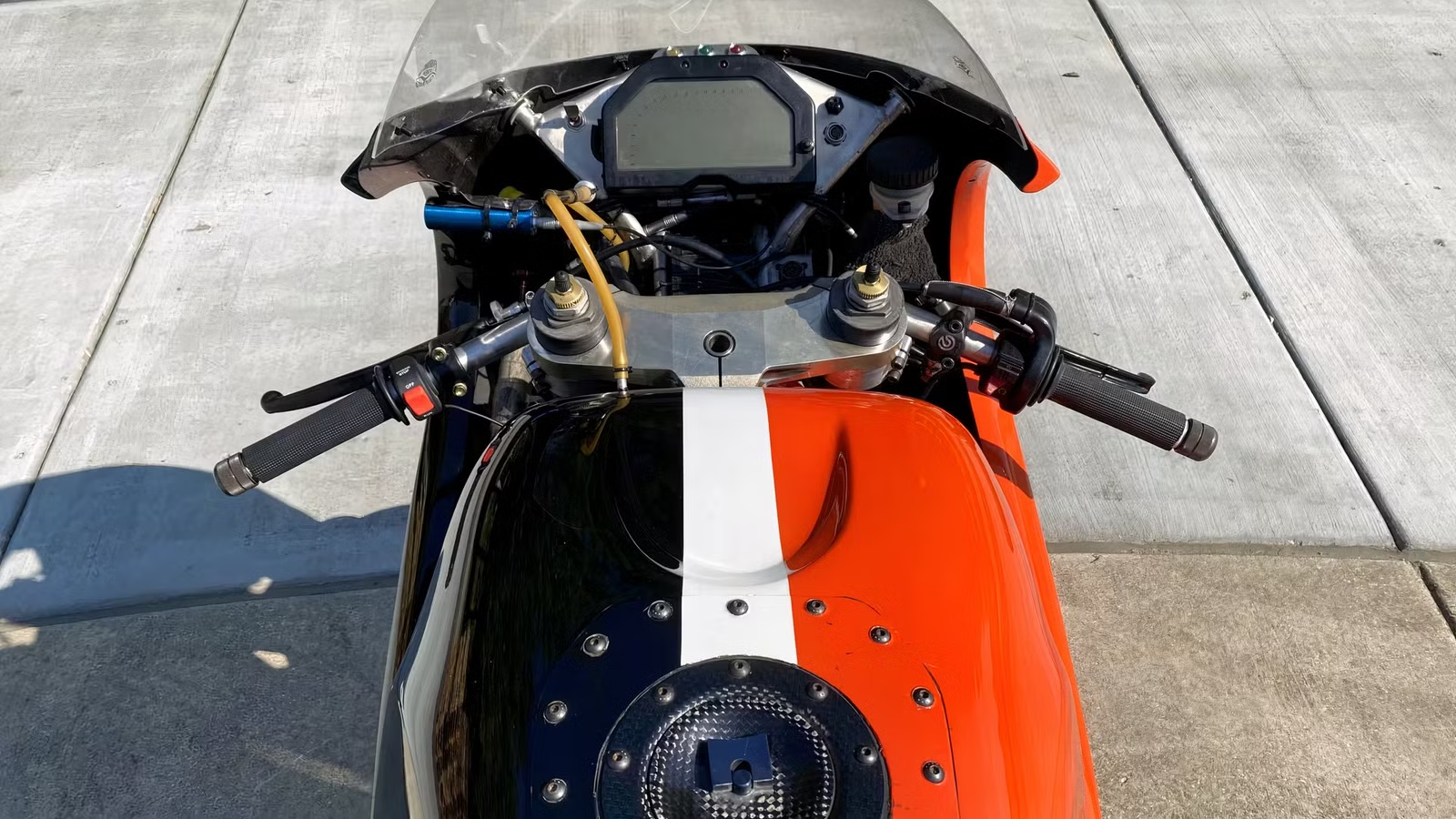
It’s an open secret that Harley-Davidson built its reputation on the backs of its heavyweight cruisers, thunderous V-twin engines, and a true-blue American identity. However, during the 1990s, the American bikemaker pursued a radically different path: challenging established superbike makers on the racetrack. The thought process wasn’t radical. For decades, automakers had used racing as a platform to showcase their engineering and instill excitement for their road-going models. Harley-Davidson seemed to want to apply the same philosophy to its motorcycles, while at the same time moving from its traditional cruiser base to appeal to younger riders. The result was an ambitious racing program that produced one of the rarest and most unusual road-going Harleys.
How “Race On Sunday, Sell On Monday” inspired Harley-Davidson’s Superbike Ambitions

For most of the 20th century, American motorsport ran on a simple philosophy: race on Sunday, sell on Monday. It worked on the idea that winning on the racetrack would translate to showroom credibility, giving customers another irresistible reason to buy their road-going cars. This was particularly big amongst Detroit automakers who participated in NASCAR, drag racing, and other forms of motorsport to promote their powerful engines, performance packages, and muscle cars. The racetrack became both a proving ground and a stage where manufacturers could demonstrate their machines’ capabilities.
Harley-Davidson had its own rich competition heritage. However, by the late 20th century, its identity was increasingly associated solely with its heavyweight cruisers, distinctive V-twins, and relaxed highway riding. That formula gave it a loyal customer base, but it also limited the brand’s appeal to slow cruisers. Meanwhile, European bikemakers like Ducati were filling the void and gaining a reputation for their high-performance motorcycles by competing in the AMA Superbike Championship and Daytona 200.
For Harley-Davidson, superbike racing offered an opportunity to broaden their brand identity. A competitive racing machine would showcase their engineering capabilities, while introducing the brand to riders who preferred speed, cornering ability, and track performance over shiny chrome and lazy ergonomics.
The Harley-Davidson VR1000: The Radical American Ducati-Fighting Superbike

The motorcycle that emerged from this ambitious project was the Harley-Davidson VR1000. It was a purpose-built superbike developed for American Superbike racing, and had a 60-degree, 996cc V-twin featuring liquid cooling, fuel injection, double overhead camshafts, and four valves per cylinder. The engine platform was a significant departure from Harley’s road-going motorcycles at that time. The VR1000 had none of the bikemaker’s cruiser characteristics, being developed with racing and performance in mind.
The VR1000’s development began in 1988, eventually reaching competition readiness in 1994, making its debut in Daytona 200 with Miguel Duhamel aboard. It faced established Japanese and European superbike rivals, including Ducati. The VR1000 never became a championship-winning success story, but remains one of Harley-Davidson’s most radical engineering projects.
Road-going versions of the VR1000 were built as well. AMA Superbike racing homologation rules required a minimum of 50 street-legal examples to be made. Harley built that many numbers in 1994. However, since meeting American emission norms proved to be difficult, Harley homologated and sold those motorcycles in Poland, rather than selling them in the United States.
Harley-Davidson VR1000 Engine, Chassis, And Racing Technology

The VR1000 was fundamentally different from Harley-Davidson’s traditional cruiser motorcycles. Its liquid-cooled, fuel-injected V-twin used four valves per cylinder and double overhead cams and was designed to sustain higher engine speeds required for racing. The engine produced 135 horsepower at 10,000rpm according to historical Harley-Davidson data.
The chassis was unique too. Rather than repurposing an existing Harley-Davidson cruiser platform, the VR1000 featured a dedicated racing aluminum beam frame and track-spec components. The motorcycle was designed to prioritize handling precision and high-speed cornering stability. For this, Harley-Davidson took help from engineering specialists like Roush, Cosworth, and Harris Performance. Specialist component suppliers like Ohlins, Marchesini, and AP Racing helped with cycle parts.
The VR1000 showed promise during its early race outings, including a third-place finish in the 1994 Mid-Ohio race. However, reliability issues and comparatively slow development pace hindered its ability to deliver consistent performance. Despite being active for years, the VR1000 never secured an AMA Superbike race victory.
The VR might not have achieved success on track, but it turned out to be an important motorcycle for Harley-Davidson. The lessons learned from the VR1000 racing program helped Harley during the development of the V-Rod, especially its liquid-cooled Revolution engine that debuted in 2001.
Why The VR1000 Is A Rare And Highly Sought-After Collectible Today

The Harley-Davidson VR1000 has an unusual place in American motorcycle history. It carries the name of a bikemaker associated with heavyweight cruisers, yet its engineering and purpose are similar to that of a European superbike. That contrast is part of its appeal, especially for collectors looking for motorcycles that pushed their makers’ boundaries.
Another reason for its rare status was its limited production number. With around 50 units made, getting your hands on a well-kept, documented example, especially in the United States, is a highly difficult task. Also, given its specialized nature, owning and maintaining one is a far different and more difficult task than owning a regular Harley-Davidson cruiser.
For collectors, the VR1000 is more than just a rare Harley-Davidson. It is a reminder of the time when an American bikemaker stepped out of its comfort zone and challenged established bikemakers like Ducati. It also remains one of the greatest what-ifs of American motorcycle history. Just imagine: what if the Harley-Davidson VR1000 had won the AMA Superbike championship.

Related posts

Latest Post


No Comments