
Ford Design Chief Drives Dark Horse SC 3,200 Miles Cross-Country
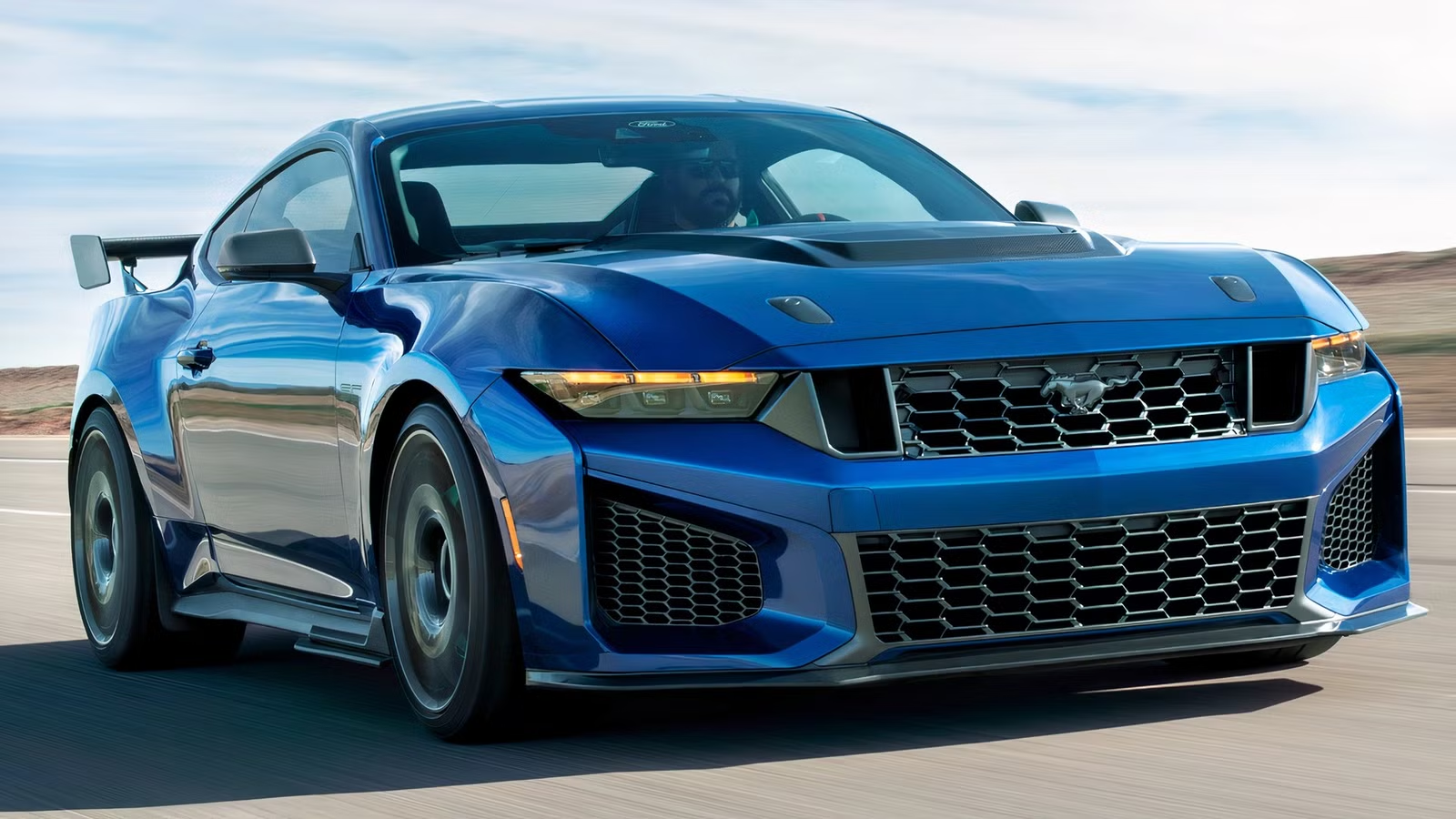
Todd Willing, Ford‘s head of design, had a Dark Horse SC prototype and 3,200 miles of American road between Michigan and California. Instead of running the new 795-horsepower Mustang through the usual gauntlet of design clinics and focus groups, he just drove it, ending the trip at Laguna Seca during Monterey Car Week. The approach borrows from “gemba,” a Japanese term meaning “the actual place,” and it’s a genuinely different way to validate a halo Mustang before it reaches customers.

Rather than watching people react to clay models under studio lighting, Willing took unannounced detours into Ford dealerships, ate gas-station attention from strangers, and let the SC get judged the way owners will actually judge it: on real roads, in real traffic, next to real competitors. For a car built to go head-to-head with the Corvette Z06 and the outgoing Shelby GT500’s legacy, that’s not a small departure from how Ford has typically built confidence in a flagship.
Why Ford’s Design Chief Ditched The Clinic For The Open Road
Willing’s trip covered Independence Pass in Colorado, the desert roads around Moab and Death Valley, and the switchbacks through Yosemite before wrapping up at Laguna Seca. That’s not a direct route, and it wasn’t meant to be. The idea, inspired by CEO Jim Farley’s interest in gemba thinking, was to feel the SC exactly how an owner would: through long stretches of boredom, bad pavement, traffic jams, and the occasional big rig blocking the view.

Along the way, Willing stopped, unannounced, at two Phil Long Ford locations in Colorado and at Team Ford in Las Vegas. He’d walk in, introduce himself, then mention there was a Dark Horse SC prototype sitting in the parking lot. Sales, service, and parts staff came out to look every time. Those are the people who hear customer gripes and enthusiasms daily, and Willing used the stops to pull unfiltered feedback straight from the people closest to the sale.
The Dark Horse SC Kept Drawing A Crowd Wherever It Went

The reactions weren’t confined to dealer lots. Willing says he got flagged down at nearly every gas stop, and drivers pulled alongside on the highway to wave or honk. A Corvette driver threw him a thumbs-up. In Kansas, a woman driving a rival performance car asked him to roll down the window so she could ask about it. None of that tells you a torque figure or a lap time, but it tells Ford something a focus group can’t: that the SC’s styling reads as legitimate to people who cross-shop it against the cars it’s supposed to beat.
That matters because the SC isn’t just another trim bump. It picks up where the supercharged GT500 left off, running the same 5.2-liter Predator V-8 architecture but with 795 hp and 660 lb-ft routed through a seven-speed dual-clutch transmission and a Torsen limited-slip differential. Ford spent 12,000 hours on the aero package alone and developed model-specific tires over two years, so the design and engineering teams clearly weren’t treating this as an afterthought. Willing’s drive backs that seriousness with something specs can’t buy: proof the car reads as special to strangers at a gas pump, not just to engineers on a dyno.
What This Means For How Ford Builds Its Next Halo Mustang

Ford has leaned on this kind of hands-on validation before, pulling development lessons from its NASCAR and GT4/GTD race programs straight into the SC’s hood design and traction control software. Willing’s road trip extends that same philosophy from engineering into design leadership itself. If a car looks right, sounds right, and earns respect from a Corvette driver at a stoplight, that’s a signal no clinic room replicates.
Whether this becomes Ford’s standard process for future performance Mustangs or GT-badged halo cars remains to be seen, but it’s a notable break from how automakers have traditionally greenlit a flagship’s design. For a lineup that already spans a $35,000 EcoBoost coupe and a $325,000 GTD, knowing the SC still turns heads on the open road, not just in a boardroom, says something about where Ford thinks the Mustang’s identity really lives.
Enthusiasts have long suspected that boardroom research clinics miss what actually sells a performance car: the way it looks parked at a truck stop, the way strangers react when you roll down the window. Willing’s cross-country drive suggests Ford’s design team agrees, and that’s worth watching the next time a halo Mustang comes down the pipeline.

Related posts




Latest Post




No Comments