
F1’s Greatest Engine Inspired This Forgotten Norton Superbike
John Surtees conquered both the motorcycle and Formula 1 worlds, being the only person to have become world champion in both. It’s understandable why, as they’re entirely different series with entirely different specifications. But while Surtees might be the only human to have done both, others have tried. And in the 1970s, Norton Villiers Triumph tried to take a winning F1 engine and put it into a bike. The only problem was, it wasn’t that easy.
Britain’s Motorcycle Industry Was Fighting For Survival In The 1970s

Britain’s once-great motorcycle industry was a shadow of its former self by the 1970s. Aging designs and crumbling architecture were allowing Japanese manufacturers like Honda, Yamaha, Suzuki, and Kawasaki to increase their market share, as their more reliable, more modern machines impressed the motorcycling public. The introduction of the Honda CB750 in 1969 was an effective death knell for the country’s bikes, as riders saw they didn’t have to put up with the old ways anymore.
One brand that was very much of the old guard was Norton Villiers Triumph (NVT). Formed in 1973 to bring several famous British brands under one roof and combine their prodigious heritage, NVT still faced considerable financial difficulties and industrial problems in the wake of the CB750, and while Norton’s Commando remained a respected machine, it was looking increasingly dated. Engineers had already extracted considerable performance from the powerplant, and further development was offering diminished returns. What Norton needed was something not only genuinely new, but which could demonstrate the power of British engineering. And an unlikely possibility emerged.
Cosworth Was Already Building One Of Formula 1’s Greatest Engines


While the British motorcycle industry was struggling, British-founded Cosworth was succeeding. Its legendary DFV V8 engine had transformed F1 since its 1967 debut, taking 54 race wins alongside five drivers’ championships and five constructors’ championships between 1967 and 1973. So dominant was the engine that it won every single race in both 1969 and 1973.
The secret to the DFV was not just raw horsepower. Cosworth had combined sophisticated engineering with a relatively compact design, resulting in an engine that was powerful, practical, and capable of winning at the highest level of international motorsport. Its considerable achievements made it an obvious partner for manufacturers seeking cutting-edge racing technology. But while this technology was attracting attention in the Formula 1 paddock, there was another manufacturer that was eyeing it up for a different purpose. It would require some ingenuity, but could the principles that made the DFV so good on four wheels also work for two?
The Norton Challenge Cosworth: A Cosworth-Powered Superbike That Never Was

In 1972, NVT Chief Executive Dennis Poore approached F1 engine manufacturers BRM and Cosworth with the goal of getting an F1 engine into a motorcycle. Cosworth was the eventual winner, with its V8 offering an exciting starting point for a modern 750cc twin, and plans for the brand to only design the cylinder heads quickly changed to developing the entire engine and gearbox. It would take three years to come to fruition but, when it was finally unveiled, it was impossible to ignore.
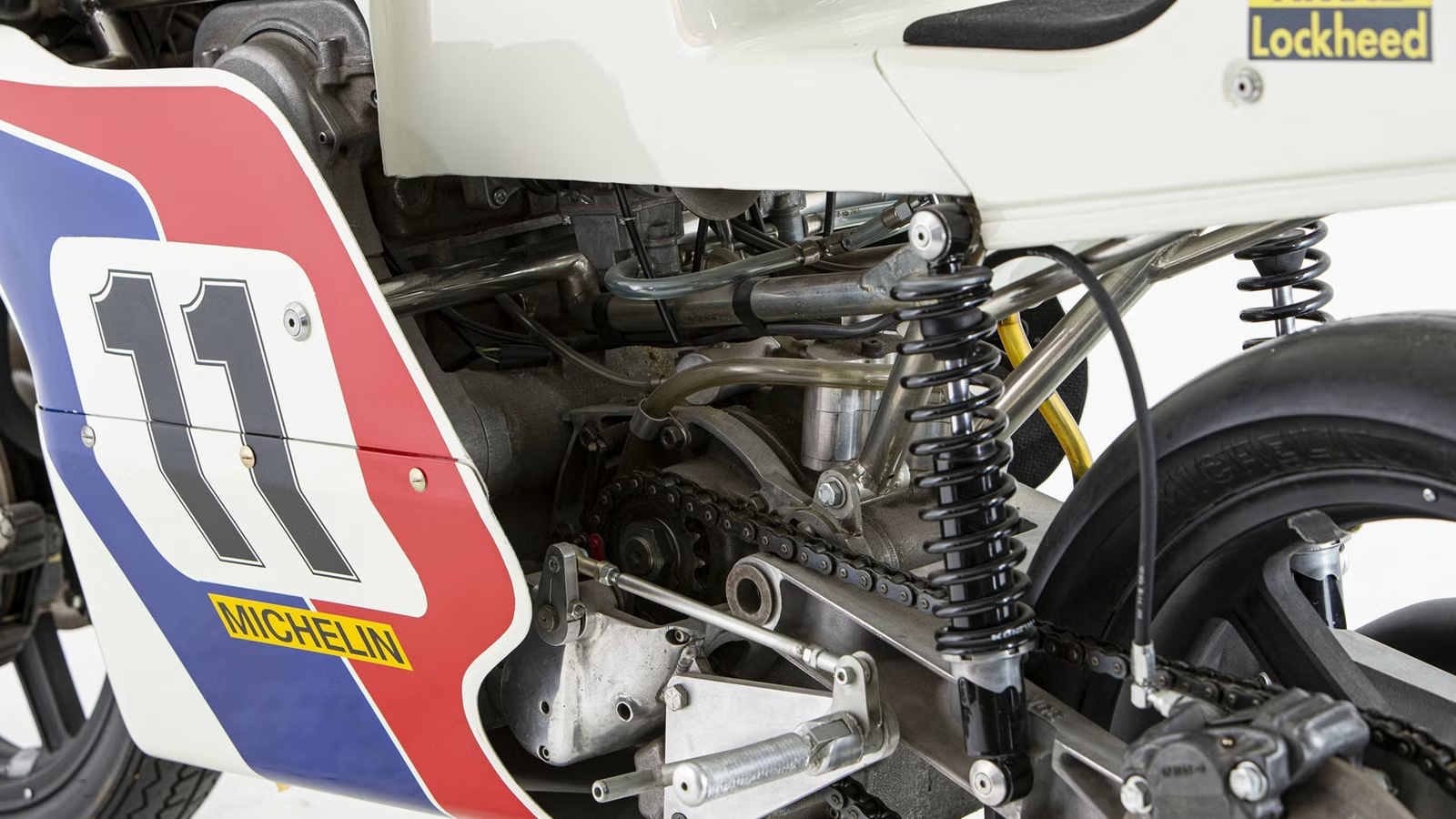
Known as the Norton Challenge P86, or the Norton Challenge Cosworth, the experimental motorcycle was a serious attempt at bringing F1-inspired technology into the two-wheeled world of superbike racing. But it obviously couldn’t just chuck a whopping great V8 into a frame and be done with it, so some changes needed to be made.
For a start, the 3.0-liter V8 engine was bumped down to a 746cc parallel twin, though it was still developed around the same principles associated with the V8 — namely aspects of the combustion chambers, cylinder head design, and conrods derived from the already proven F1 racing design. It also had a Dual Overhead Camshaft (DOHC) for better airflow and more power at higher revs, four valves per cylinder, liquid cooling, and around 95 HP — ambitious for the mid-70s. The engine was also a stressed member within the chassis, rather than it simply being a part of the structure. This provided the greater rigidity needed to truly exploit its power under racing conditions.
So, on paper, the Norton Challenge Cosworth seemed like an absolute world-beater. It was a bike with a two-cylinder F1 engine made by one of the most successful Formula 1 engine manufacturers in the world, with all the same technology, engineering, and power you’d associate with that. It could be just the thing NVT needed to bring it back to the forefront of motorcycling and forge a new path, right? Well, as Norton found out, promise on paper doesn’t always turn into performance in reality.
There were difficulties from the outset. Vibration was a concern, and was no doubt increased by having the engine as a stressed member. Weight was also a sizable issue, as the engine alone weighed around 195 lbs, which was particularly heavy for a race bike of the time. Even the road-going Honda CB750’s engine was slightly lighter. These are usually things that can be fixed with development but, with NVT’s finances already strained, they had to remain.
The bike did actually make its way to a track to be ridden in anger though, making its racing debut at Brands Hatch in 1975 for the final round of the MCN Superbike Championship, though trouble continued. An inauspicious start saw it caught up in a 10-bike crash at the first corner on Saturday, with a retirement coming the day after due to the crash damage. An attempt at the Transatlantic Trophy a year later, again at Brands, brought more disappointment, while a first-lap retirement from the Isle of Man Classic TT in June 1976 essentially signaled the end of the exciting, but ill-fated, project.
Norton’s F1-Inspired Twin Was Almost Forgotten

With no competitive results to speak of and as finances quickly dwindled, NVT abandoned its factory racing program and with it the P86. It became an incredibly rare bike, with only four complete examples and approximately 30 engines that passed into private hands before NVT’s eventual demise in 1978.
But while the gamble hadn’t paid off, the groundwork it had laid would become useful later on. The Quantel Cosworth, produced during the 1980s, took the basic Norton design and developed it further, addressing some of the shortcomings and improving the engine with fuel injection, increasing capacity to around 820cc, bumping power up to around 120 HP, and the revisions needed to make the package more competitive.
The transformation was a success. What had once been a final, desperate shot at profitability that failed to materialize has been turned into a more serious racing proposition. The Quantel Cosworth finished second at Battle of the Twins in 1986, and won the 1988 Daytona Pro Twins/Battle of the Twins race. The engine finally proved what it was capable of, but did so too late.
The Norton Challenge Cosworth Finally Proved What It Could Do

It’s a cruel irony that the engine intended to help save NVT would eventually prove its worth, but only after the company had disappeared. But while the Norton Challenge Cosworth was never the world-beater its creators had hoped for, its failure wasn’t the end of the story.
Norton had gambled on something genuinely different: a twin-cylinder motorcycle engine developed using the principles of one of Formula 1’s most successful designs. It was an ambitious idea, but one that needed more development time and money than NVT could afford. The ambition was there, if not the execution. The Quantel Cosworth showed what was capable of the engine a decade later, proving that the engine wasn’t the problem – timing was.
The Norton Challenge Cosworth remains a rare and largely forgotten machine, but it stands as a reminder of what British engineering was still capable of, even as the surrounding industry struggled to survive. It couldn’t save Norton, but it did get the last word on the track.
Sources: Motorcycle Classics, MCNews

Related posts


Latest Post


No Comments