
Brilliant Motorcycles We’re Thankful For
Motorcycling history is full of great motorcycles. Outrageously powerful, supremely well-engineered, and record-breaking machines, they all remind us of just what can be achieved on two wheels. This isn’t a list of those bikes. A truly important motorcycle can be unremarkable, commercially risky, and eventually comprehensively outperformed by the competition, yet still leave the industry different from how it found it.

Much of what we take for granted today exists because a manufacturer gambled on an unconventional idea. Each of these motorcycles created a category, changed how we ride, or forced manufacturers to rethink their engineering. In chronological order, here are ten motorcycles we’re immensely thankful for and the lasting impact they’ve left on motorcycling.
1958 Honda Super Cub C100
By the mid-1960s, Americans were listening to the Beach Boys and the Hondells sing about a little Japanese Honda. The Super Cub had accomplished something quite extraordinary in a country where motorcycles were often associated with rebelliousness, an image reinforced by Marlon Brando’s character in The Wild One. Honda’s famous 1963 advertising campaign challenged that perception, and the engineering backed it up. A centrifugal clutch eliminated the need to learn clutch coordination, while the step-through frame and leg shields made riding in everyday clothes practical. With over 100 million Super Cubs eventually produced, Honda demonstrated that the biggest untapped motorcycle market consisted of people who weren’t motorcyclists at all, and just needed a cheaper, more convenient mode of transport.
1968 Yamaha DT-1

While Honda was busy getting Americans onto motorcycles, Yamaha noticed a growing appetite for taking them off the pavement. The company developed the DT-1 specifically for recreational trail riding, borrowing engine technology from its competition machinery. Its two-stroke engine benefited from Yamaha’s Autolube system, sparing owners the inconvenience of manually mixing oil with gasoline. Being street legal also meant riders didn’t need a truck to reach the trails. The American off-road culture was subsequently captured so wonderfully in the 1971 documentary On Any Sunday, which owed much of its accessibility to game-changing motorcycles like the DT-1. Today’s dual-sport segment grew out of that newfound recreational freedom.
1969 Honda CB750 Four

Honda initially used sand-molded crankcases because it was uncertain about demand for its groundbreaking four-cylinder motorcycle. But the sales quickly justified switching to conventional die-casting for higher-volume production. Soichiro Honda had also backed the decision to use a hydraulic front disc brake, giving mass-market motorcyclists access to braking technology that would eventually become an industry standard. The CB750’s transverse inline-four brought a level of refinement and performance that fundamentally altered the expectations of American motorcycle buyers. Honda had made sophisticated engineering commercially viable on a scale previously unseen in the performance bike market.
1980 BMW R 80 G/S

The letters G/S stood for Gelände and Straße, German for terrain and road. BMW’s decision to put both in the name of a big boxer-powered motorcycle was a very radical decision in 1980. Its Monolever rear suspension combined a single-sided swingarm with a shaft drive, simplifying rear-wheel removal and reducing weight compared with BMW’s conventional arrangement. Hubert Auriol subsequently won the 1981 Paris-Dakar Rally aboard a competition-prepped version. BMW had demonstrated the potential of a large, multicylinder motorcycle far beyond paved roads. Decades later, Ewan McGregor and Charley Boorman would take the G/S’s descendants around the world.
1985 Suzuki GSX-R750

The original Gixxer, affectionately nicknamed the Slabside, brought endurance-racing engineering into the reach of ordinary enthusiasts. Suzuki used an aluminum frame, developed its oil-cooled engine to reduce mass, and gave it immense ability to withstand sustained high-speed running. A privately entered GSX-R750 won the 24 Hours of Le Mans in its debut year. In America, a young Texan named Kevin Schwantz would soon become synonymous with Yoshimura-prepared Suzukis, further cementing the Gixxer’s racing identity. The Gixxer made the relationship between production sport bikes and racing machinery closer, giving amateur racers a much more competitive starting point.
1992 Honda CBR900RR FireBlade

Having helped establish the big Japanese superbike in 1969, Honda was now set to rewrite the rules yet again. Development leader Tadao Baba wanted the FireBlade to offer the agility of a middleweight without compromising the performance expected of a flagship. His obsession with saving weight extended to using a rather unconventional 16-inch front wheel and retaining conventional telescopic forks when inverted ones were becoming fashionable. The lighter chassis rewarded precise braking and steering inputs, allowing riders to exploit more of the motorcycle’s performance through handling prowess. The industry’s subsequent fixation on power-to-weight ratios owes plenty to Baba.
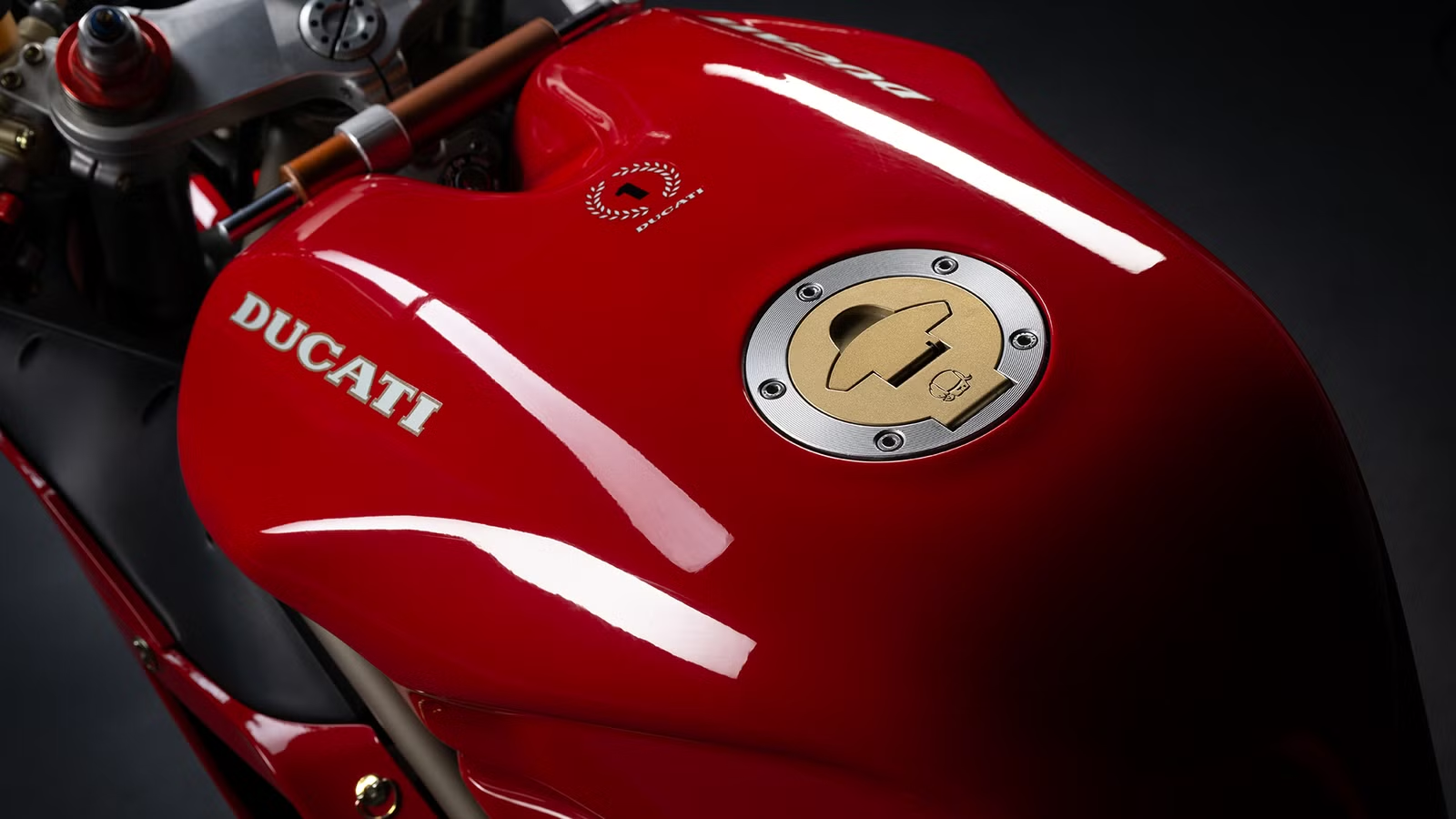
1994 Ducati 916

In 1998, a Ducati 916 found itself inside New York’s Guggenheim Museum as part of The Art of the Motorcycle exhibition. Four years earlier, Carl Fogarty had won his first World Superbike Championship aboard one. Only a few industrial products have received such emphatic recognition from two entirely different worlds. Massimo Tamburini understood how mechanical packaging could dictate a motorcycle’s proportions. Moving the exhaust beneath the seat freed up space, while the single-sided swingarm made rear-wheel changes easier. Both became defining elements of the Ducati’s gorgeous appearance, but it was the 916 that helped elevate motorcycle design into an art form.
1998 Yamaha YZ400F

Yamaha caused quite a stir at the 1997 AMA Supercross finale in Las Vegas when Doug Henry won aboard its experimental four-stroke YZM400F. The thumper had beaten the two-strokes at their own game. Henry subsequently won the 1998 AMA outdoor motocross championship aboard the production-based YZ400F. Its broader power delivery allowed riders to find traction without relying as heavily on the clutch to keep the engine within a narrow powerband. Four-stroke engine braking also required developing new corner-entry techniques. Other manufacturers soon invested heavily in competitive four-stroke machinery, fundamentally changing motocross grids, riding styles, and the sound of MX.
1998 Yamaha YZF-R1

Iconic Motorbike Auctions
That same year, Yamaha was equally busy rewriting the engineering handbook for superbikes. The original R1’s biggest contribution was its stacked transmission, which repositioned the gearbox shafts vertically relative to one another, considerably reducing the engine’s length. This freed up space between the engine and rear axle, allowing Yamaha to fit a longer swingarm without increasing the wheelbase. The arrangement helped manage rear-wheel traction under acceleration while preserving the agility of a compact chassis. The stacked transmission layout would become one of the industry’s most consequential packaging innovations.
1999 Suzuki Hayabusa

Suzuki displayed a delightful sense of humor in naming its flagship after a peregrine falcon, a bird that preys on blackbirds. Honda’s CBR1100XX Super Blackbird was, of course, the motorcycle whose speed crown Suzuki intended to snatch. The resulting emphasis on aerodynamic efficiency produced the Hayabusa’s unmistakable bulbous bodywork. Its speed helped bring the manufacturers’ top-speed wars to a head before the industry adopted its informal 186-mph ceiling. Meanwhile, the Busa also developed a particularly strong following in American drag racing and custom motorcycle culture, even becoming Laurence Fishburne’s ride in the 2003 movie Biker Boyz. Suzuki had helped establish an entire hyperbike sub-genre and still means business.
Source: OEMs

Related posts
Latest Post


No Comments