
America’s Most Game-Changing Muscle Car Arrived In The Worst Decade
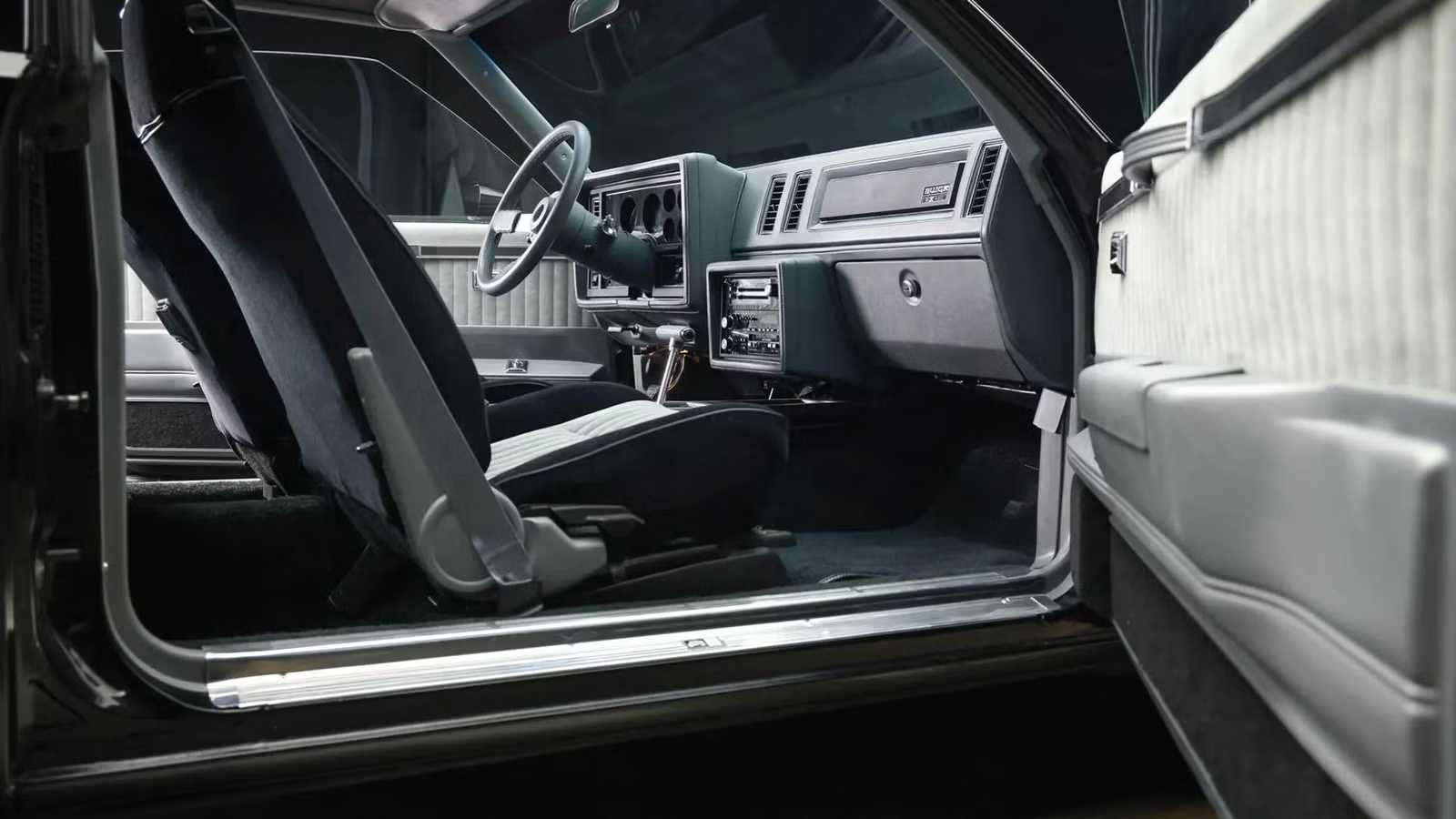
The muscle car’s golden age burned bright and fast. By the time the 1970s arrived, soaring fuel prices, tightening emissions regulations, and a grim economic mood had already begun to smother the fire. Through the late ’70s and into the ’80s, muscle cars struggled to find their identity, becoming pale imitations of their former selves — packing the kind of horsepower that would barely impress on a modern motorcycle. Detroit’s performance cars had lost the plot, and it showed.

By the ’80s, many muscle cars were simply chugging along. The V8s were reined in to the point of being no more useful than a four-pot, with European manufacturers showing that even a humble hatchback could run rings around more old-school performance cars. America’s muscle car manufacturers seemed to be in desperate need of some new thinking in the era of excess, and it arrived from an unlikely place. The most game-changing muscle car of the ’80s was from a manufacturer better associated with comfort, not speed, but what they came up with is still a stone-cold icon revered by car fans across the world — and it didn’t even have a V8.
The Buick GNX Redefined The American Muscle Car
Consider for a second what you could get with a Chevrolet Camaro in the late ’80s. The base engine was a 135-horsepower V6, while the base V8 produced up to 170 horsepower. Opting for a Z28 meant a 190-horsepower 305 cid V8, or there was the option of a 215-horsepower LB9 engine or a 225-hp 350 cid V8 borrowed from the Corvette with a couple of changes.
Buick Decided To Target A Younger Buyer

Buick had an idea to go a lot further than those numbers, without even resorting to eight cylinders, and in doing so reinvented the American muscle car for the Reagan era. The company had noticed in the early ’80s that its customer base was aging, and the badge was becoming better associated with leisurely Sunday morning drives than Saturday night cruises.
Buick wanted to attract a younger buyer and so introduced the Grand National in 1982, based on the Regal. It wasn’t much more than a sticker and paint-job package, but there was enough interest for Buick to introduce a far more serious Grand National in 1984, fitted with turbocharged 3.8-liter V6 power and finished in sinister black over black. This car produced 200 horsepower and 300 lb-ft of torque — already up there with the most powerful muscle cars of the time — rising to 235 horsepower by 1986. This modern, forced-induction muscle car, with its styling as sharp as a Filofax edge, had a hard-nosed, businesslike look and feel that seemed a world away from the flabby nonchalance that had filtered into some corners of the American sports car market. But there was more to come.
The Grand National Was A Massive Hit With Buyers
The Grand Nationals were a huge sales success. Buick produced 9,614 Grand Nationals from ’84 to ’86, says Hemmings, and for ’87, when production was about to wrap up, Buick built 20,194 examples to keep hard-working dealerships happy. To mark the end of this sales success story, Buick’s chief engineer Dave Sharpe decided the car could be turned up to 11, and persuaded management to offer a limited-edition super Grand National. The result was the GNX.
A Closer Look At The Buick GNX
1987 Buick GNX Specs
|
Engine |
Turbocharged 3.8-liter V6 |
|
Power |
276 hp |
|
Torque |
360 lb-ft |
|
0-60 mph |
4.7 seconds |
Source: Buick/ Independent Tests
Before we go any further with the GNX story, it’s worth noting that the 1986 Grand National that preceded it was not a slow car — at all. When one car magazine tested the Grand National, it was capable of reaching 60 mph in just 4.9 seconds, which was faster than a Lamborghini Countach.
Buick Decided To Make The Grand National A Lot Quicker
In 1987, Buick decided to build an even faster version — a car that would leave its mark in the automotive history books. The limited-edition Buick GNX — or the “Grand National Experimental” — was an evolved version of the Grand National. Buick produced 547 vehicles, and each GNX received its own sequential number from #001 to #547. The car couldn’t look more menacing. The body was painted black with GNX badges on the grille, decklid, and wheel centers, along with 16-inch black mesh aluminum alloy wheels.
To produce the GNX, Buick teamed up with ASC/McLaren. The engineers started with the same V6 fitted to other Grand National models but added a special Garrett T-3 turbocharger equipped with a ceramic impeller. ASC also fitted a new valve body for the automatic transmission. A new intercooler was installed with more cooling fins per row for improved heat dissipation. Then there was a ceramic-coated turbo shield and inlet pipe, plus a larger dual exhaust. Suspension changes were made to keep the car planted under hard acceleration. Finally, the engine control unit was recalibrated to allow 15 PSI of boost. The result was 276 horsepower and 360 pound-feet of torque.
The GNX Is As Quick As A Supercar
The GNX had taken the Grand National from extremely quick to one of the quickest cars on the planet. The rear-drive Grand National can cover the quarter-mile in 13.9 seconds at 98 mph according to independent testing, but the GNX can do it in 13.5 seconds at 102 mph. The GNX can also hit 60 mph in 4.7 seconds, a figure matched only by the Callaway Twin-Turbo Corvette, and just a whisker behind the Porsche 911 Turbo at 4.6 seconds. For 1988, Buick downsized the Regal, switching to a front-wheel-drive layout and adopting a smoother aesthetic — it was the end of an era.
Buying A Buick GNX In 2025

Prices For 1987 American Sports Cars (In 2025)
- 1987 Buick GNX: $106,000
- 1987 Twin-Turbo Callaway Corvette: $17,900
- 1987 Ford Mustang GT: $13,300
- 1987 Chevrolet Corvette: $9,800
Source: Hagerty Valuation Tools (Good Condition)
Buick GNXs have become iconic figures in American pop culture. These cult classics command huge money, buoyed no doubt by the car’s center-stage appearance with Kendrick Lamar at the Super Bowl. When new, the GNX wasn’t a cheap car, with a “suggested retail price” of $29,290, says Hemmings, while a well-equipped Grand National sold for $18,295. These days, you will need deep pockets to get the keys to one of the 547 GNXs produced.
A good-condition 1987 Buick Regal GNX will cost $106,000, according to Hagerty Valuation Tools. If you want a better idea of how iconic the GNX is compared to its late ’80s competition, consider this: a 1987 Ford Mustang GT, equipped with a 225-horsepower 5.0-liter V8, costs just $13,300, says Hagerty. A 1987 base Corvette, with 240 horsepower, comes in at just $9,800 — meaning you could buy six twin-turbocharged Callaway Corvettes of the same era, which carry a good-condition price of $17,900, for the price of a single GNX.
Sources: Hagerty.com; Hemmings.com

Related posts




Latest Post


No Comments